How to Bless a House as a Catholic Layperson: A Step-by-Step Guide
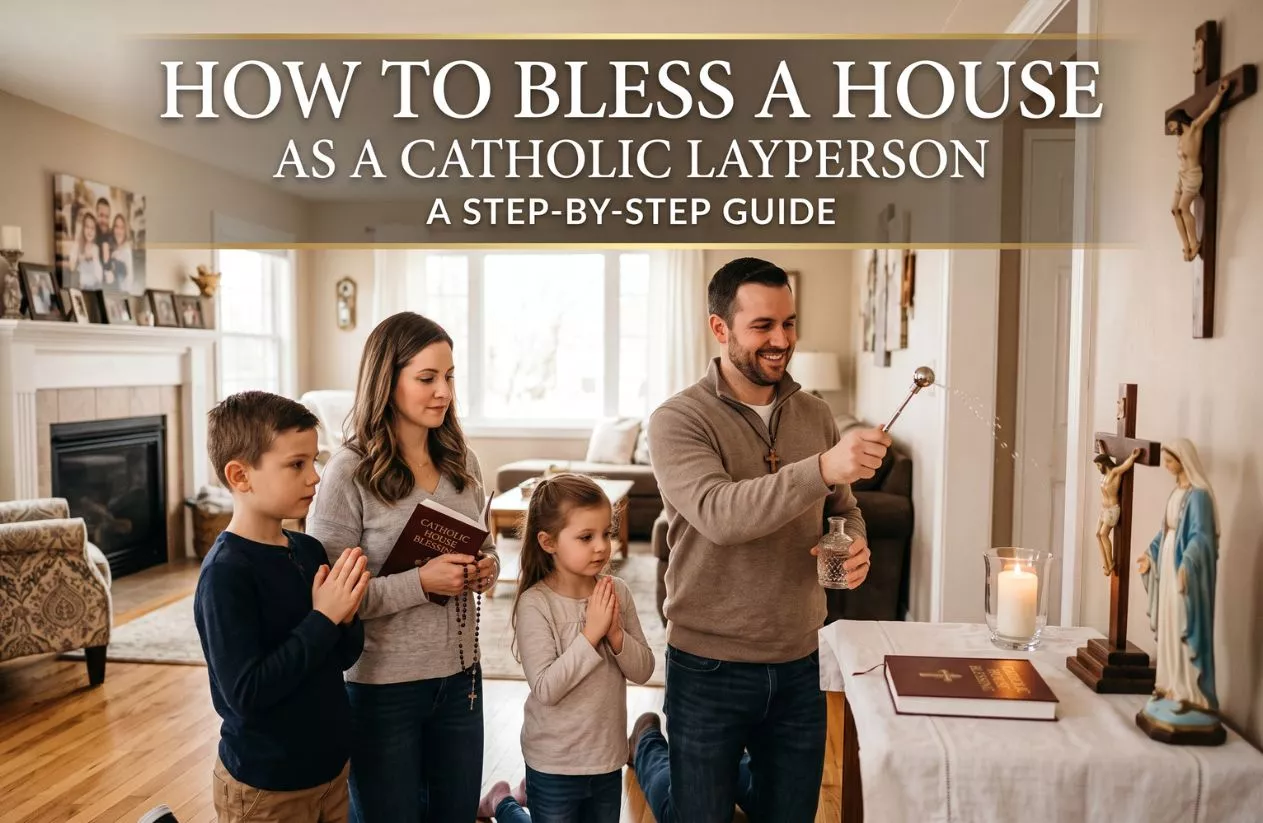
Quick Summary: A Catholic layperson can bless and spiritually cleanse their house by exercising their God-given spiritual authority over their home and domain. Using blessed sacramentals—specifically Holy Water and Blessed Salt—the head of the household moves systematically through the living space while reciting approved deprecatory prayers, such as the St. Michael Prayer or Psalm 91. While laypeople cannot perform solemn liturgical rites or command demons directly, they can establish a powerful perimeter of spiritual peace, drive away spiritual disturbances, and dedicate their dwelling to Christ.
Moving into a new residence, experiencing persistent unrest, or simply wanting to dedicate your living space to Almighty God often brings up a practical question: how to bless a house catholic layperson guidelines permit.
In Catholic tradition, your home is far more than four walls and a roof—it is the Ecclesia Domestica, the Domestic Church. It serves as the primary sanctuary where faith is lived, marriages are strengthened, and children are formed in grace. Because the home plays such a critical role in your family’s spiritual life, keeping it spiritually secure is essential.
While solemn liturgical consecrations are reserved for ordained clergy, Holy Mother Church grants laypeople real, functional authority to protect their immediate domain. By understanding your spiritual jurisdiction and using blessed sacramentals correctly, you can conduct an effective home blessing that drives away spiritual disturbances and establishes Christ’s peace under your roof.
Table of Contents
Understanding Lay Authority: Can a Layperson Bless Their Own Home?
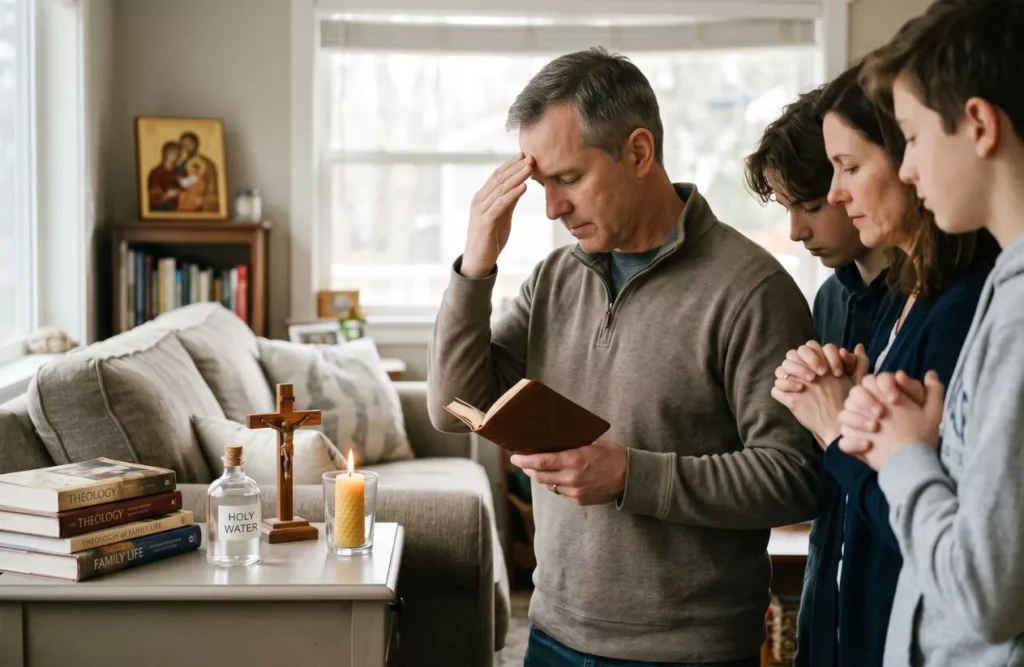
A common point of confusion among faithful Catholics is whether a catholic house blessing by a lay person’s initiative is spiritually valid or canonically permissible. Many wonder: can a layperson bless a house without a priest present?
The answer is yes, provided you operate within the exact boundaries of your God-given spiritual authority. While laypeople cannot impart sacerdotal (priestly) blessings onto physical structures, they hold true spiritual jurisdiction over their personal property and family.
The Theological Foundation of Household Jurisdiction
Every baptized Catholic possesses a share in the royal priesthood of Christ (1 Peter 2:9). When combined with Natural Law and the Sacraments of Holy Matrimony or Baptism, this baptismal priesthood establishes real spiritual authority head of household catholic principles recognize.
Scripture shows that heads of households hold spiritual responsibility for their domestic realm (Joshua 24:15). In Catholic dogmatic theology, the Christian home is formally designated as the Ecclesia Domestica—the Domestic Church. Because parents and legal guardians are accountable to God for the protection of this sanctuary, they possess legitimate spiritual jurisdiction over:
- Their minor and dependent children.
- Their marital covenant.
- Their physical property, house, and land.
This jurisdiction gives you the rightful authority to claim your property for Christ, apply blessed sacramentals to your walls and doorways, and cast out atmospheric disturbances through prayer.
Lay Prayers vs. Priestly House Blessings
To avoid spiritual overreach, you must understand the distinction between what a priest accomplishes during a formal house blessing and what a layperson does during a private household cleansing.
| Feature | Formal Priestly House Blessing | Lay Household Cleansing & Prayer |
| Minister | Ordained Priest or Deacon | Head of Household / Resident Lay Catholic |
| Source of Authority | Holy Orders (In Persona Christi) | Baptism & Household Jurisdiction |
| Liturgical Text | Book of Blessings / Rituale Romanum | Approved Private Lay Prayers |
| Nature of Blessing | Constitutive (Official Church Consecration) | Invocation (Asking God’s Protection) |
| Sacramental Power | Imparts sacerdotal blessing on the physical house | Applies Church-blessed items within personal domain |
| Scope | Universal (Can bless any home or parishioner) | Restrained strictly to one’s own residence/family |
Strict Spiritual Safety Rules for Laypeople
When learning how to bless a house as a catholic lay person, protocols mandate that the most critical rule involves the distinction between deprecatory and imperative prayer.
- Deprecatory Prayer (Allowed for Laypeople): This means addressing God, Jesus Christ, the Blessed Virgin Mary, or St. Michael, asking them to drive away evil. An example is: “Lord Jesus, please send Your holy angels to purge this room of all darkness.”
- Imperative Prayer (Forbidden for Laypeople): This means addressing, commanding, or interrogating evil spirits directly. An example is: “I command you, spirit of fear, to leave this house.”
Directing commands at evil spirits requires the apostolic authority of Holy Orders. Attempting imperative commands without sacerdotal authority is spiritually dangerous—it violates Church order and leaves your household vulnerable to spiritual retaliation.
Laypeople must always direct their prayers upward to God, trusting Him to handle the forces of darkness.
Essential Items Needed Before You Begin
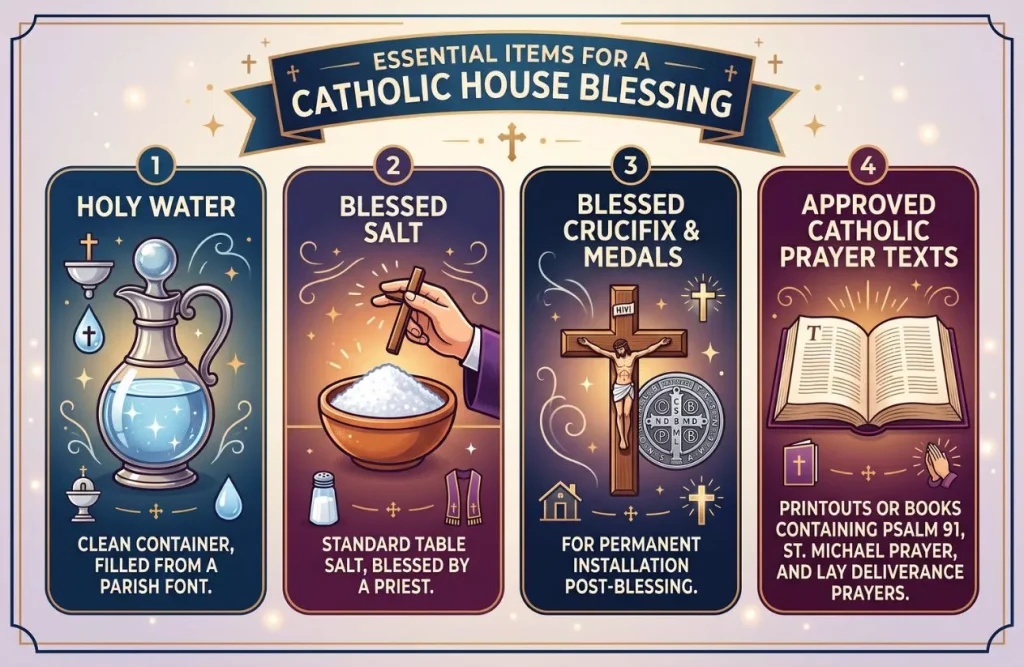
Before starting your walk through the home, gather the proper sacramental items for house blessing procedures. Sacramentals do not work as magic talismans; they derive their spiritual power through the official prayers of the Church and the faith of those who use them.
Having these items blessed by an ordained priest or deacon ahead of time ensures you have everything required for a proper catholic home blessing checklist.
1. Holy Water
Obtain fresh holy water from the large dispenser or font located in the vestibule of your local parish (or bring clean water and ask a priest to bless it). Ensure you use a clean, dedicated glass or plastic bottle. Holy water serves as your primary tool to recall baptismal promises, purify the atmosphere, and drive away unholy presences.
2. Blessed Salt (or Exorcised Salt)
Bring culinary sea salt or table salt to your parish priest for a traditional blessing. If possible, ask a priest who uses the traditional Roman Ritual (Rituale Romanum) to pray the traditional exorcism blessing over the salt. Using holy water and blessed salt in a house-blessing establishes both atmospheric cleansing (water) and a permanent spiritual perimeter (salt).
3. Blessed Crucifix & St. Benedict Medals
Prepare one central wall Crucifix for the primary entrance or main living area, alongside small St. Benedict Medals for entry doorways and window frames. Ensure all crucifixes and medals have been explicitly blessed by a priest or deacon prior to installation.
“If you don’t have a crucifix or St. Benedict Medal, you can browse a selection here; just make sure to ask a priest to bless it.”
St. Benedict Medal For Door Knob

4. Approved Catholic Prayer Texts
Keep printed copies or a prayer book ready containing Church-approved lay prayers. Your prayer selection should include:
- Psalm 91 (“He who dwells in the shelter of the Most High…”)
- The St. Michael the Archangel Prayer
- Approved Lay Deliverance Prayers (such as those compiled by Catholic exorcists specifically for lay use)
Preparation: Cleaning the Physical and Spiritual Space
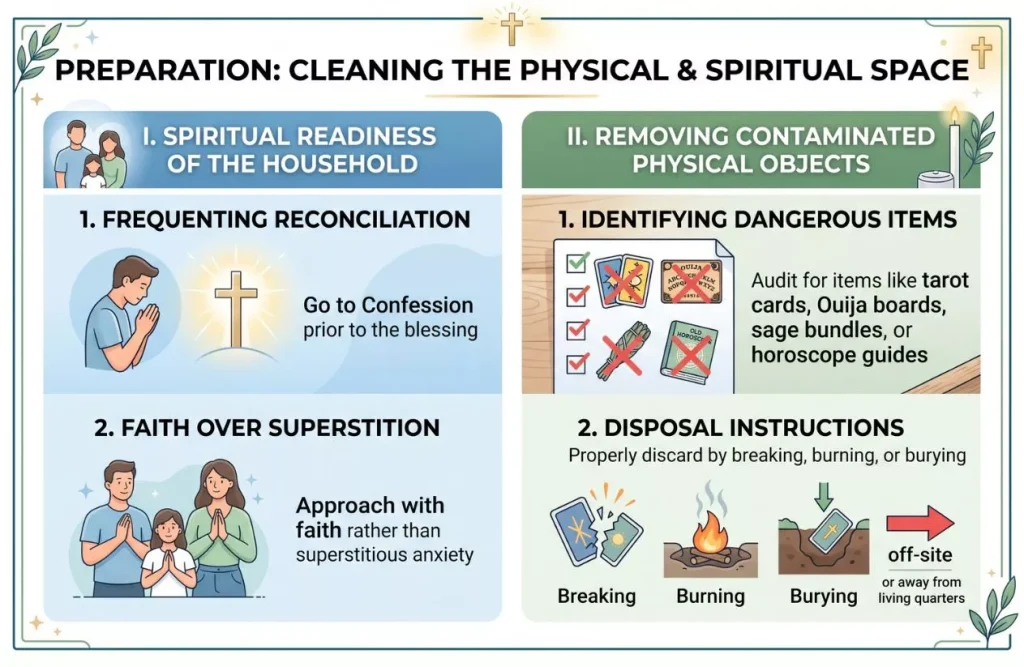
Before applying physical sacramentals to your walls or doorways, proper spiritual and physical groundwork must be laid.
A catholic house spiritual cleansing cannot produce lasting peace if open spiritual doors remain unaddressed inside the home. Preparing your family and living environment ensures your prayers are rooted in faith and sacramental grace.
Spiritual Readiness of the Household
Preparing for a catholic house blessing begins within the souls of those residing under the roof. Sacramentals channel the Church’s intercession into an environment disposed to receive God’s grace; they do not function automatically if unrepentant sin is present.
- Seek Sacramental Confession: The head of the household and family members should make a thorough Sacramental Confession prior to the blessing. Operating in a state of sanctifying grace ensures your prayers carry spiritual weight and integrity.
- Cultivate Faith Over Fear: Ensure the family approaches the blessing with calm trust in Christ’s victory on the Cross rather than superstitious dread. The goal is to dedicate the household to God, not to indulge in anxiety or sensationalism.
Removing Contaminated Physical Objects
A crucial step when preparing for catholic house blessing efforts is auditing your living space for spiritually compromised items. You cannot effectively consecrate a home to Christ while keeping objects that honor false gods, spiritism, or the occult.
Conduct a room-by-room inspection and immediately remove items such as:
- Occult Tools: Ouija boards, tarot cards, pendulum divination kits, and astrology or horoscope guidebooks.
- New Age Paraphernalia: Smudging bundles (white sage or palo santo used for ritual cleansing), healing crystals, dreamcatchers, and feng shui protection items.
- Idolatrous Objects: Statues or symbols representing pagan deities, esoteric talismans (such as the evil eye or Hamsa hand), and luck charms.
Proper Disposal Guidelines for Contaminated Objects
When handling spiritually compromised items, evaluate the history and nature of the object before taking action:
- When to Surrender Items to a Priest: If an object was used in formal Satanic rituals, blood pacts, or active witchcraft—or if it has been accompanied by explicit supernatural phenomena—do not attempt lay disposal. Place the object in a container, sprinkle it with Holy Water, and bring it directly to your parish priest or diocesan exorcist. Priests possess the sacerdotal authority required to sever deep occult ties and safely dispose of high-risk items.
- Direct Lay Destruction (For Standard Occult & New Age Items): For ordinary commercial paraphernalia—such as purchased tarot decks, astrology books, New Age crystals, or sage bundles—laypeople can exercise their household authority using standard guidelines recommended by Catholic exorcists:
- Sever Spiritual Ties Through Prayer: Sprinkle the items with Holy Water and pray aloud: “In the name of Jesus Christ, I break and sever all unholy ties, links, and attachments to these objects, and I command any spirit connected to them to go directly to the foot of the Cross.”
- Render Completely Unusable: Break glass, stone, or metal items into pieces; cut up wooden objects; and burn paper, cloth, or books completely to ash in an outdoor fire. Never donate, sell, or pass along these items to anyone else.
- Bury or Dispose Safely: Bury the destroyed remnants deep in the earth off-site, or dispose of the completely ruined fragments in outdoor waste containers so they can never be retrieved or reused.
How to Dispose of Occult Objects
Catholic exorcists explain the importance of physically destroying occult items so that their spiritual ties are broken and no one else can ever pick them up or use them.
Step-by-Step Procedural Walkthrough: Room-by-Room House Blessing
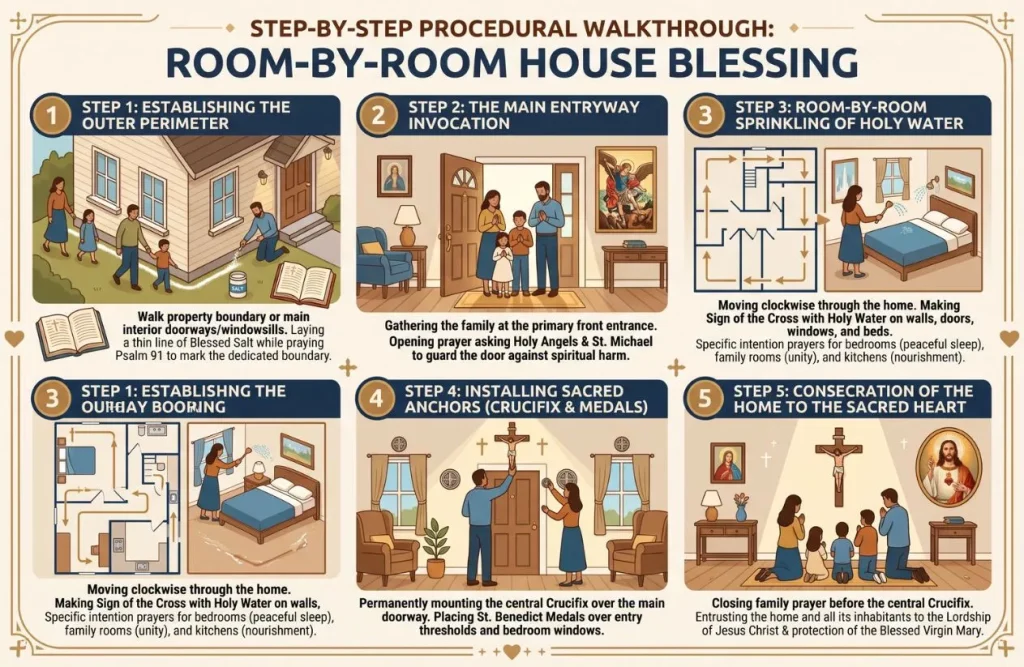
Once your household is spiritually prepared and all contaminated items have been removed, you are ready to begin the step by step catholic home blessing. The head of the household leads the walkthrough, accompanied by family members who can join in the responses and prayers.
Step 1: Establishing the Outer Perimeter with Blessed Salt
Begin at the boundaries of your living space to mark off the property for Almighty God.
- For Single-Family Homes: Walk the exterior physical property line of your yard or house foundation.
- For Apartments or Townhomes: Walk the interior walls, window sills, and exterior entry thresholds.
As you walk, sprinkle small amounts of blessed salt along the ground, window frames, and door sills. While laying this physical perimeter, recite Psalm 91 aloud (“He who dwells in the shelter of the Most High…”), asking God to station His holy angels along the boundary and prevent any unholy presence from entering.
Step 2: The Main Entryway Invocation
Gather your family together just inside the main front doorway of the home to begin the interior cleansing.
The head of the household opens with the Sign of the Cross and leads an initial prayer of invocation:
“In the name of the Father, and of the Son, and of the Holy Spirit. Amen. Heavenly Father, we ask You to pour down Your grace upon this doorway. Send Saint Michael the Archangel and Your holy heavenly host to guard this entrance against every snare of the devil, every spirit of division, and all physical or spiritual harm. May all who enter this door find Your peace, and may all evil be turned away. Amen.”
Step 3: Room-by-Room Sprinkling of Holy Water
Understanding how to use holy water to bless a house systematically ensures that no space is left overlooked. Walk through the home in an orderly, clockwise direction from room to room.
In each room, hold your container of holy water and sprinkle it toward the four walls, doorways, windows, and beds in the form of a Cross, saying:
“In the name of the Father, and of the Son, and of the Holy Spirit. Lord, purge this room of all spiritual darkness and fill it with Your Holy Spirit.”
Tailor short intention prayers as you move through specific living spaces:
- Bedrooms: “Lord, grant pure, restful sleep to all who sleep here. Protect their minds from night terrors, anxiety, and unholy oppression.”
- Living & Family Rooms: “Lord, cast out every spirit of anger, discord, or pride. Fill this room with charity, patience, and true Christian unity.”
- Kitchen & Dining Space: “Lord, bless the food prepared here, nourish our bodies, and give us thankful hearts at every meal.”
Step 4: Installing Sacred Anchors (Crucifix and Medals)
With the perimeter established and the atmosphere purified, permanently install your sacred sacramentals as visual and spiritual anchors throughout the residence.
- Mount the Central Crucifix: Securely hang your primary blessed Crucifix directly above or adjacent to the interior frame of the main entrance door (or as the centerpiece of your family prayer space).
- Affix St. Benedict Medals: Place a blessed St. Benedict Medal over the interior lintels of all exterior entry doors, basement doors, and bedroom window frames.
These physical items serve as continuous reminders to demonic forces that your residence is sealed under the victory of Christ’s Holy Cross.
Step 5: Consecration of the Home to the Sacred Heart
Complete your room by room catholic house blessing by gathering the entire family around your newly installed central Crucifix or an Image of the Sacred Heart of Jesus.
Together, make a solemn act of consecration to make Christ the undisputed King of your household:
“Lord Jesus Christ, we formally consecrate our home, our family, and all our possessions to Your Sacred Heart. We choose You this day as the Lord, Master, and Protector of our dwelling. Drive far from us every influence of the enemy. We place our household under the loving mantle of the Immaculate Heart of Mary and the earthly guardianship of Saint Joseph. May Your peace, grace, and love reign supreme in this house now and forever. Amen.”
Recommended Prayers for a Lay Catholic House Blessing
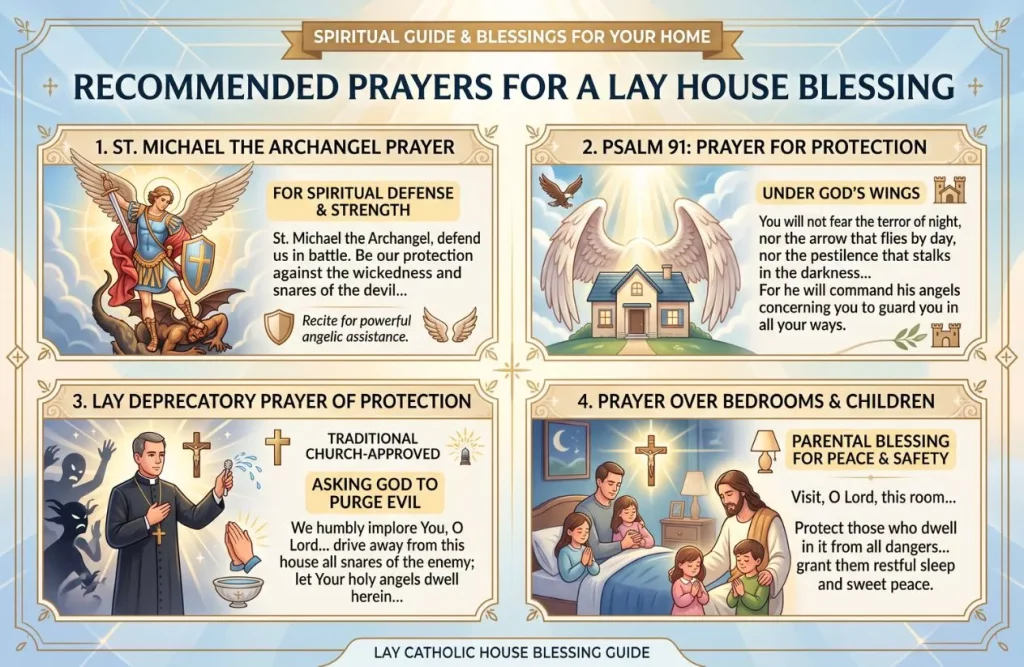
Reciting structured, Church-approved texts ensures your prayers for catholic house blessing remain safe, reverent, and aligned with Catholic dogmatic tradition. The following four prayers provide a complete spiritual arsenal for laypeople conducting a home cleansing.
1. The St. Michael the Archangel Prayer
Written by Pope Leo XIII in 1884, the St Michael prayer for protection is the Church’s premier deprecatory prayer against spiritual aggression. Because Saint Michael is the commander of the heavenly host, invoking his aid asks the archangel himself to exercise divine authority over demonic presences.
When to Use It: Recite this prayer aloud at the main front entrance of the home before beginning your room-by-room walkthrough, and again upon installing your St. Benedict Medals over thresholds.
“Saint Michael the Archangel, defend us in battle. Be our protection against the wickedness and snares of the devil. May God rebuke him, we humbly pray; and do thou, O Prince of the Heavenly Host, by the power of God, cast into hell Satan and all the evil spirits who prowl about the world seeking the ruin of souls. Amen.”
2. Psalm 91: Prayer for Protection Under God’s Wings
Known traditionally as the “Abiding Prayer” or “Shield of the Faithful,” a psalm 91 house blessing prayer invokes God’s explicit biblical promise to station angels around those who trust in Him.
When to Use It: Read this Psalm aloud while laying your outer boundary line of blessed salt along windowsills, door frames, or property lines.
Key Verses (Psalm 91:1–2, 9–11):
“He who dwells in the shelter of the Most High, who abides in the shadow of the Almighty, will say to the Lord, ‘My refuge and my fortress; my God, in whom I trust.’ … Because you have made the Lord your refuge, the Most High your habitation, no evil shall befall you, no scourge come near your tent. For He will give His angels charge of you to guard you in all your ways.”
3. Lay Deprecatory Prayer of Protection
To avoid spiritual overreach, laypeople must never address or command spirits directly. Instead, use this traditional, Church-approved deprecatory wording (adapted from lay deliverance protocols compiled by Catholic exorcists) to petition Christ to purge your residence.
When to Use It: Recite this prayer while sprinkling Holy Water in central living areas, basements, or rooms where family conflict has occurred.
“Lord Jesus Christ, by Your Holy Cross and Precious Blood, we ask You to cleanse this home of all spiritual darkness. We ask You to render impotent, deaf, and blind every unholy spirit in this place, stripping them of all power, armor, and influence. Send Your Holy Angels to establish an unyielding perimeter of protection around our home, and command every evil spirit to depart directly to the foot of Your Cross, never to return. We ask this through Christ our Lord. Amen.”
4. Prayer Over Bedrooms and Children (Parental Blessing Text)
Parents possess legitimate, sacramental spiritual authority over their minor children and the bedrooms where they rest. Tracing the Sign of the Cross over a child’s forehead or bedroom wall invokes God’s peace against night terrors, unexplainable anxiety, and nighttime disturbances.
When to Use It: Recite this prayer while sprinkling Holy Water in every bedroom during the walkthrough, or as a daily bedtime blessing over your children.
“Hear us, Holy Lord, Almighty Father, Eternal God, and in Your goodness send Your holy angel from Heaven to watch over, cherish, protect, visit, and defend all who dwell in this room. Lord, grant that those who sleep here may remain firm in Your peace, free from all fear and spiritual oppression, and awaken renewed to serve You. Through Christ our Lord. Amen.”
What to Do After the Blessing: Maintaining a Holy Home
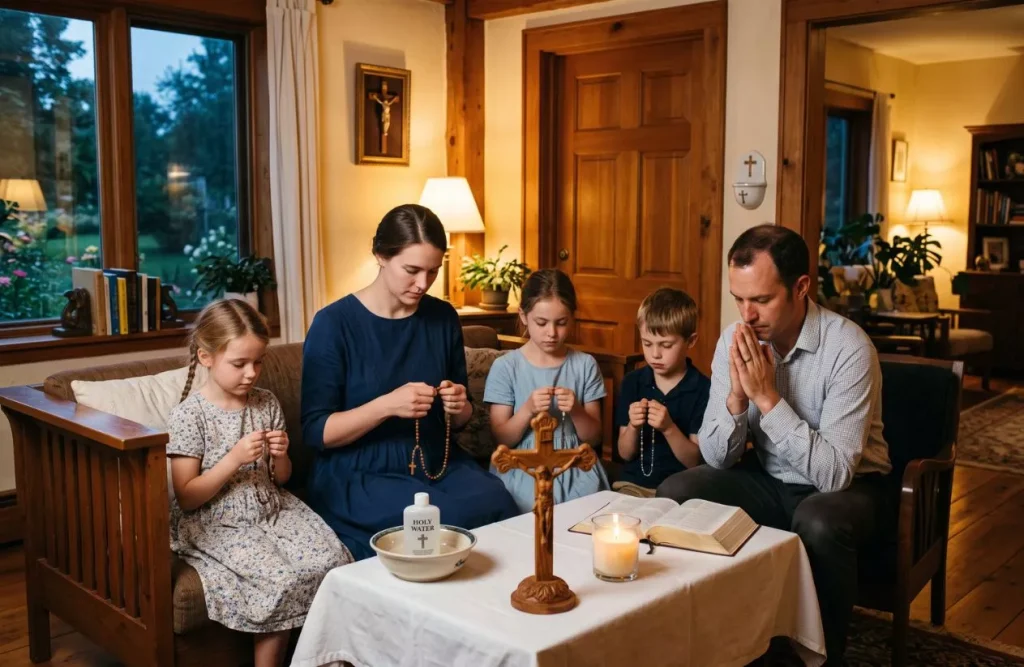
Conducting a home blessing establishes a spiritual boundary, but keeping your home secure requires daily upkeep. Just as dust and grime return if a house is not routinely cleaned, spiritual clutter can creep back if the household neglects its daily spiritual life.
Maintaining spiritual peace in home environments depends on establishing healthy spiritual habits.
By incorporating practical routines into your family’s schedule, you can ensure long-term catholic daily home protection.
Keep Sacramentals Accessible and Active
Don’t pack away your sacramentals once the initial walkthrough is complete. Keep them visible and integrated into your daily routine:
- Maintain Entrance Fonts: Install a wall-mounted holy water font near your primary front and back entryways. Refill it regularly with fresh holy water from your parish. Encourage family members to cross themselves whenever leaving or returning home to keep baptismal graces front-of-mind.
- Keep Sacred Art Visible: Ensure crucifixes, images of the Sacred Heart of Jesus, and icons of the Blessed Virgin Mary remain prominently displayed in main living areas and bedrooms. Physical imagery serves as a constant reminder of God’s presence.
Establish Daily Family Prayer Habits
Evil spirits thrive in spiritual vacancies. Filling your home with active, daily prayer leaves no room for unholy influences to take root.
- Pray the Daily Family Rosary: Gathering the family daily—or even a single decade each evening—invokes the immediate protection of the Blessed Virgin Mary. Her intercession shields homes from confusion, division, and spiritual fatigue.
- Nightly Parental Blessings: Before children go to sleep, parents should trace the Sign of the Cross on their foreheads using Holy Water. This simple act exercises your God-given authority and grants young children peace of mind before rest.
- Bless Meals Together: Never skip saying grace before meals. Thanking God for physical nourishment keeps a spirit of gratitude at the center of family life.
Cultivate a Moral and Peaceful Environment
Sacramentals and prayers cannot counteract an environment where deliberate sin, habitual anger, or ungodly influences are tolerated. Demonic influences are drawn to spiritual discord the way mold is drawn to dampness.
To keep spiritual darkness at bay:
- Control Media and Entertainment: Be vigilant about the music, movies, television shows, and internet content entering your home. Eliminate media that promotes occult themes, blasphemy, explicit impurity, or gratuitous violence.
- Reject Chronic Anger and Discord: Unforgiveness, loud shouting, ongoing marital hostility, and bitter arguments fracture the spiritual peace of a home. St. Paul warns against giving the devil an opportunity through unresolved anger (Ephesians 4:26–27).
- Practice Frequent Forgiveness: Address conflicts quickly through humble apologies and mutual forgiveness. A home filled with patience, charity, and goodwill remains uncomfortable ground for evil spirits.
Frequently Asked Questions (FAQ)
Can a single layperson or apartment renter bless their living space?
Yes. Anyone who legally resides in a dwelling possesses genuine spiritual jurisdiction over their immediate living area. Whether you own a single-family house, rent an apartment, or share a room, you have the right to use blessed sacramentals—such as Holy Water and Blessed Salt—alongside Church-approved lay prayers to protect your space.
How often should a Catholic layperson bless their house?
A full home blessing walkthrough should be performed upon moving into a new residence, after major structural renovations, following periods of intense family conflict or severe illness, or annually on the Feast of the Epiphany. However, lighter daily or weekly practices—such as sprinkling Holy Water in bedrooms or making the Sign of the Cross at entryways—can be done continuously.
What should I do if spiritual disturbances persist after a lay blessing?
If unexplainable phenomena, severe oppression, or atmospheric unrest persist after performing a lay house blessing, pause lay efforts and contact your local parish priest. A priest possesses sacerdotal authority to evaluate the situation, perform an official liturgical blessing using the Book of Blessings, and refer the case to the diocesan exorcism office if extraordinary demonic activity is present.
Can I use sage or palo santo to cleanse my house if I say Catholic prayers with it?
No. Burning white sage (smudging) or palo santo for spiritual cleansing originates from animistic, shamanic, and pagan ritual traditions. Mixing non-Christian spiritual practices with Catholic prayers is a form of syncretism that violates the First Commandment. To cleanse your home, use Church-approved sacramentals exclusively: Holy Water, Blessed Salt, or traditionally blessed church incense like frankincense and myrrh.
Final Reflection: A Peaceful Sanctuary for Christ
Transforming your house into a spiritual fortress does not require extraordinary measures or superstitious worry. By following Church tradition and understanding how to bless a house catholic layperson guidelines approve, you establish a physical and spiritual framework that welcomes the Holy Spirit while turning away unholy influences.
Always remember that sacramentals are designed to lead us back to the Sacraments and a vibrant relationship with Jesus Christ. Sprinkling Holy Water, placing Blessed Salt, and mounting a Crucifix over your doorway are powerful actions when backed by a life of grace, regular Sacramental Confession, and daily family prayer.
When you dedicate your living space to Almighty God and cultivate a household marked by charity, peace, and faith, your home becomes far more than mere shelter. It becomes a true Domestic Church—an unshakeable sanctuary where the light of Christ reigns supreme, shielding your family today and for generations to come.