Catholic Discernment of Spirits: Distinguishing Demonic Influence from Mental Illness
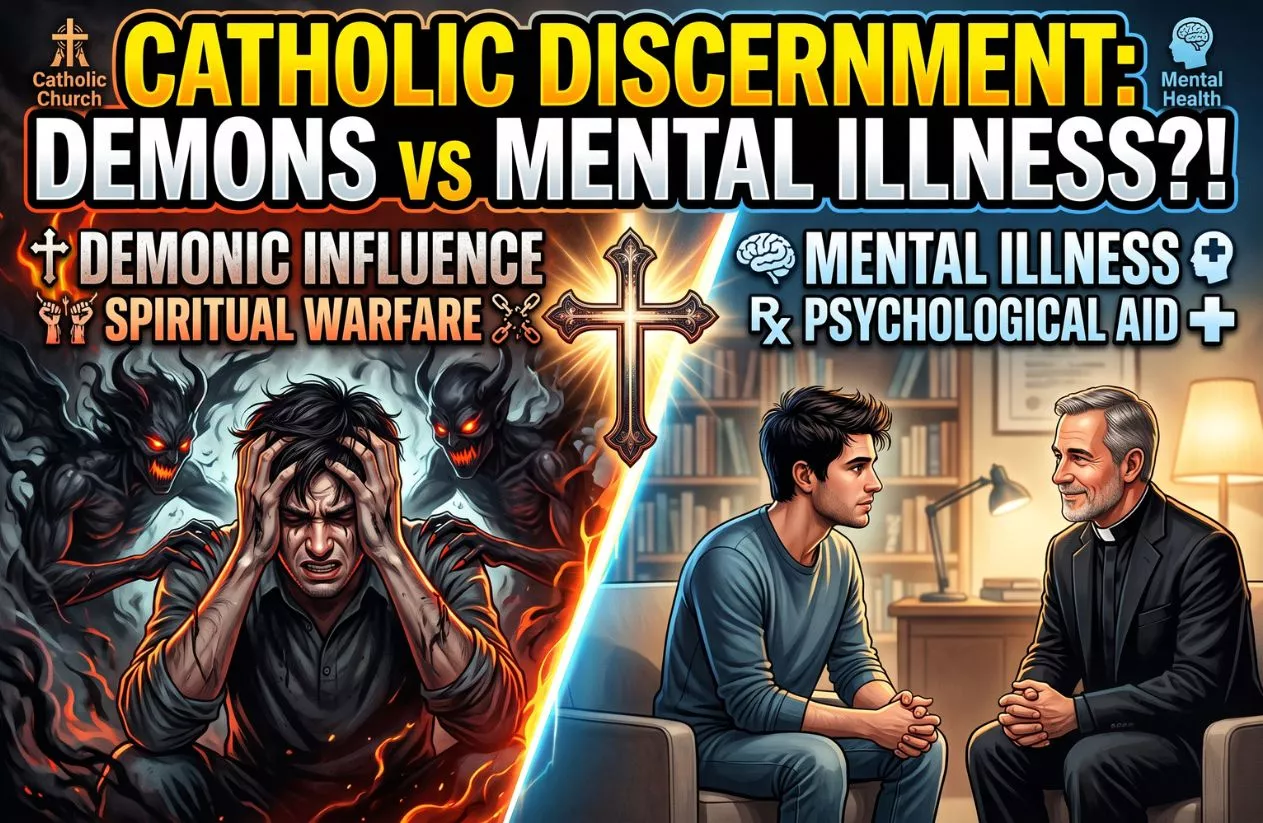
Quick Summary: In Catholic theology, spiritual discernment requires distinguishing between natural psychological conditions and extraordinary demonic activity. Before authorized priests can proceed with deliverance or exorcism, strict Church protocol mandates thorough medical and psychiatric evaluations. By combining clinical science with the gift of discernment, Catholic exorcists rely on established biblical discernment principles to ensure individuals receive psychiatric help for mental illness and spiritual intervention only when true diabolical signs—such as aversion to the sacred or hidden knowledge—are present.
Few topics in the modern world generate as much sensationalism, fear, or misunderstanding as the realm of exorcism and diabolical activity. Pop culture often portrays the Church as rushing to label every erratic behavior, unexplainable illness, or dark emotional state as a case of demonic possession. The reality, however, is precisely the opposite.
Holy Mother Church approaches reports of extraordinary spiritual activity with intense skepticism, rigorous investigation, and profound pastoral care. Through the formal practice of catholic discernment of spirits, the Church enforces strict protocols designed to protect vulnerable individuals.
This framework ensures that natural mental health conditions receive proper clinical psychiatric care, while spiritual intervention is reserved exclusively for genuine cases of extraordinary diabolical influence. Understanding this boundary is essential for maintaining both psychological health and spiritual safety.
Table of Contents
Understanding the Foundation: What is Discernment in the Bible?
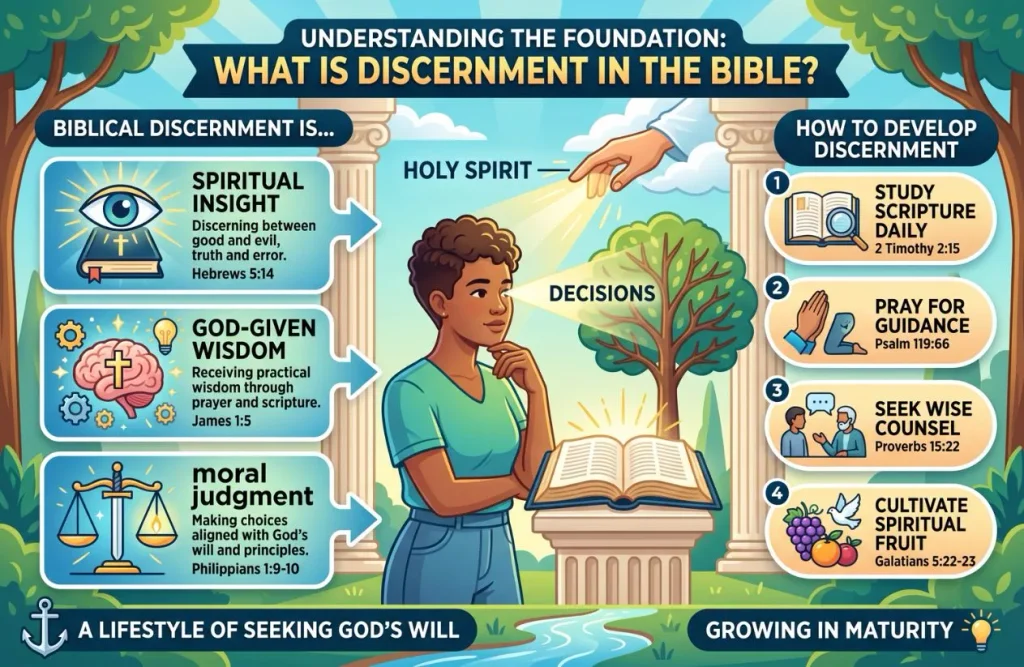
To understand how the Church evaluates complex spiritual cases today, we must first look at the foundational biblical framework. Many modern Christians view discernment simply as practical wisdom for daily decision-making. However, if you examine what is discernment in the bible, Sacred Scripture reveals a far deeper, more vigilant spiritual discipline.
The true discernment meaning in the bible centers on the active capacity to identify the origin of a thought, impulse, or phenomenon. According to Catholic theology, every internal movement or external spiritual event originates from one of three sources:
- The Divine Source: Inspirations coming directly from God, His holy angels, or divine grace.
- The Natural Source: Human psychological states, emotional desires, physical brain chemistry, or subconscious processing.
- The Diabolical Source: Deceptions, temptations, or extraordinary afflictions originating from fallen angels (demons).
Scripture commands the faithful not to accept every spiritual claim at face value. Because human nature is prone to error and evil spirits can disguise themselves, biblical discernment acts as a protective shield for the soul, ensuring that psychological distress is never confused with divine communication, nor diabolical manipulation overlooked.
Key Bible Verses About Discernment
Catholic protocols surrounding deliverance and exorcism are not modern inventions; they are rooted directly in Sacred Scripture. Looking at specific bible verses about discernment shows how the Apostles instructed the early Church to exercise spiritual vigilance.
1. 1 John 4:1–3 — Testing the Spirits
“Beloved, do not believe every spirit, but test the spirits to see whether they are from God, for many false prophets have gone out into the world.”
This passage forms the absolute bedrock of Catholic discernment protocol. Saint John explicitly commands the Church to adopt a posture of careful investigation rather than blind credulity. The Church obeys this command by systematically testing whether a person’s affliction yields to natural medical treatment or exhibits supernatural characteristics.
2. 1 Corinthians 12:10 — The Charism of Discerning Spirits
“…to another the working of miracles, to another prophecy, to another the ability to distinguish between spirits, to another various kinds of tongues…”
Saint Paul explicitly lists discretion spirituum—the ability to distinguish or discern between spirits—as a specific charism granted by the Holy Spirit. This gift enables certain believers, particularly experienced spiritual directors and priests, to perceive whether an underlying influence is holy, natural, or unholy.
3. Hebrews 5:14 — Training the Faculties Through Practice
“But solid food is for the mature, for those who have their powers of discernment trained by constant practice to distinguish good from evil.”
The author of Hebrews emphasizes that spiritual discernment is also a developed skill. It requires ongoing practice, deep knowledge of moral theology, and spiritual maturity. In the context of Church protocols, this scriptural truth explains why novice priests are never assigned to deliverance ministry; it requires years of trained, practiced judgment to navigate the complexities of the human psyche and the unseen realm.
The Gift of Discernment in Deliverance Ministry
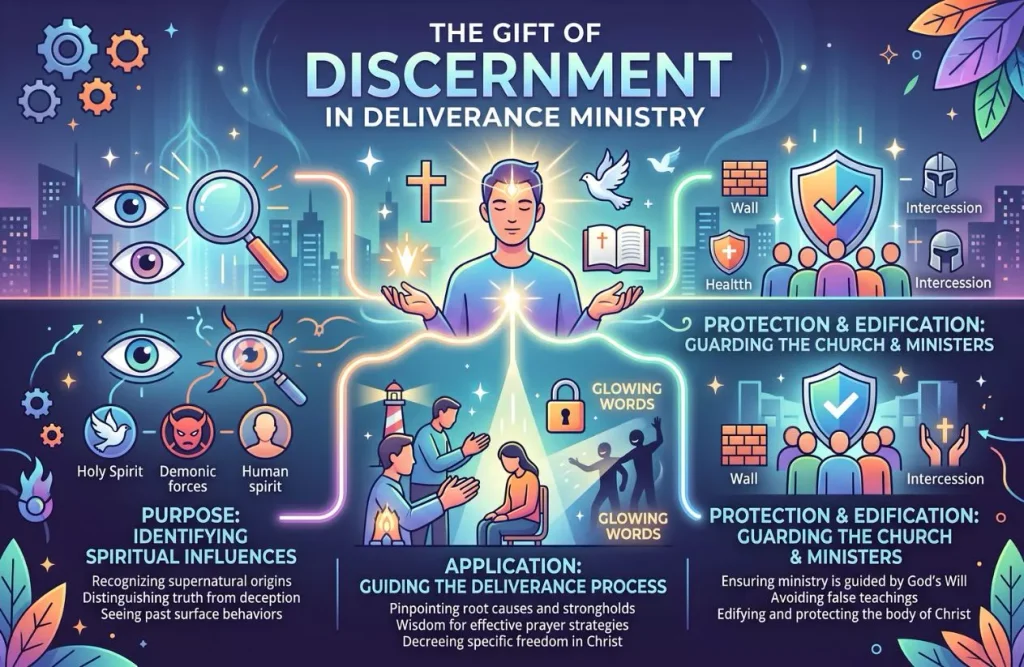
Within the context of official Catholic deliverance protocols and exorcism teams, the gift of discernment plays a vital, supportive role. Operating alongside rigorous medical evaluations, this spiritual charism acts as a supernatural aid for those ministering to individuals in deep distress.
When a diocesan exorcist gathers his team—which typically includes assistant priests, trained lay intercessors, and medical professionals—gift of discernment charisms help the team maintain spiritual focus.
It enables intercessors to remain prayerfully aware during prayers of deliverance, recognizing subtle shifts in the spiritual atmosphere, sensing hidden deceptions, or identifying when a person is experiencing intense spiritual warfare versus ordinary emotional exhaustion.
A Charism, Not a Medical Diagnosis
Despite the genuine value of spiritual gifts within prayer teams, the Catholic Church maintains a strict canonical boundary: a charism is never a diagnostic medical tool.
The Church explicitly teaches that the gift of discernment is a supernatural grace given by the Holy Spirit for the building up of the Church—not an empirical method for evaluating pathology.
Therefore, Church guidelines strictly forbid relying solely on spiritual impressions, intuitions, or private revelations to declare that someone is demonically afflicted.
- Spiritual Impressions are Subjective: Even well-intentioned intercessors can mistake their own subconscious bias, emotional empathy, or personal anxieties for divine revelation.
- Preserving Human Dignity: Misdiagnosing a medical or psychiatric condition as a demonic affliction can lead to severe harm, including delayed medical treatment, psychological trauma, and spiritual despair.
- The Mandate for Empirical Proof: Catholic protocol dictates that subjective spiritual impressions must always yield to objective, verifiable facts. A priest or team member may sense a spiritual disturbance, but no official deliverance process or exorcism rite can proceed without thorough, objective clinical testing conducted by licensed healthcare professionals.
Applying Biblical Discernment: Mental Health vs. Demonic Activity
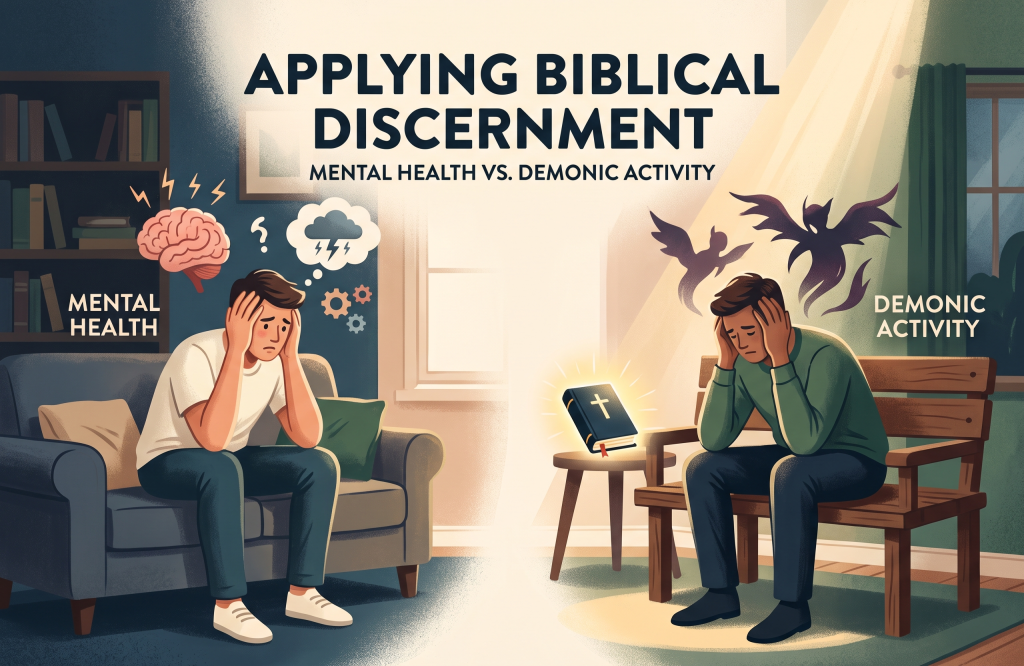
Moving from broad biblical discernment principles to practical application requires an uncompromising, evidence-based methodology. When a person displays severe emotional distress, personality shifts, or erratic behavior, the Church does not rush to supernatural conclusions.
Instead, the formal practice of catholic discernment of spirits operates on a principle of elimination, systematically ruling out every medical, neurological, and psychiatric explanation first.
The Catholic Golden Rule: Natural Before Supernatural
The foundational rule governing Catholic deliverance protocol is simple: always assume a natural cause until the supernatural is definitively proven.
This rule is rooted in Thomistic theology, which teaches that grace builds upon nature rather than destroying it. Because God created the physical order, natural laws govern body and mind.
When a person exhibits bizarre behaviors or altered states of consciousness, Church protocols mandate treating those symptoms as biological or psychological disorders until exhaustive clinical evaluations prove otherwise.
Diocesan guidelines require anyone seeking help from an exorcist to first undergo comprehensive medical exams, brain imaging, blood work, and psychiatric evaluations. If a medical treatment or psychiatric medication relieves the symptoms, the condition is biological, and spiritual intervention is unnecessary.
Psychological Conditions Frequently Mistaken for the Demonic
Throughout history, medical science has identified numerous complex neurological and psychiatric conditions that can closely mimic spiritual oppression or possession. Proper discernment requires understanding these clinical overlaps:
1. Schizophrenia & Psychosis vs. Spiritual Manifestations
Psychotic disorders often cause auditory or visual hallucinations, paranoid delusions, and disorganized speech. Individuals experiencing religious delusions may believe they are talking to demons or receiving direct messages from God.
- The Clinical Distinction: Hallucinations stemming from psychosis are chaotic, inconsistent, and often respond to antipsychotic medications. Spiritual manifestations during an evaluation, by contrast, exhibit coherent intelligence, explicit aversion to blessed sacramentals, and phenomena that transcend human capability.
2. Dissociative Identity Disorder (DID) vs. Demonic Entities
Formerly known as Multiple Personality Disorder, DID causes a person’s identity to fragment into distinct alter states, often with their own names, voices, behaviors, and memory gaps, usually as a coping mechanism for severe childhood trauma.
- The Clinical Distinction: A person with DID uses alter personalities as psychological defense mechanisms. In contrast, a demonic presence is an external, non-human entity that demonstrates genuine malice, hidden knowledge, and a violent reaction to sacred authority rather than trauma-induced coping behaviors.
3. Sleep Paralysis & Night Terrors vs. Nocturnal Oppression
Sleep paralysis occurs when the brain wakes up while the motor nervous system remains in a rapid-eye-movement (REM) state, leaving the person awake but unable to move. This state often includes terrifying pressure on the chest and waking hallucinations of dark figures in the room.
- The Clinical Distinction: Sleep paralysis is a well-documented neurological disruption of the sleep cycle. Unless acompanied by verified objective phenomena in the home that persist during waking hours, nighttime paralysis is treated medically through sleep hygiene and neurological care.
4. Epilepsy & Tourette’s Syndrome vs. Physical Reactions
Neurological conditions like temporal lobe epilepsy can cause sudden seizures, bodily contortions, and temporary loss of consciousness. Tourette’s Syndrome can cause uncontrollable verbal tics, including involuntary swearing (coprolalia) or vocal outbursts.
- The Clinical Distinction: Involuntary motor spasms and vocal tics are neurochemical involuntary reflexes that can be identified on an electroencephalogram (EEG). They lack the intentionality, intelligence, and supernatural markers required for a diagnosis of diabolical influence.
The 4 Official Signs of True Diabolical Influence
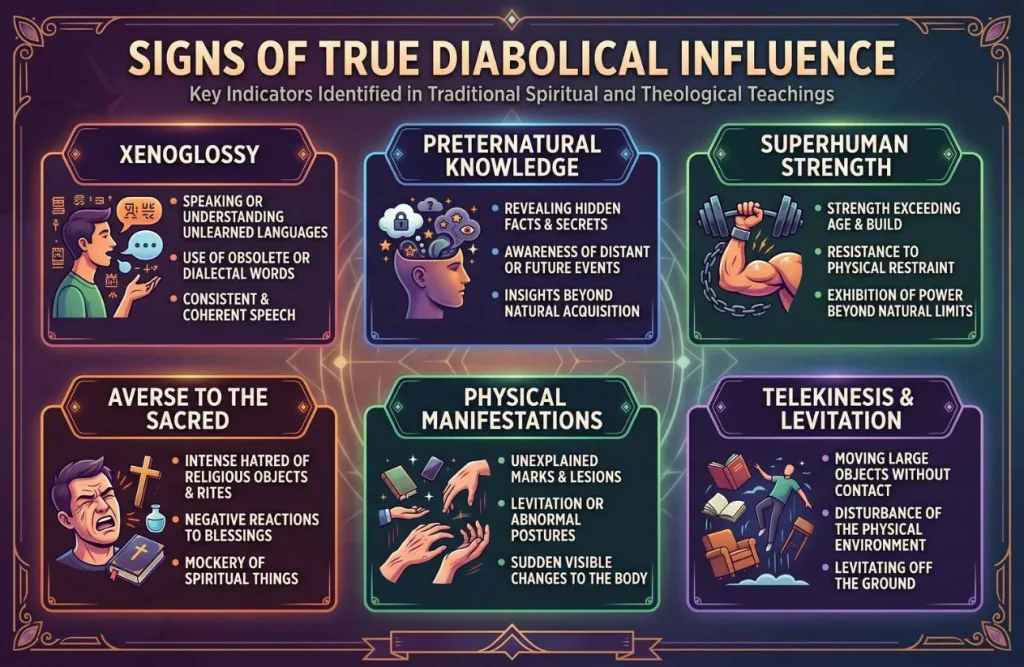
Once a thorough psychiatric and medical evaluation confirms that an individual’s symptoms cannot be attributed to any known psychological or neurological condition, an authorized exorcist looks for explicit supernatural evidence.
The Rituale Romanum (Roman Ritual)—the official liturgical manual of the Catholic Church—outlines specific signs of demonic possession catholic protocol recognizes as proof of extraordinary diabolical action.
To rule out natural causes, the Church requires the presence of objective phenomena that defy clinical science and human capacity. These four classic roman ritual exorcism signs provide the empirical threshold needed before an exorcism can be authorized:
1. Aversion to the Sacred (Hierophobia)
An intense, violent, and unexplainable physical or emotional reaction to holy objects, blessed sacramentals, or sacred prayers.
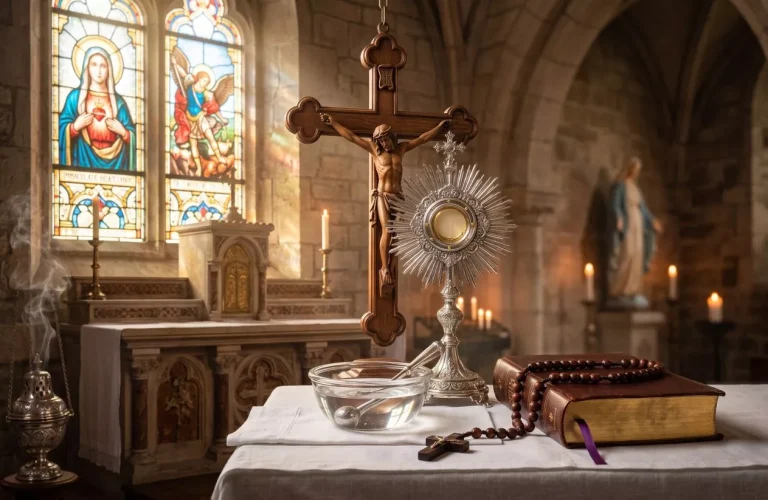
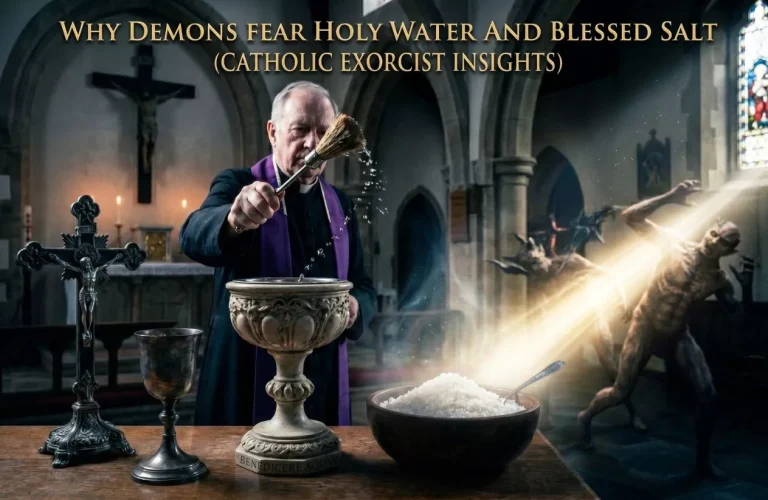
- How It Is Tested: To eliminate placebo effects, psychological projection, or acting, the evaluating priest conducts blind tests. For example, the priest may apply ordinary tap water alongside hidden Holy Water, or use an unblessed crucifix next to one containing a genuine relic of the True Cross. A diabolical presence reacts violently only to the genuinely blessed sacramental—even when hidden from sight.
2. Knowledge of Hidden or Remote Things (Xenoglossy & Clairvoyance)
The ability to reveal secret facts, distant events, or private information that the individual could not possibly know through natural means.
- How It Is Tested: The entity might reveal the secret, unconfessed sins of the evaluating priest, state what someone is doing miles away in real time, or know hidden details about deceased individuals that are unknown to the public.
3. Speaking or Understanding Unknown Languages (Xenoglossia)
Fluently speaking, reading, or understanding complex foreign or ancient languages that the person has never studied, learned, or been exposed to.
- How It Is Tested: An individual with no formal education might suddenly converse fluently in ancient Latin, Koine Greek, Aramaic, or Hebrew. The priest tests this by speaking to the entity in an ancient language to verify if it comprehends complex grammar and responds coherently.
4. Unnatural Physical Strength
Exhibiting physical power vastly disproportionate to the individual’s age, build, gender, or medical condition.
- How It Is Tested: A frail, elderly individual or a small child demonstrating the physical force required to overpower several strong adults simultaneously—without straining muscles or exhibiting standard adrenaline-induced muscle tears—signals a force operating outside natural biophysics.
Frequently Asked Questions (FAQ)
Can a person have both a mental illness and demonic oppression?
Yes. Demonic entities often exploit pre-existing psychological vulnerabilities, emotional trauma, or mental health conditions to deepen a person’s suffering. In these complex cases, Catholic exorcists collaborate directly with licensed psychiatrists and medical teams to ensure the individual receives clinical treatment for their mental health while the spiritual team addresses the underlying diabolical affliction.
Who decides if an exorcism is necessary?
Only the local Diocesan Bishop holds the canonical authority to permit a Major Exorcism. The bishop makes this decision after receiving a formal recommendation from his appointed diocesan exorcist and a designated board of medical, psychological, and theological experts who have thoroughly reviewed the case and ruled out natural causes.
How do laypeople practice spiritual discernment daily?
Everyday spiritual discernment for lay Catholics does not require seeking out extraordinary supernatural signs. Instead, laypeople practice daily discernment by remaining in a state of sanctifying grace, receiving the Sacraments regularly, avoiding all occult or New Age practices, and applying Saint Ignatius of Loyola’s Rules for the Discernment of Spirits to evaluate everyday thoughts, temptations, and emotional states.
Final Thoughts on Protecting the Mind and Soul
Navigating the complex boundary between natural psychological distress and extraordinary spiritual activity requires immense humility, pastoral wisdom, and scientific rigor.
Far from a sensationalized pursuit of the supernatural, the formal practice of catholic discernment of spirits serves as a vital safeguard for human dignity. By insisting that medical science and spiritual evaluation work hand in hand, Holy Mother Church ensures that those suffering from mental illness receive compassionate, professional psychiatric care without stigma.
At the same time, this careful vigilance ensures that those facing true diabolical affliction are not abandoned, but brought safely into the liberating power and peace of Jesus Christ.
Related Article: Powerful Spiritual Warfare Prayers