The Complete Catholic Guide to Sacramentals for Home Protection and Spiritual Defense
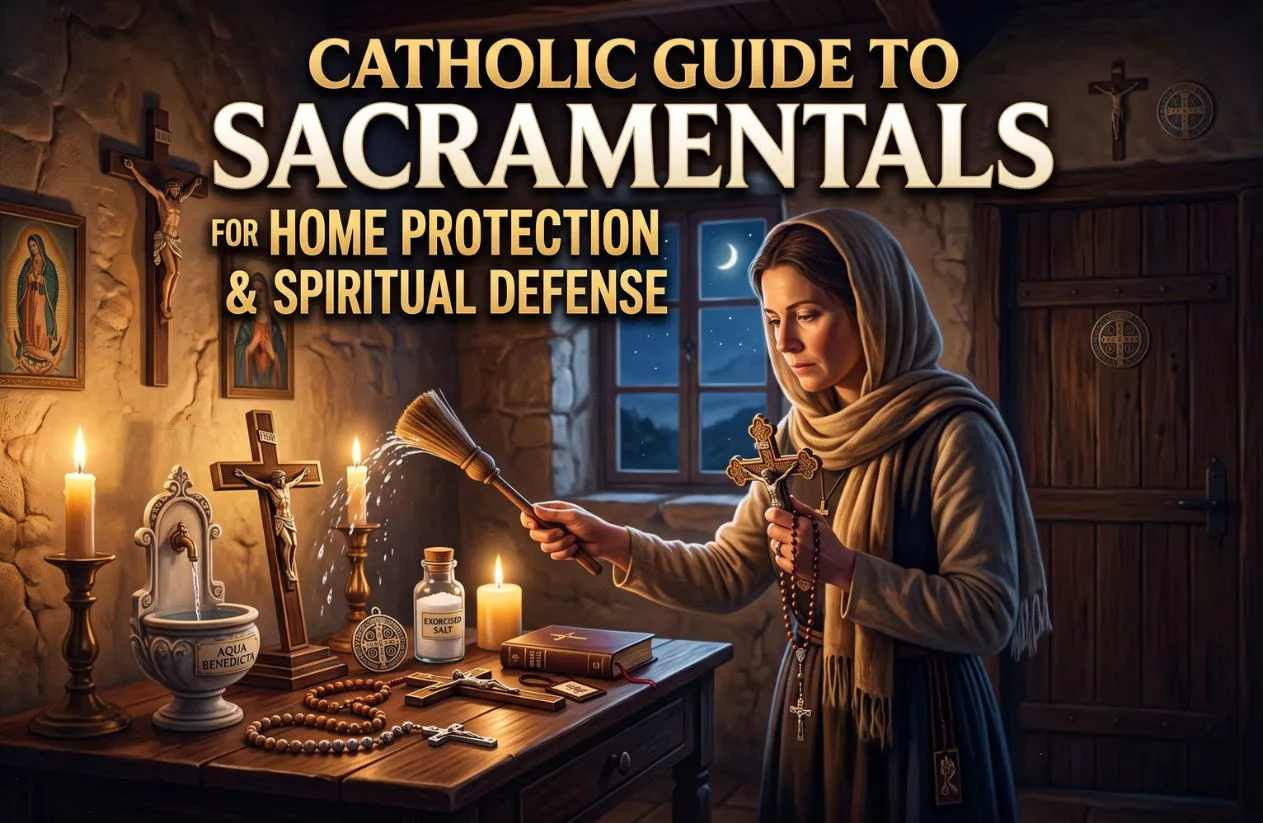
Affiliate Disclosure: This post may contain affiliate links to Catholic resources, books, and sacramentals we recommend. If you purchase through these links, we may earn a small commission at no additional cost to you. All affiliate earnings are reinvested directly into improving our platform, supporting our mission, and creating more valuable spiritual warfare resources for the faithful. Thank you for your support!Quick Summary: Catholic sacramentals—such as Holy Water, Blessed Salt, Crucifixes, and St. Benedict Medals—are holy objects or actions instituted by the Church to dispose the faithful to receive grace and draw protection against spiritual evil. Unlike magic or superstitions, sacramentals derive their efficacy through the prayer and authority of the Catholic Church. Laypeople can use sacramentals within their home (the Domestic Church) to establish a perimeter of peace and spiritual protection.
Every home faces unseen spiritual dynamics. Whether you are dealing with unexplained restlessness under your roof, seeking to shield your family from subtle cultural pressures, or simply striving to create a peaceful sanctuary dedicated to Christ, learning how to properly implement catholic sacramentals for home protection is one of the most practical steps a layperson can take.
In the Catholic tradition, the home is not merely a physical structure—it is the Domestic Church. It is the place where faith is lived out daily, where children learn to pray, and where the grace of the Sacraments takes root in everyday life.
Because the household holds such a crucial place in the spiritual life of the family, it often becomes a battlefield for peace, unity, and spiritual clarity.
Fortunately, the Church does not leave the faithful unarmed. Through centuries of pastoral tradition, Holy Mother Church has provided us with sacramentals: tangible, holy items blessed by the authority of the priesthood to ward off spiritual harm and invite the presence of God into our living spaces.
However, knowing how to use these items correctly—grounded in sound Catholic theology rather than superstitious habit—makes all the difference between a house filled with meaningful spiritual protection and one relying on misplaced sentimentality.
In this guide, we will break down the true nature of sacramentals, explore the primary items every Catholic household should have, and walk step-by-step through how heads of households can establish a secure spiritual perimeter over their living space.
Table of Contents
What Are Catholic Sacramentals? (Theological Foundation)
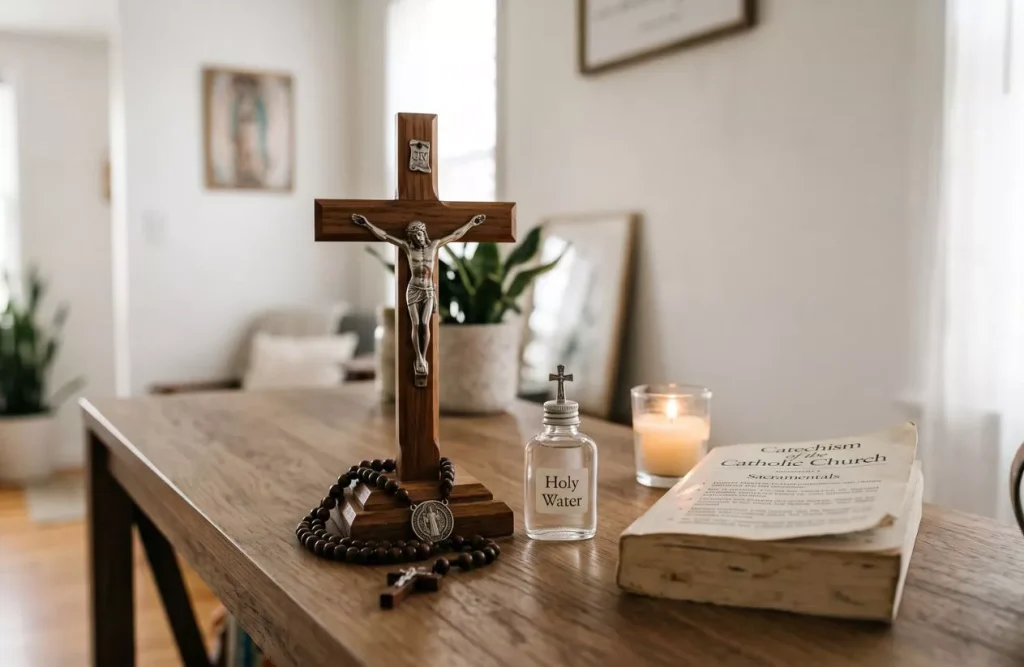
To use catholic sacramentals for home protection effectively, we must first understand what they actually are—and what they are not. In a world full of misconceptions, understanding the theological foundation behind these sacred objects ensures that we use them with reverence, proper intention, and genuine faith.
When asking what is a sacramental in Catholic teaching, we turn directly to the Catechism of the Catholic Church (CCC 1667). The Church defines sacramentals as “sacred signs instituted by the Church” that bear a resemblance to the sacraments. They signify spiritual effects obtained through the intercession of the Church, disposing the faithful to receive the chief effect of the sacraments and sanctifying various circumstances of life.
Sacraments vs. Sacramentals: Understanding the Difference
A common point of confusion for many laypeople is mixing up sacraments with sacramentals. While their names sound similar and both serve our spiritual growth, they operate on entirely different theological principles.
The seven Sacraments (such as Baptism, the Holy Eucharist, and Confession) were instituted directly by Jesus Christ Himself. They convey sanctifying grace ex opere operato—meaning “by the work performed.” When a valid sacrament is administered, the grace is guaranteed by God regardless of the holiness of the minister.
Sacramentals, on the other hand, were instituted by the Catholic Church under the guidance of the Holy Spirit. They do not confer sanctifying grace on their own. Instead, they work ex opere operantis Ecclesiae—meaning through the prayers and intercession of the Church, as well as the faith, devotion, and disposition of the person using them.
| Feature | Sacraments | Sacramentals |
| Origin / Institution | Instituted directly by Jesus Christ | Instituted by the Catholic Church |
| Number | Exactly Seven (Baptism, Eucharist, Confession, etc.) | Numerous (Holy Water, Salt, Medals, Blessings, Ashes) |
| Primary Purpose | Necessary for salvation; confers sanctifying grace | Prepares us to receive grace and sanctifies daily life |
| How They Work | Ex opere operato (Confers grace directly by the rite itself) | Ex opere operantis Ecclesiae (Works through Church intercession & user’s disposition) |
| Core Function | Imparts divine life to the soul | Wards off evil, protects living spaces, and disposes us toward God |
Understanding how sacramentals work helps us see their true value: they are continuous extensions of the Church’s prayer life brought directly into our homes.
Avoid Superstition: Why Sacramentals Aren’t “Magic Charms”
Because sacramentals are physical items used for spiritual defense, it is easy to fall into a dangerous trap: treating them like amulets, talismans, or superstitious luck charms.
The Catholic Church strictly warns against superstition. Placing a St. Benedict Medal over your front door or sprinkling blessed salt across a window sill carries zero magic power. The medal itself has no intrinsic energy, and the salt has no mystical physical force. If someone believes that simply hanging an object guarantees protection—without any regard for personal holiness, prayer, or faith—they are practicing superstition, not Catholicism.
Sacramentals derive their spiritual strength from three core pillars:
- The Authority of the Church: The priest or deacon who blesses the item acts in the name of the Universal Church, attaching the Church’s official intercessory prayer to that object.
- The Faith and Disposition of the User: Because sacramentals rely on your personal devotion, an unrepentant heart neutralizes their effectiveness.
- A State of Grace: Living a life aligned with God—frequenting the Sacrament of Reconciliation (Confession), attending Sunday Mass, and maintaining a sincere prayer life—is what makes these tools spiritually potent in your household.
Think of sacramentals as spiritual lightning rods. They do not generate the power themselves; rather, they direct the power, grace, and protection of Almighty God into your home because you are reaching out to Him in faith.
The Core Four: Essential Sacramentals for Protecting Your Home
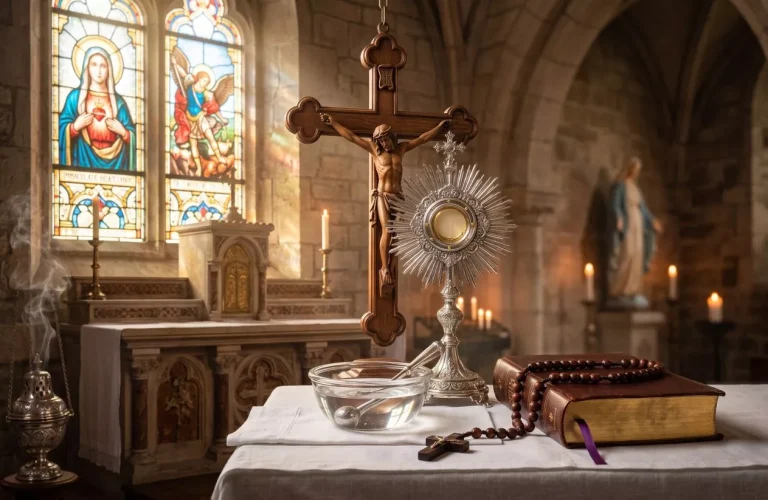
When building a spiritual shield over your household, Catholic tradition points to four primary sacramentals. These foundational items act as physical anchors for the Church’s prayers, transforming an ordinary house into a fortified Domestic Church.
1. Holy Water: The Primary Weapon Against Evil
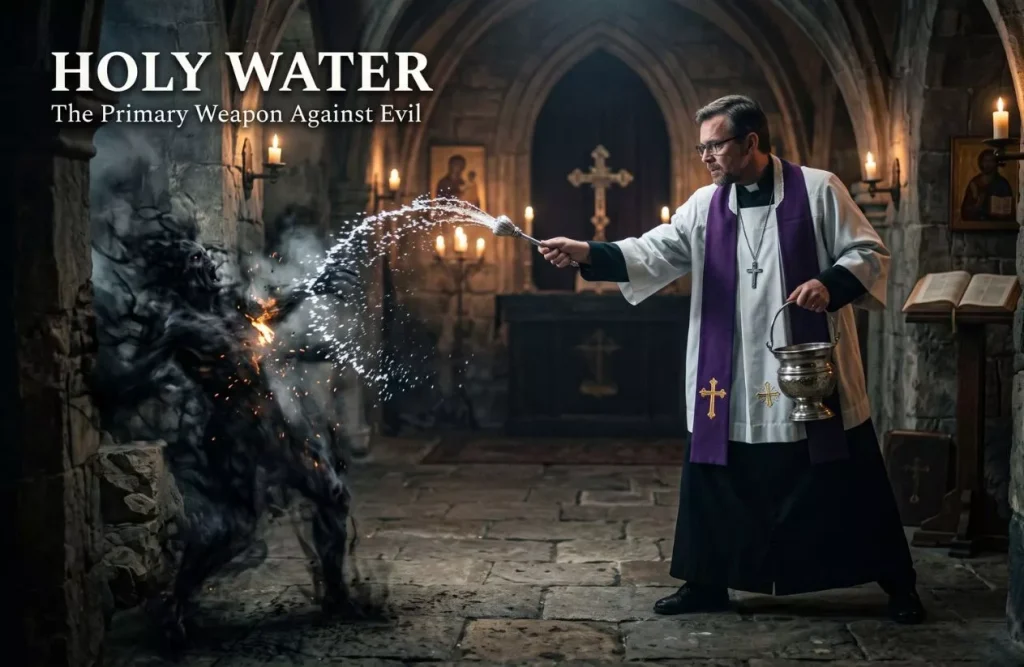
Holy water is the most frequently used sacramental in Catholic spiritual warfare. Its theological weight stems directly from its connection to Holy Baptism. Every time you cross yourself with holy water, you renew your baptismal promises—renouncing Satan, his works, and his empty promises.
Furthermore, according to long-standing Catholic tradition (and explicitly affirmed by St. Teresa of Ávila), holy water repels demonic spirits and remits venial sins when used with a contrite, faithful heart. Because evil spirits despise purity and the reminder of Christ’s redeeming waters, holy water acts as a spiritual cleanser in any space.
Practical Application for Laypeople:
- Daily Room Sprinkling: Walk through your home periodically—especially during times of family discord or spiritual distress—making the Sign of the Cross with holy water over walls, windows, and beds.
- Home Fonts: Install a wall-mounted holy water font near your main entrance. Blessing yourself as you leave or enter reminds family members to leave worldly anxieties outside.
- Parental Blessings: Parents have explicit spiritual authority over their children. Before bedtime or long travels, trace the Sign of the Cross on your spouse’s and children’s foreheads using holy water.
Related Article: What Is Spiritual Warfare? Meaning, Biblical Examples, and How to Fight
2. Blessed Salt: Establishing Spiritual Perimeters
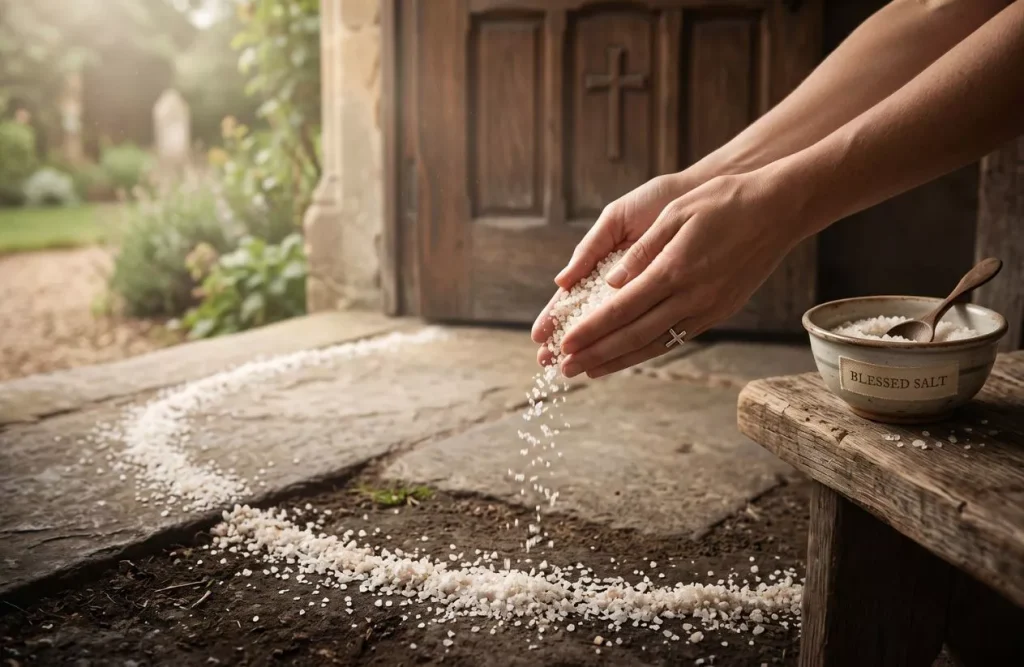
While holy water cleanses and sanctifies, blessed salt serves primarily to preserve, purify, and establish spiritual boundaries. Its scriptural origin is rooted in the Old Testament, where the prophet Elisha poured salt into the contaminated spring of Jericho to heal its waters (2 Kings 2:19–22).
In Catholic tradition, blessed salt carries a dual blessing: it drives away evil influences and prevents them from returning.
- Standard Blessed Salt vs. Exorcised Salt: Standard blessed salt receives a traditional priestly blessing asking God to grant health of mind and body to those who consume it. However, priests using the traditional Roman Ritual (Rituale Romanum) pray an explicit prayer of exorcism over the salt before blessing it, specifically commanding any demonic presence to depart from wherever the salt is placed.
Practical Application for Laypeople:
- Threshold Barriers: Sprinkle a thin line of blessed salt across window sills, door thresholds, and floor corners to establish a symbolic perimeter of protection against spiritual intrusions.
- Property Lines: Lay small amounts along the four outer corners of your property line or yard.
3. The St. Benedict Medal: The Shield of the Exorcist
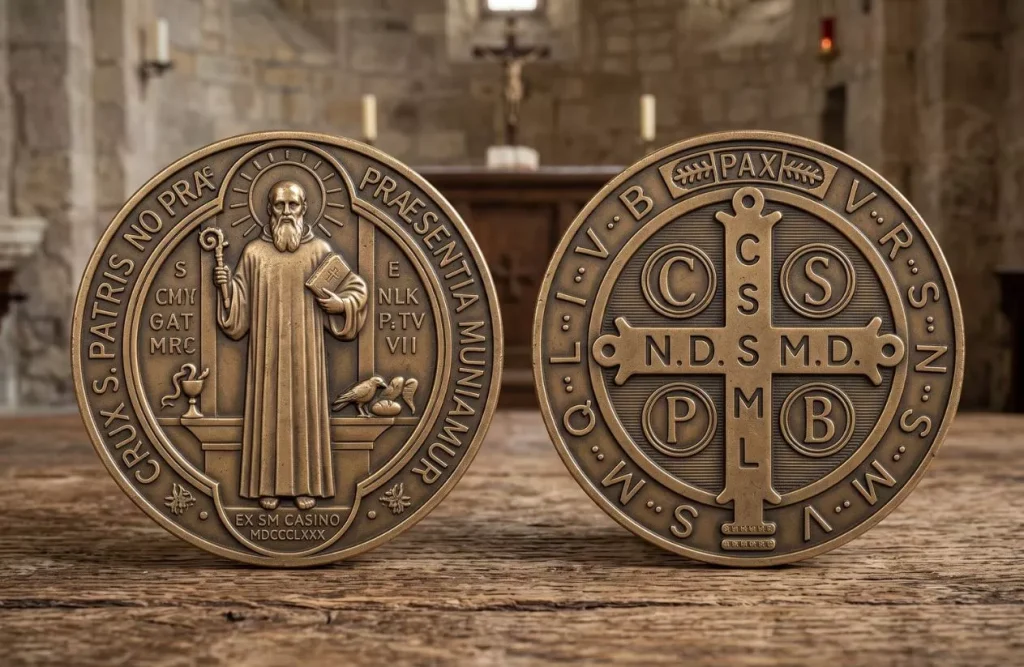
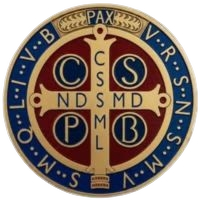
St. Benedict of Nursia is widely recognized as a primary patron saint against demonic attacks, witchcraft, and poison. The Jubilee St. Benedict Medal contains rich exorcistic inscriptions designed to ward off evil spirits.
The back of the medal displays a cross containing specific Latin initials representing powerful prayers of command:
- C S S M L (Crux Sacra Sit Mihi Lux): “May the Holy Cross be my light!”
- N D S M D (Non Draco Sit Mihi Dux): “May the dragon never be my guide!”
- V R S (Vade Retro Satana): “Begone, Satan!”
- N S M V (Nunquam Suade Mihi Vana): “Never tempt me with your vanities!”
- S M Q L I V B (Sunt Mala Quae Libas, Ipse Venena Bibas): “What you offer is evil; drink your own poison!”
Practical Application for Laypeople:
- Doorway Placement: Affix a blessed St. Benedict Medal above the interior frame of every exterior entry door and bedroom window.
- Land Boundary Burial: Bury a medal in each of the four physical corners of your property or home foundation.
- Priestly Blessing: Ask your parish priest to use the traditional Exorcism Blessing of St. Benedict (found in the older Rituale Romanum) when blessing your medals, which imparts their full spiritual faculty.
Note: Don’t use a St Benedict Medal without a proper blessing of the priest; it must be blessed and, if possible exorcised. Dont let anyone that are not a priest bless it.
St Benedict Medal For Door Knob
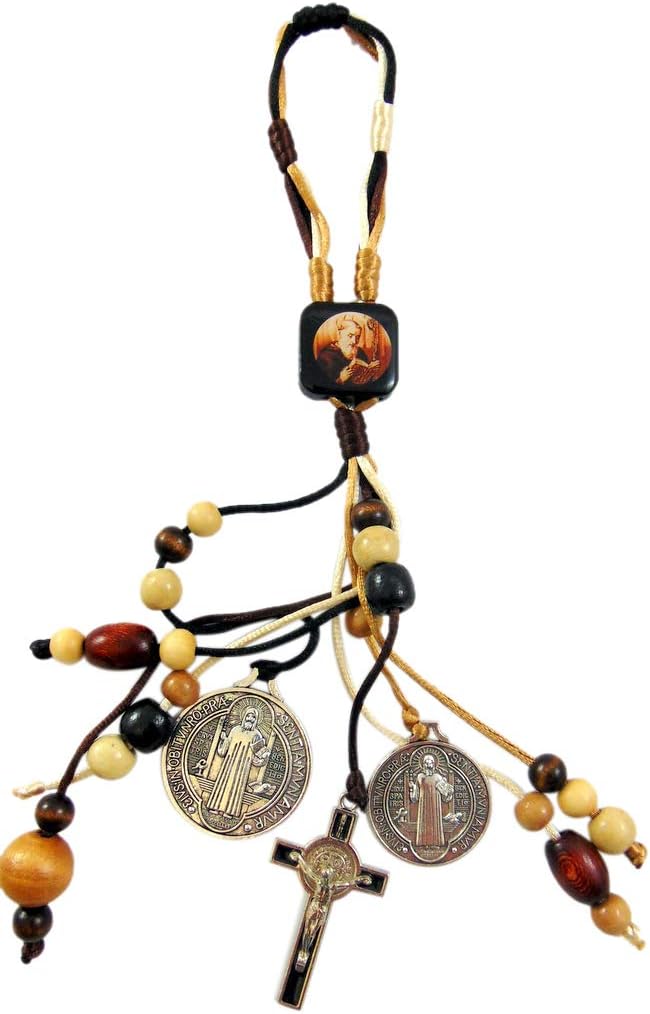
4. The Blessed Crucifix: The Centerpiece of the Domestic Church
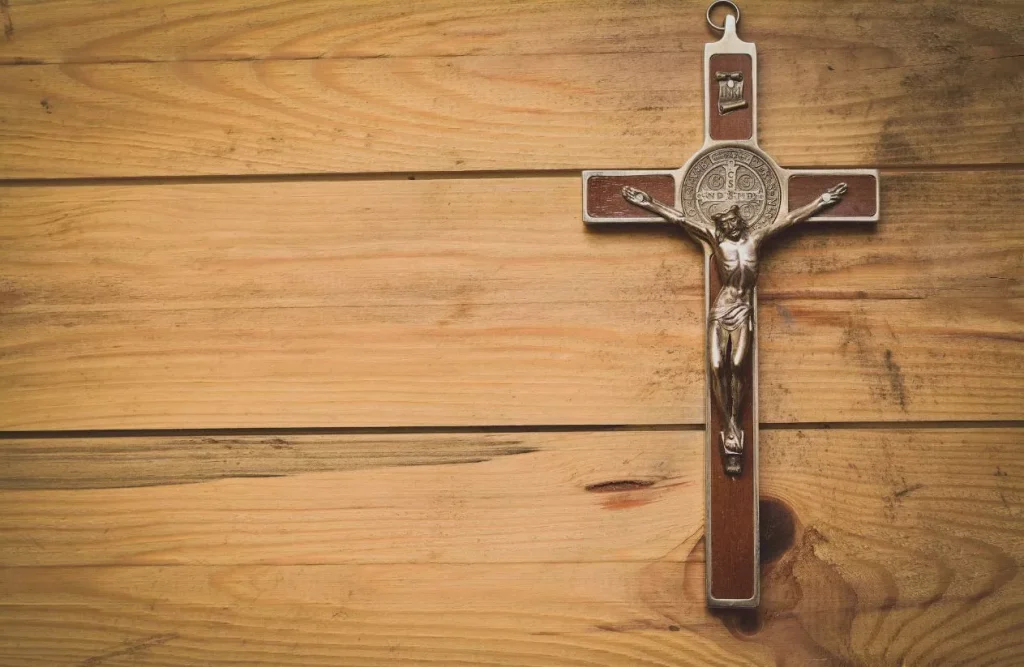
The Crucifix is the ultimate symbol of Christian victory. Unlike a plain cross, the Crucifix displays the Corpus—the suffering body of Jesus Christ. It serves as an unyielding visual proclamation that the Prince of Darkness was decisively defeated on Calvary.
Demonic forces abhor the Crucifix because it exposes their definitive defeat and reminds them of God’s infinite love for humanity. Displaying a blessed Crucifix in your home publicly centers your living space around Christ’s sacrifice.
Practical Application for Laypeople:
- Main Entrance Placement: Hang a prominent, blessed Crucifix directly above or adjacent to your home’s main entryway.
- Bedroom Safeguard: Place a Crucifix on the wall of every bedroom—positioned where it is the first thing family members see when waking up and the last thing before sleeping.
- Home Altar Anchor: Set up a central prayer corner (a home altar or prayer table) featuring your primary family Crucifix alongside Holy Scripture, holy water, and candles for daily family rosaries.
Step-by-Step Guide: How Lay Catholics Can Bless and Protect Their Living Space
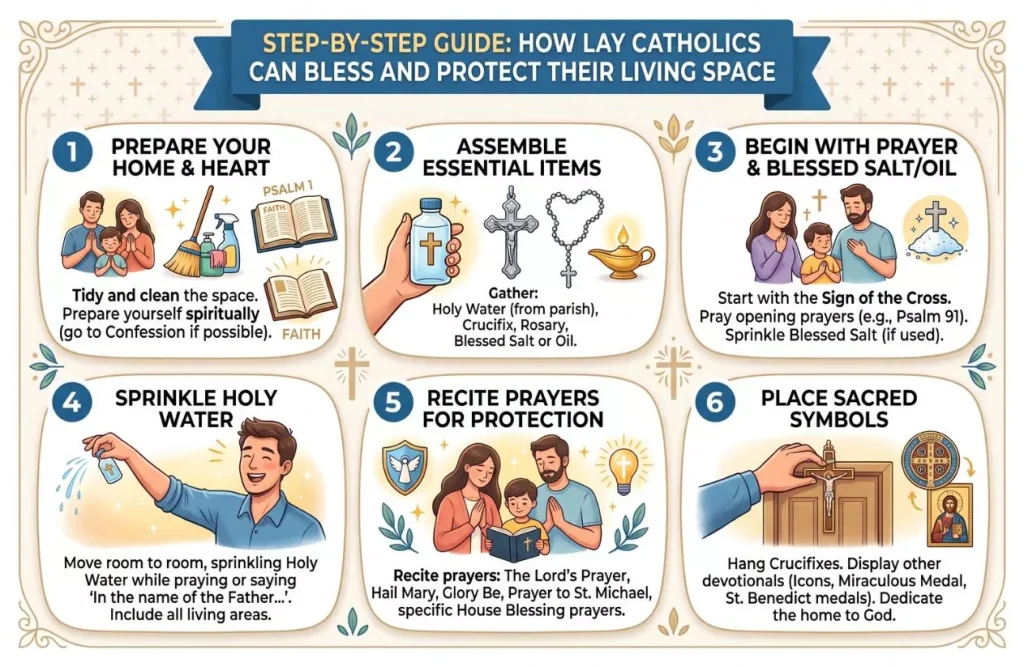
Applying catholic sacramentals for home protection is most effective when executed with order, reverence, and spiritual intentionality. The head of the household (or the resident lay Catholic) can follow this structured guide to establish a physical and spiritual perimeter of peace across the home.
Preparation: Spiritual Readiness of the Household
Before applying physical sacramentals, the home must be spiritually cleared. Sacramentals are tools that channel the Church’s prayer into a faithful environment; they cannot compensate for unrepentant sin or open spiritual doors.
- Reconcile with God: The head of the house and family members should go to Sacramental Confession (Sacrament of Reconciliation). Operating in a state of sanctifying grace ensures your prayers for your household carry spiritual weight.
- Remove Contaminated Items: Thoroughly inspect your living space for any items tied to occult, spiritist, or New Age practices. Surrender to a priest all items such as:
- Ouija boards, tarot cards, and astrology/horoscope charts.
- Smudging materials used for spiritual cleansing (e.g., sage, palo santo, white sage bundles).
- New Age crystals, dreamcatchers, and amulets.
- Statues or symbols of pagan deities, idols, or superstitious luck items (e.g., evil eye talismans, feng shui protection mirrors).
Step 1: Laying the Perimeter with Blessed Salt
Begin at the outermost boundaries of your living area to mark off your space dedicated to God.
- Take your blessed salt (preferably exorcised salt) and walk the outer perimeter of your property or, if living in an apartment, the interior walls and entry doorways.
- As you place small amounts of salt along window sills, door frames, and property corners, pray aloud with confidence.
- Recite the St. Michael Prayer or Psalm 91 (“He who dwells in the shelter of the Most High…”), asking God to station His angels around your dwelling and prevent any unclean spirit from crossing the threshold.
Step 2: Sprinkling Holy Water in Every Room
With the perimeter established, move through the interior rooms to purify the atmosphere of your home.
- Hold a container of holy water and proceed through every room in a calm, clockwise direction.
- In each room, make the Sign of the Cross with holy water toward the four walls, windows, and doorways, saying:“In the name of the Father, and of the Son, and of the Holy Spirit. Lord, purge this room of all spiritual harm and fill it with Your Holy Spirit.”
- Pay special attention to bedrooms, basement areas, and primary gathering spaces where stress or conflict frequently arises.
Step 3: Enthroning the Crucifix and Placing Medals
Once the home is cleansed and blessed, physically install your permanent sacramentals as visual and spiritual anchors.
- St. Benedict Medals: Affix a blessed St. Benedict Medal above the interior lintel of your front entrance, back entrance, and bedroom doors.
- Central Crucifix: Mount your primary family Crucifix above or beside the main entrance of the home or in the central family room. Ensure it is fixed securely where all who enter can acknowledge Christ’s sovereignty over the household.
Step 4: Consecrating the Household to the Sacred Heart of Jesus
The final and most critical step is placing the home under the explicit kingship of Jesus Christ. A house blessing reaches its fulfillment when the inhabitants formally consecrate themselves to the Divine Heart of Our Lord.
- Gather the family together before your central Crucifix or an Image of the Sacred Heart of Jesus.
- Recite an official Act of Consecration of the Family to the Sacred Heart of Jesus.
- Explicitly invite Christ to be the Lord, Decision-Maker, and Protector of your home, asking the Immaculate Heart of Mary to safeguard your family under her mantle of grace.
Additional Catholic Sacramentals for Extended Protection
While Holy Water, Blessed Salt, St. Benedict Medals, and Crucifixes form the core perimeter of home defense, Catholic tradition offers several other time-tested sacramentals.
Incorporating these items into your household routine strengthens the spiritual atmosphere and provides ongoing protection for individual family members.
Blessed Candles: Illuminating the Darkness
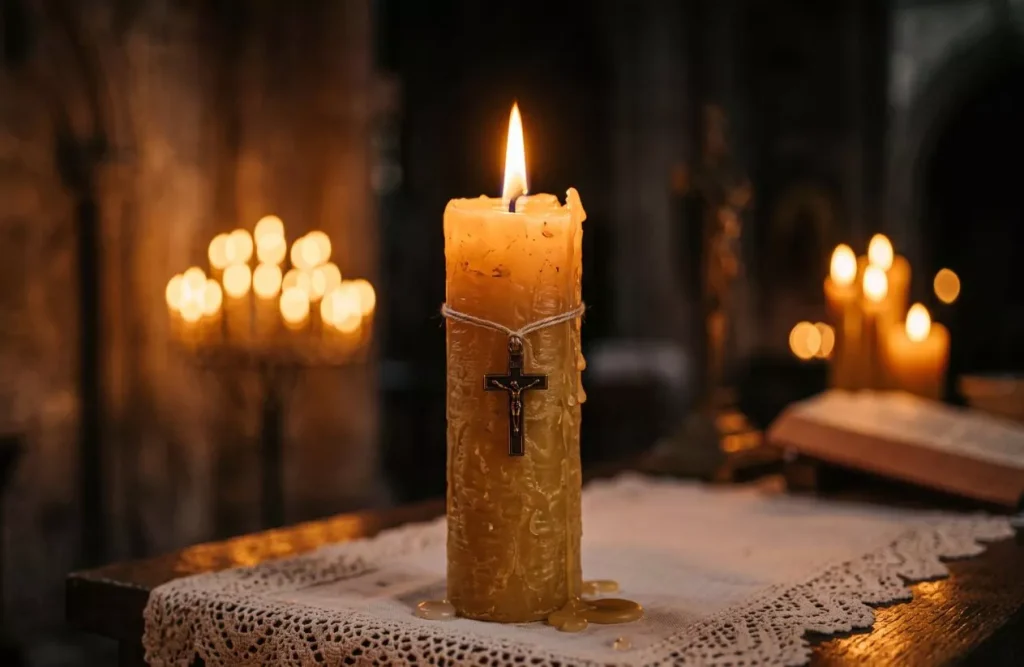
In Catholic liturgy and home devotion, candles represent the presence of Christ, the Light of the World. Candles that have been blessed by a priest—particularly those made of 100% pure beeswax—carry a long history of use in spiritual warfare and home protection.
- Significance: Beeswax candles hold symbolic purity in Church tradition, as the wax created by virgin bees represents Christ’s pure flesh, the wick His soul, and the flame His divinity.
- When to Light Them: Light blessed candles during family evening prayers, severe weather or natural disasters, and periods of heightened spiritual distress, anxiety, or night terrors in the home.
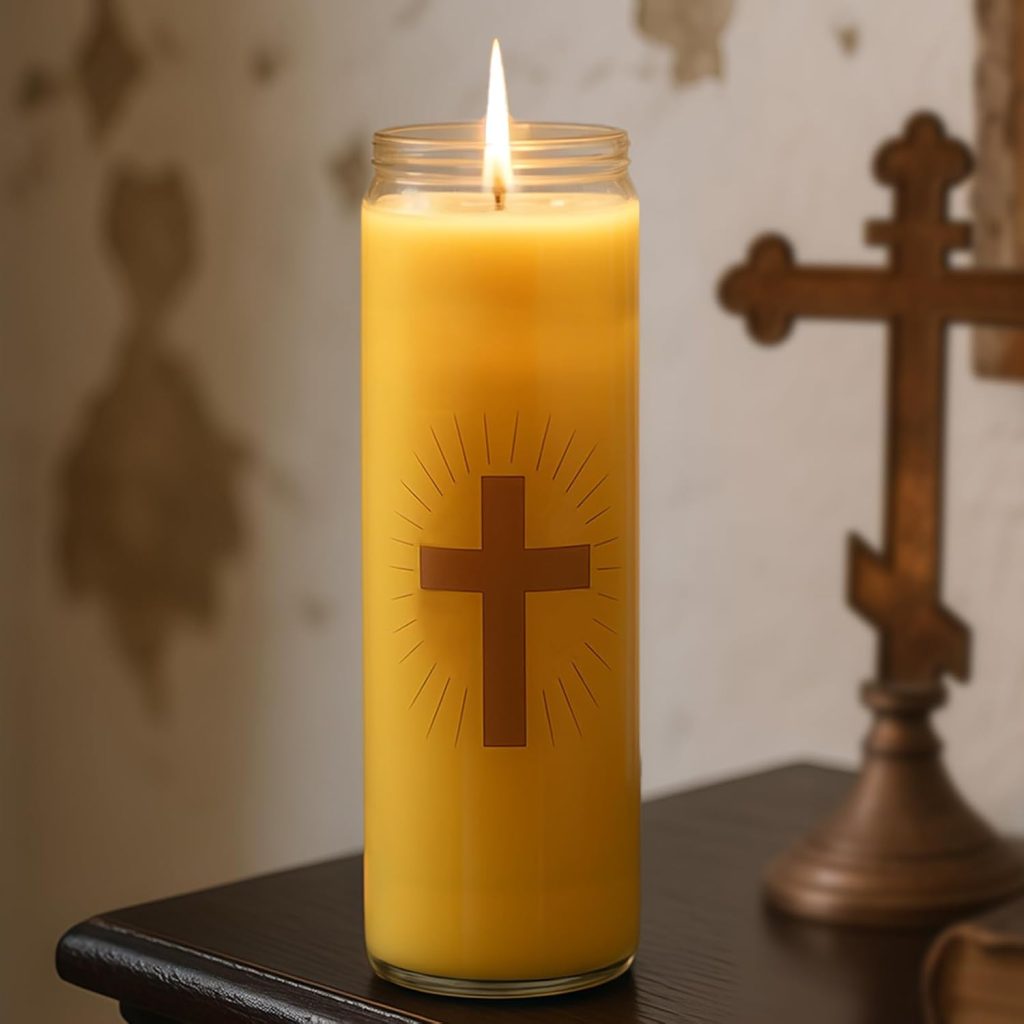
- 3-Day / Devotional Candles: Keeping a blessed multi-day candle burning near your home prayer space serves as a continuous physical prayer, inviting God’s peace into the home.
Bees Wax Candle Good To Be Blessed By Priest
Blessed Epiphany Chalk: The Annual Doorway Blessing
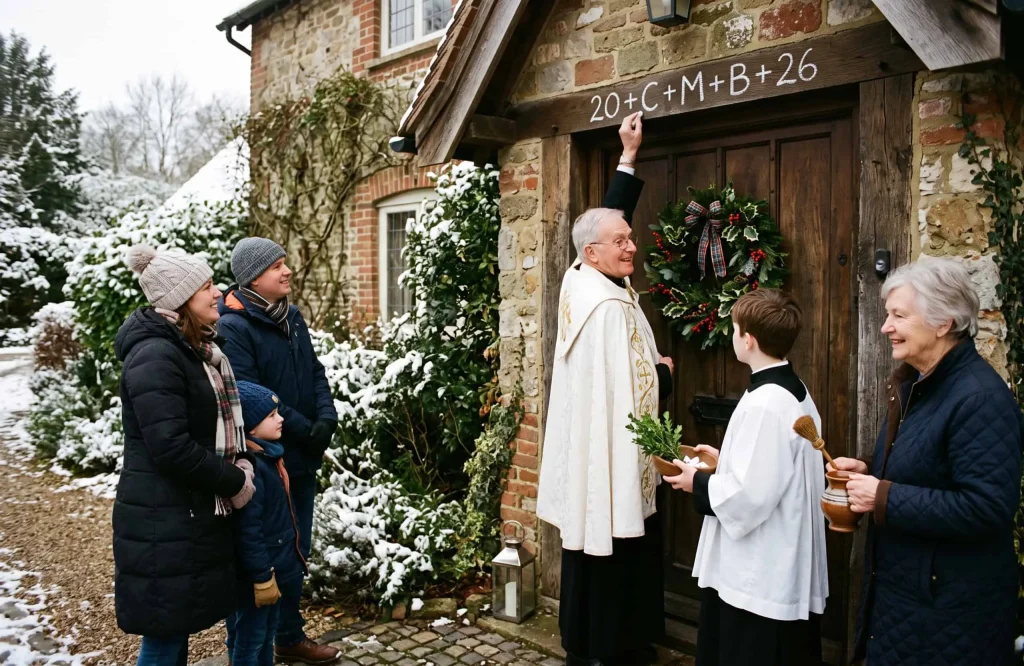
One of the richest annual traditions for protecting Catholic homes is the Epiphany House Blessing, performed on or around the Feast of the Epiphany (January 6).
- The Inscription Pattern: Using chalk blessed by a priest on Epiphany, the head of the household writes a specific pattern over the main entry door, such as: 20 + C + M + B + 26 (using the current year’s numbers).
- Meaning of the Symbols:
- The numbers represent the current calendar year.
- The crosses represent Christ’s blessing.
- The letters C, M, B stand for the traditional names of the Three Magi (Caspar, Melchior, and Balthasar) and serve as an abbreviation for the Latin blessing: Christus Mansionem Benedicat (“May Christ bless this house”).
- Effectiveness: This visible mark serves as a public declaration that your home belongs to Christ for the entire year ahead.
Images of the Sacred Heart and Immaculate Heart
Publicly displaying blessed images of the Sacred Heart of Jesus and the Immaculate Heart of Mary is a powerful way to invite divine protection into living spaces.
- Promised Protection: In her visions of Saint Margaret Mary Alacoque, Our Lord explicitly promised to bless every place where an image of His Sacred Heart is exposed and honored.
- Placement: Hang enthroned images of the Sacred Heart and Immaculate Heart together in your living room, dining area, or main hallway as constant visual reminders of Christ’s mercy and Mary’s maternal mantle.
The Brown Scapular & Miraculous Medal: Personal Worn Sacramentals
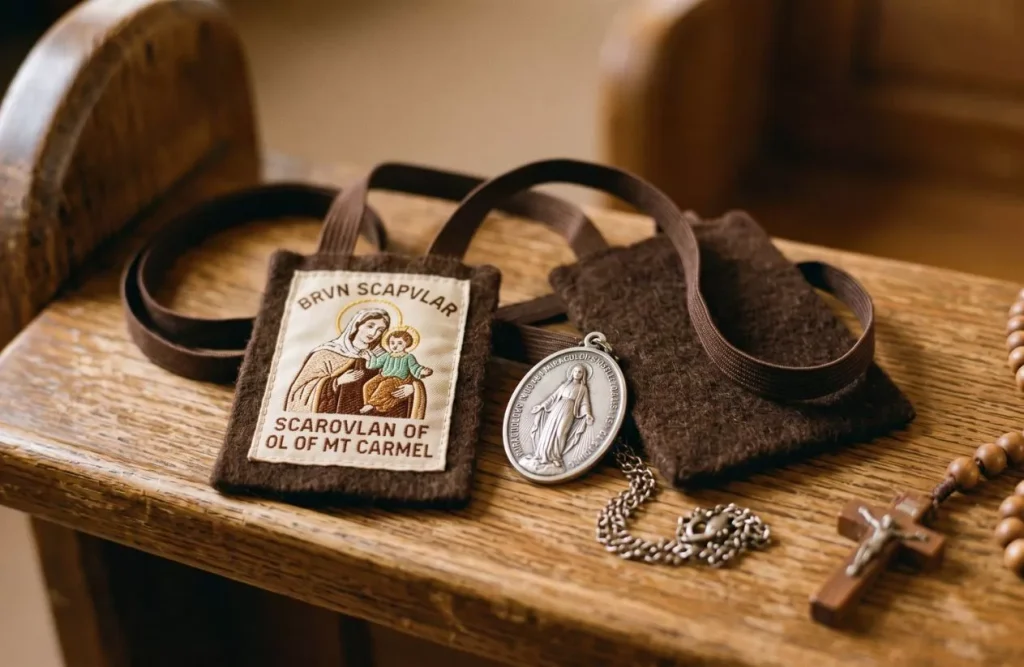
While home protection focuses on physical structures, family members must also be protected individually when they step outside the home. Wearing personal sacramentals around the neck ensures that Church protection accompanies them wherever they go.
- The Brown Scapular of Our Lady of Mount Carmel: Given to St. Simon Stock by the Blessed Virgin Mary, the Brown Scapular is a garment of protection worn over the shoulders. When properly invested by a priest, it signifies continuous devotion to Mary and her promise of spiritual protection.
- The Miraculous Medal: Revealed to St. Catherine Labouré in 1830, this medal bears the image of Our Lady crushing the head of the serpent under her feet. Wearing a blessed Miraculous Medal around the neck invokes Mary’s intercession against demonic temptation and physical danger.
Boundaries of Lay Authority: What You Can and Cannot Do
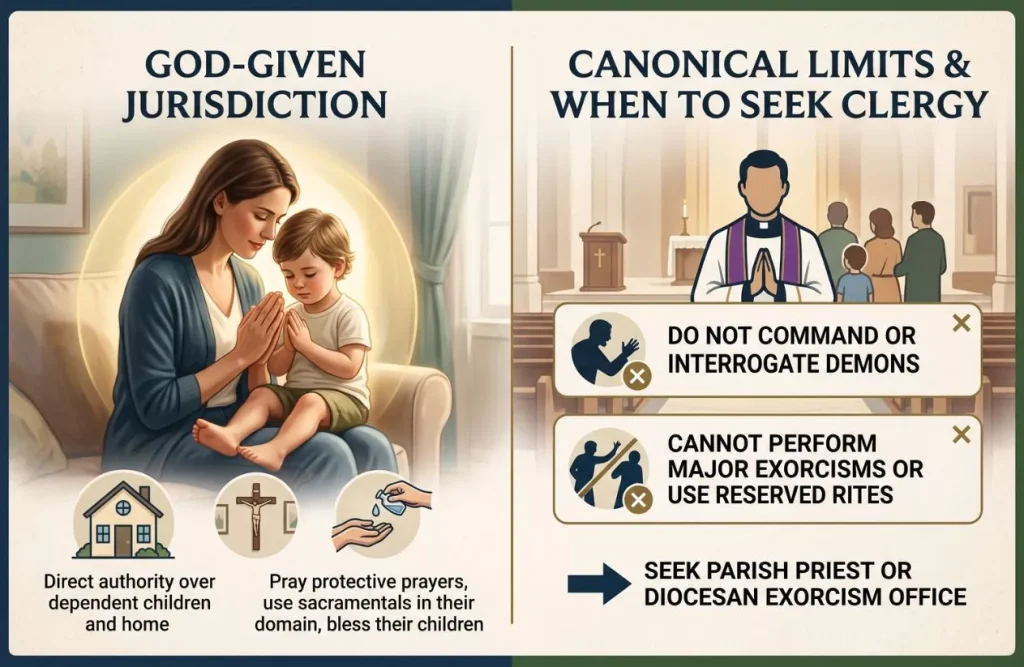
When engaging in spiritual warfare or applying catholic sacramentals for home protection, every layperson must understand the theological concept of spiritual authority and jurisdiction.
Attempting to exercise authority you do not possess is spiritually dangerous, ineffective, and can open doors to severe demonic retaliation.
In Catholic theology, spiritual authority flows through structural hierarchy. Understanding your God-given domain ensures that your prayers remain safe, effective, and completely aligned with Church teaching.
Understanding God-Given Jurisdiction
God assigns real, functional spiritual authority to laypeople based on their natural and sacramental states of life:
- Heads of Household & Parents: Parents hold true spiritual jurisdiction over their dependent children, their marriage, and their physical living space. A father or mother has the right and duty to pray protective prayers over their household, bless their children, and drive spiritual disturbances out of their own home using sacramentals.
- Self-Jurisdiction: Every baptized individual has authority over their own body, soul, thoughts, and personal belongings.
What Laypeople CAN Do (Within Your Domain):
- Use Sacramentals: Sprinkle holy water, place blessed salt, display crucifixes, and hang St. Benedict Medals across your property.
- Pray Protective Prayers: Recite deprecatory prayers (asking God or St. Michael to command evil spirits to leave), such as the St. Michael Prayer, Psalm 91, or approved Deliverance Prayers for the Laity (e.g., those compiled by Catholic exorcists for lay use).
- Bless Family Members: Make the Sign of the Cross with holy water on your children or spouse.
- Consecrate Your Home: Dedicate your household to the Sacred Heart of Jesus and the Immaculate Heart of Mary.
Canonical Limits: What Laypeople MUST Avoid
While lay Catholics have true authority in their home, that authority ends at their threshold. Crossing canonical boundaries into priestly ministry violates Church order and exposes the household to harm.
1. Do NOT Command, Address, or Interrogate Demons Directly
Laypeople must never speak directly to evil spirits. Do not say, “I command you, spirit of anger, to leave this house.” Direct commands (imperative exorcism) require the apostolic authority of Holy Orders. Addressing demons directly invites them into dialogue, which laypeople are not equipped to handle.
Instead, laypeople must always use supplicatory/deprecatory prayer—asking God, Jesus Christ, or St. Michael to bind and drive away the spirit:
“Lord Jesus Christ, I ask You to cast out any evil spirit from my home and send it to the foot of Your Holy Cross.”
2. Do NOT Attempt Exorcisms or Priestly Rites
- Lay Catholics cannot perform major exorcisms or attempt to use the official solemn rites reserved in the Rituale Romanum.
- Laypeople cannot lay hands on non-family members or perform deliverance prayers over strangers or unrelated individuals, as you lack spiritual jurisdiction over them.
- Do not attempt to deliver people who are bound by deep occult involvement, generational curses, or severe demonic manifestations without clerical guidance. (Instead, advise them to seek a Catholic Exorcist.)
When to Seek Official Church Help
Sacramentals and lay prayers handle everyday spiritual noise, temptations, and ordinary atmospheric disturbances. However, if extraordinary demonic activity is present, lay prayers alone are not enough.
Pause lay deliverance efforts and contact your local parish priest or diocesan chancellor if you observe:
- Severe Physical Phenomena: Objects moving without physical cause, unexplainable foul odors (such as sulfur or rotting flesh) that persist after cleaning, or knocking/banging noises inside walls in groups of three (mocking the Trinity).
- Aversion to the Sacred: A family member demonstrating sudden, extreme, irrational violence or nausea when presented with holy water, a crucifix, or the name of Jesus.
- Preternatural Abilities: Knowledge of secret or hidden things, sudden fluency in unlearned ancient languages, or unnatural physical strength beyond human limits.
- Persistent Oppression: Unexplained, overwhelming depression, suicidal thoughts, or intense fear that immediately clears upon leaving the home premises and shows no medical cause.
In such cases, the local parish priest will evaluate the situation, bless the home with official priestly prayers, and, if necessary, refer the family to the official diocesan exorcism office for formal discernment and help.
Final Reflection: Living a Life of Grace as the Ultimate Protection
It is essential to remember that physical tools are meant to serve spiritual realities. While learning how to properly implement catholic sacramentals for home protection provides a tangible defense for your living space, these sacred items are never a substitute for a vibrant relationship with Jesus Christ.
Sacramentals do not work as passive armor; they are instruments designed to point us back to the Sacraments, deepen our personal prayer, and keep our homes centered on God’s presence. Hanging a Crucifix or laying blessed salt creates an environment conducive to holiness, but true spiritual immunity comes from living an active life of sanctifying grace.
The ultimate protection for your heart, family, and household consists of four daily and weekly pillars:
- Frequent the Holy Eucharist: Worthily receiving Holy Communion at Sunday Mass (and weekday Mass when possible) fills your soul with the divine life of Christ, making your spirit uninhabitable to darkness.
- Regular Confession: Making a good Sacramental Confession at least once a month cleanses your soul of mortal and venial sins, closing the primary doors through which evil gains a foothold in human lives.
- The Daily Family Rosary: Praying the Rosary daily invokes the immediate protection of the Blessed Virgin Mary, whose maternal mantle shields households from spiritual division, confusion, and distress.
- Living in Charity and Peace: Cultivating a home filled with forgiveness, patience, biblical order, and genuine Christian love drives out the atmosphere of anger and discord that evil spirits exploit.
When your household is rooted in the sacramental life of the Church, your home becomes far more than just a protected building. It transforms into a true fortress of faith—a sanctuary where the peace of Christ reigns supreme, and where no evil can overcome the light of God’s grace.
Frequently Asked Questions (FAQ)
Can laypeople bless their own sacramentals?
No. Laypeople cannot bless physical objects to turn them into sacramentals. Only an ordained minister (a priest or deacon) acting on behalf of the Church possesses the authority to impart an official blessing.
Where can I get Holy Water and Blessed Salt?
You can collect Holy Water from the large dispenser or tank found in the vestibule of most Catholic parishes using a clean bottle. For Blessed Salt, buy standard table salt and ask your local parish priest or deacon to pray the traditional blessing over it.
Can a deacon bless sacramentals?
Yes. Deacons are ordained ministers in the Catholic Church with the canonical authority to validly bless religious objects, houses, and sacramentals like St. Benedict Medals, Crucifixes, and Holy Water.
What should I do with old or broken sacramentals?
Items that have been blessed must never be thrown into regular trash. You must dispose of them reverently by burying them in the earth or by burning them completely and burying the ashes.
Is using sage or palo santo allowed alongside Catholic sacramentals?
No. Burning sage (smudging) or palo santo stems from pagan and shamanic rituals, which Catholics must avoid. To cleanse your home spiritually, use Holy Water, Blessed Salt, or blessed church incense like frankincense.