What to Do During an Active Demonic Attack: A Layperson’s Guide
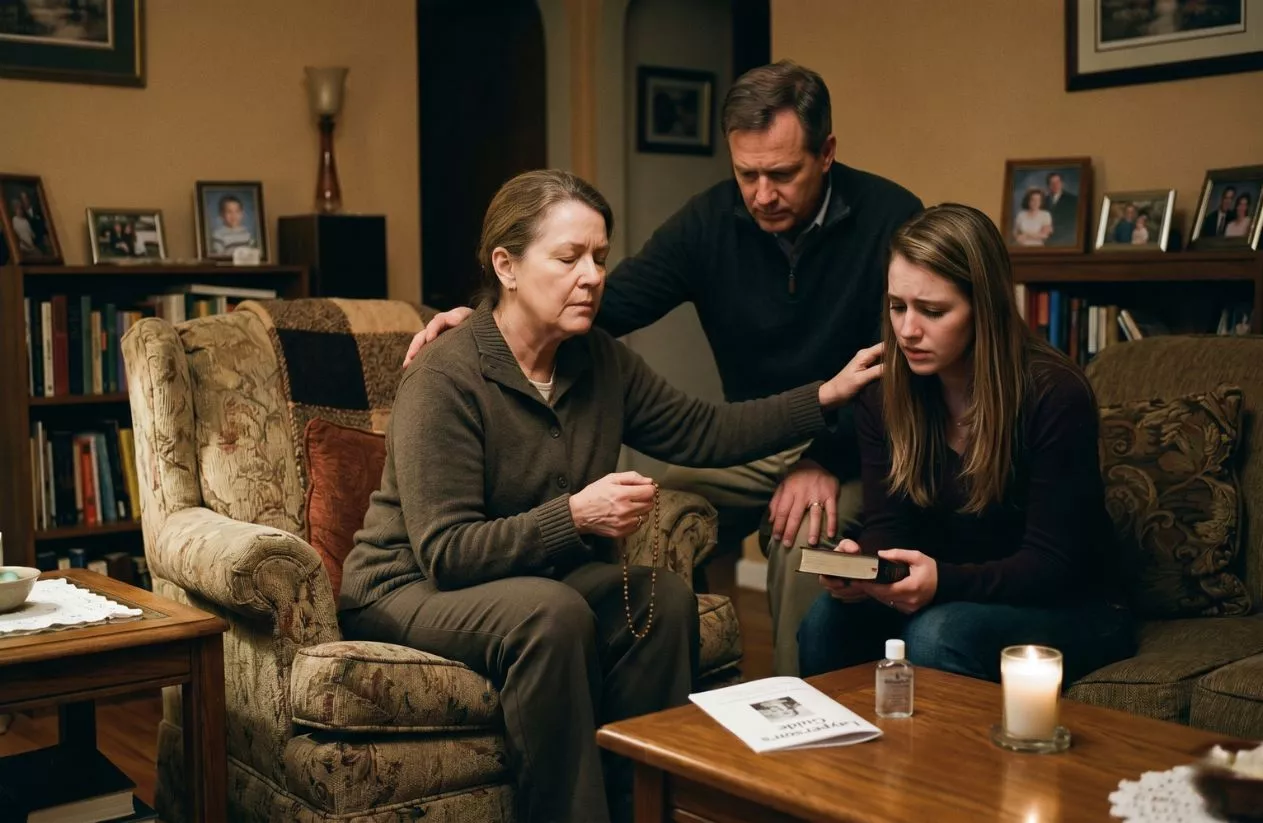
Facing a sudden preternatural crisis can be disorienting and terrifying. If you or a loved one are experiencing an active demonic attack what to do first is not a matter of panic, but of immediate, disciplined spiritual defense.
This guide provides a direct, highly practical emergency protocol for lay Catholics and Christians seeking immediate relief from hostile spiritual activity.
Grounded strictly in Sacred Scripture, historical Church tradition, and the sober wisdom of experienced diocesan exorcists, these steps are designed to de-escalate fear and assert the supreme authority of Jesus Christ.
For laypeople, spiritual defense is not about engaging in dramatic confrontation, but about standing firm in grace, deploying permissible spiritual weapons, and shutting the spiritual doorways permanently.
Related Article: What Is Spiritual Warfare? Meaning, Biblical Examples, and How to Fight
1. Immediate Crisis Protocol: The First 60 Seconds
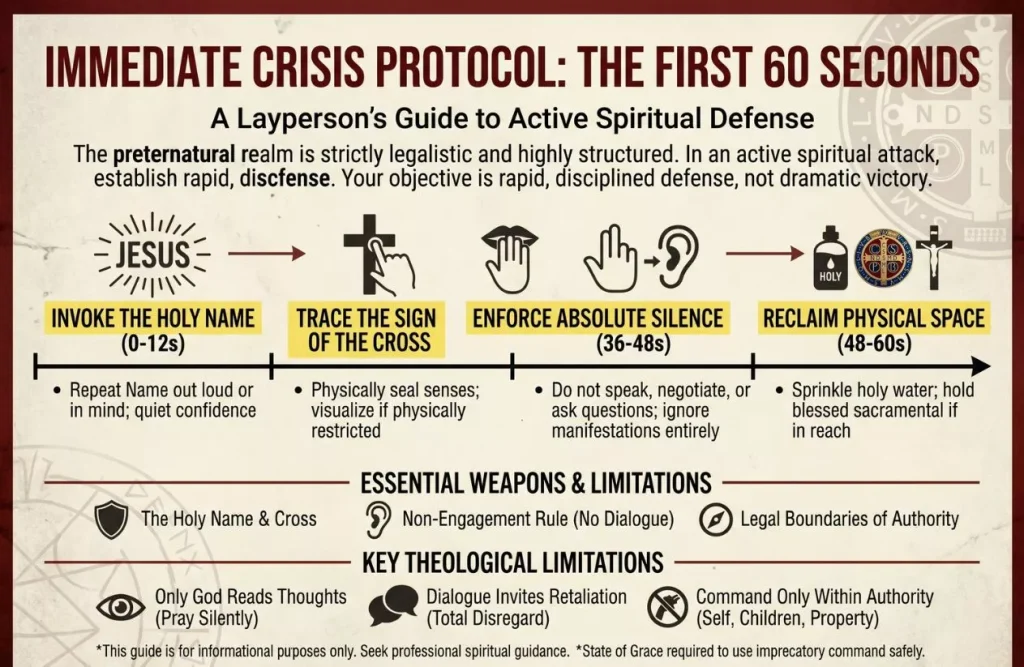
The preternatural realm is strictly legalistic and highly structured. During an active spiritual attack—whether manifesting as paralyzing sleep paralysis, an overwhelming dark presence, uncharacteristic sensory anomalies, or acute mental and emotional terror—the first sixty seconds are critical.
Your objective is not to win a dramatic spiritual duel, but to establish rapid, disciplined defense.
Quick-Response Emergency Checklist
If you are experiencing an active spiritual attack right now, execute these five steps immediately:
- Invoke the Holy Name of Jesus: Repeat the Name of Jesus Christ out loud or in your mind with quiet confidence.
- Trace the Sign of the Cross: Make the physical sign over your forehead, chest, and shoulders to seal your senses, or visualize it if you are physically restricted.
- Enforce Absolute Silence: Do not speak to, negotiate with, or ask questions of any entity or voice. Ignore the manifestations entirely.
- Assert Your Personal Authority: Calmly command the entity to depart from you in the Name of Jesus Christ.
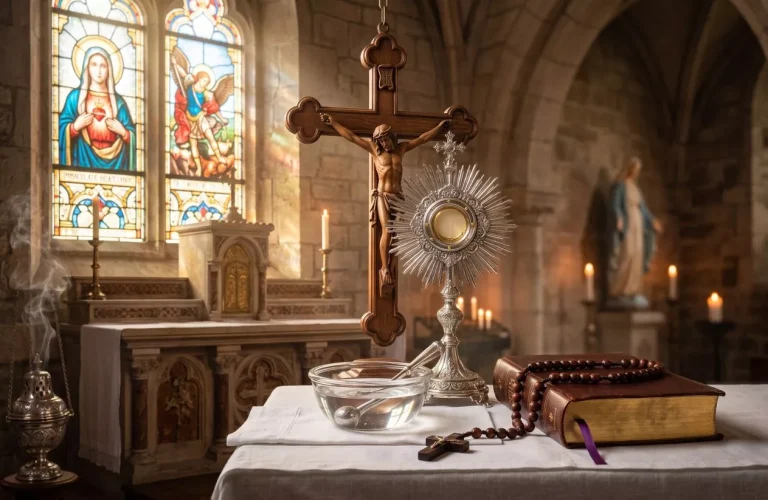
- Reclaim Your Physical Space: Sprinkle holy water or hold a blessed sacramental (like a Saint Benedict medal or crucifix) if one is within immediate arm’s reach.
The Sovereignty of the Holy Name and the Cross
The single most powerful weapon in the Christian arsenal is the Holy Name of Jesus. Sacred Scripture declares that at the Name of Jesus, “every knee should bow, of things in heaven, and things on earth, and things under the earth” (Philippians 2:10).
When fear paralyzes your voice, remember that demons can only influence your imagination and emotions; they cannot read your thoughts, as the interior of the human soul belongs exclusively to God.
You can pray silently in your mind with the exact same efficacy as speaking aloud.
Focus your intellect entirely on Jesus Christ, visualising Him as your shield, and trace the Sign of the Cross. This ancient liturgical gesture is a physical proclamation of your baptismal seal and Christ’s ultimate victory over the powers of darkness.
The Rule of Non-Engagement: Why You Must Never Dialogue
One of the most vital rules emphasized by diocesan exorcists is the absolute ban on communication. Satan and his fallen angels are vastly superior intellects with thousands of years of experience in human deception.
If you hear internal voices, see manifestations, or feel an oppressive presence, do not attempt to converse with it.
Do not ask the entity its name, its purpose, or why it is there. Do not attempt to argue, plead, or shout. Any active dialogue with a demonic presence is a form of engagement that gives the entity the attention and psychological foothold it craves.
Treat the manifestation like a passing, intrusive thought: completely ignore it, refuse to look at or analyze it, and redirect your entire attention to loving and praising God.
Understanding the Legal Boundaries of Lay Authority
In spiritual warfare, authority is determined by natural law, divine law, and sacramental office.
A common and highly dangerous mistake made by laypeople is attempting to directly command or “bind” demons in other people or external places.
According to Church-approved deliverance protocols, laypeople possess direct, protective authority over three specific realms:
- Themselves (their own body, mind, and soul).
- Their minor children (via parental authority and natural law).
- Their immediate physical property (their home and belongings, via ownership).
Within these boundaries, you may use an imprecatory command (a direct command to the demon in the Name of Jesus) to protect yourself or your minor children:
- “In the Name of Jesus Christ, I command you, spirit of fear, to leave me and go directly to the foot of His Cross.”
If you are praying for someone outside of your direct spiritual authority (such as a friend, coworker, or extended family member), you must never use direct command language.
Doing so is an act of spiritual disobedience that strips away your protection and invites demonic retaliation.
Instead, you must use deprecatory prayer (petitioning God to act on their behalf):
- “Lord Jesus, I ask that You send Your holy angels to protect [Name], bind any evil spirits harassing them, and grant them Your peace.”
Note: You must be in the state of grace to avoid demonic retaliation. And never command directly without saying in the name of Jesus.
2. Core Spiritual Weapons Permissible for Laypeople
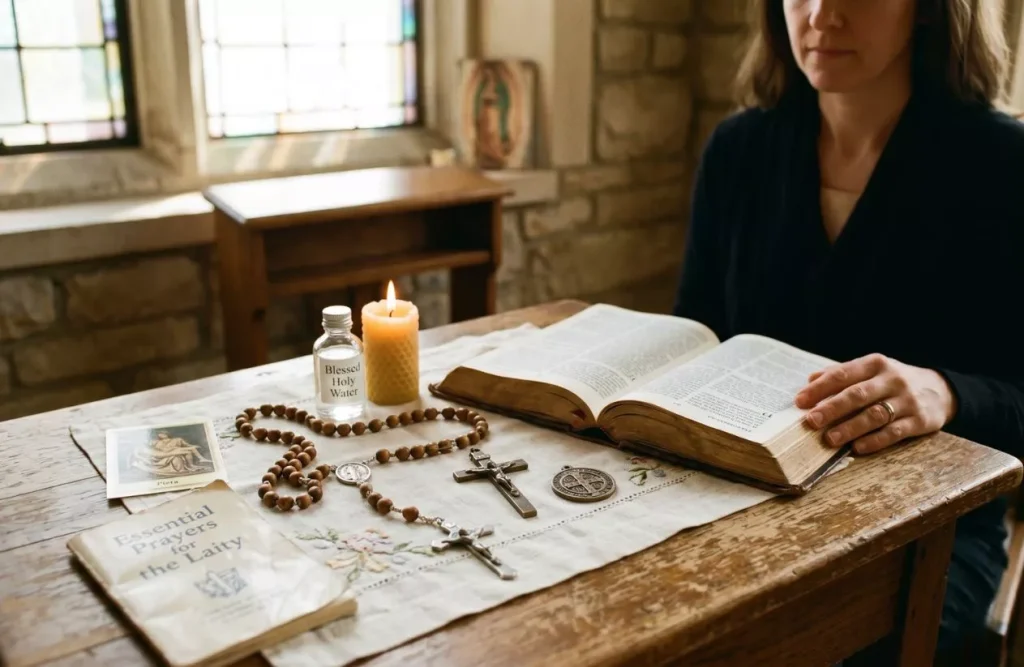
When determining what to do during an active demonic attack, understanding the tools at your disposal is only half the battle; you must also understand how to deploy them within your theological boundaries.
The Catholic Church provides the laity with powerful spiritual resources rooted in Scripture and Sacred Tradition.
These weapons do not operate via magic or superstition; rather, their efficacy relies on the infinite merits of Jesus Christ, the intercessory authority of the Church, and the faith and state of grace of the person utilizing them.
The Power of Holy Water and Blessed Salt
Holy water and blessed salt are classified as sacramentals—sacred signs instituted by the Church that prepare the faithful to receive grace and cooperate with it.
Unlike the sacraments (which confer grace directly), sacramentals derive their spiritual power from the continuous, collective prayer and authority of the mystical Body of Christ.
- Holy Water: Traced back to the earliest centuries of the Church, holy water is blessed by a priest to repel evil spirits, cleanse environments, and remind us of our baptismal protection. During an attack, sprinkling holy water around your room or signing your forehead with it physically and spiritually dispels demonic oppression. If possible, utilize water blessed under the traditional Latin ritual, which contains explicit prayers of exorcism against diabolic presence. (Holy exorcise water)
- Blessed Salt: Traditional exorcists frequently recommend placing small amounts of blessed salt (ideally exorcised salt) in the corners of a room or across doorframes. Salt acts as a physical and spiritual barrier. Under the spiritual authority of home ownership or tenancy, a layperson may use blessed salt to claim their physical boundaries and restrict demonic activity within their living spaces.
The Prayer of Saint Michael the Archangel
Composed by Pope Leo XIII in 1884 after receiving a profound prophetic vision of the spiritual battles of the modern age, the Prayer of Saint Michael is a premier protective intercessory shield.
Saint Michael is designated by Sacred Scripture as the prince of the heavenly hosts and the guardian of the people of God (Daniel 12:1).
When laypeople invoke Saint Michael, they are utilizing intercessory prayer. You are not commanding the archangel, nor are you directly confronting the demon yourself.
Instead, you are summoning a vastly superior angelic intellect who possesses the divine commission to cast down Satan.
Reciting this prayer with focused intent—especially during moments of heavy mental temptation or nighttime terror—instantly disrupts diabolic influence by surrounding your intellect and imagination with angelic protection.
Reciting Binding Prayers: Imprecatory vs. Deprecatory Language
To ensure your safety during spiritual warfare, you must understand the mechanical difference between imprecatory commands and deprecatory petitions.
                  ┌──────────────────────────────┐
                  │   SPIRITUAL WARFARE PRAYER   │
                  └──────────────┬───────────────┘
                                 │
                Is the target under your authority?
             (Yourself, your minor children, your home)
                                 │
                ┌────────────────┴────────────────┐
                ▼ YES                             ▼ NO
       [IMPRECATORY COMMAND]             [DEPRECATORY PETITION]
    "In the Name of Jesus Christ,     "Lord Jesus, I ask You to send
    I command you to leave..."         Your angels and bind this spirit..."
Deprecatory Petitions (Indirect Prayers): This is the safest, most effective form of prayer for almost all lay warfare scenarios: “Lord Jesus Christ, I ask You to bind these spirits and cast them out.” Rather than confronting the entity yourself, you are handing the battle entirely over to God.
Deprecatory prayer carries zero risk of demonic retaliation because your soul remains hidden behind the absolute, sovereign authority of Jesus Christ, His Blessed Mother, and the Heavenly Host.
Imprecatory Commands (Direct Commands): This is the language of direct confrontation: “In the Name of Jesus, I command you to depart.” As a layperson, you can only use this language over yourself, your minor children, and your personal property.
Attempting to use direct commands against demons manifesting in other adults, public buildings, or geographic locations is an act of spiritual presumption.
Because you lack the theological and natural authority over those realms, the demons are under no legal obligation to obey you, leaving you highly vulnerable to retaliation.
3. Critical Errors: What Not to Do During a Spiritual Attack
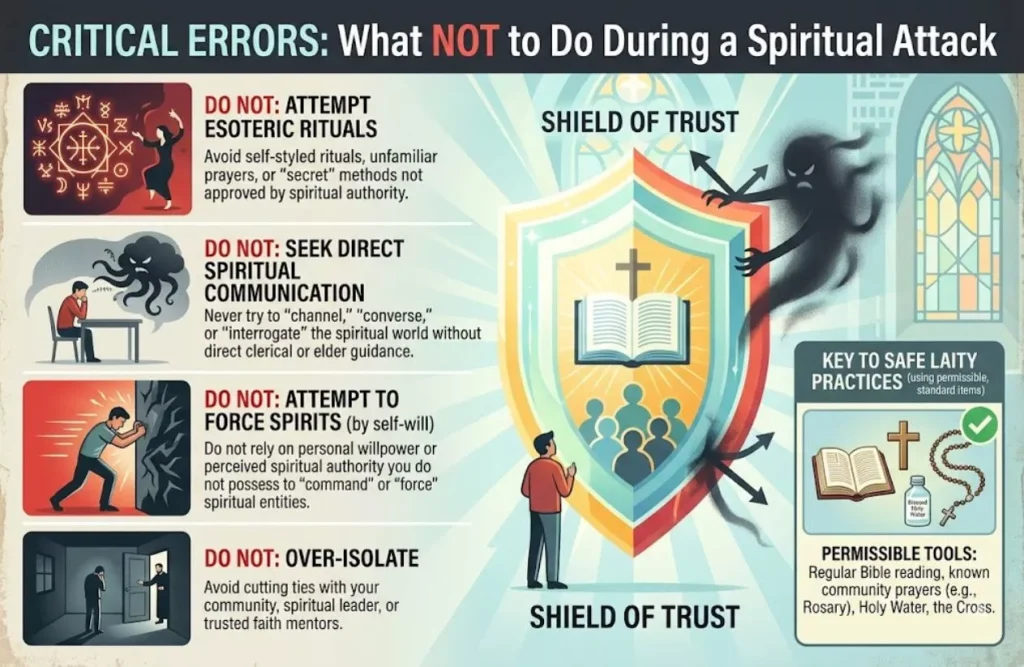
In spiritual warfare, tactical errors are not merely harmless mistakes; they are legal permissions that the enemy exploits.
When a layperson is under spiritual oppression, panic often drives them to seek immediate relief through unauthorized, unsafe, or spiritually illicit means.
To maintain your spiritual protection, you must strictly avoid the three most common pitfalls of preternatural warfare.
The Fatal Illusion of Dialogue: Never Interrogate the Enemy
A common error, popularized by theatrical representations, is trying to speak to, interrogate, or argue with a demonic entity. Laypeople must understand that fallen angels possess a vastly superior, angelic intellect.
They have spent thousands of years observing human nature, psychology, and weakness.
You cannot outsmart, out-argue, or trick a demon.
Any attempt to speak directly to an entity outside of a simple, authoritative imprecatory command of expulsion over your own designated authority—such as asking “Who are you?”, “How did you get in?”, or “Why are you doing this?”—is an act of dangerous engagement.
Engaging in dialogue allows the entity to weave complex intellectual and psychological deceptions. It shifts your focus away from God and onto the manifestation itself, which is exactly what the enemy desires.
Silence is your shield. Your conversation must be directed upward to Christ, never outward to the adversary.
Usurping Priestly Office: The Danger of Unauthorized Liturgies
A grave error among well-meaning laypeople is attempting to recite solemn prayers, exorcism formulas, or liturgical rites reserved strictly for ordained priests.
The most prominent example is the Exorcismus in Satanam et Angelos Apostaticos (popularly known as the Leo XIII Exorcism).
On September 29, 1985, the Congregation for the Doctrine of the Faith (CDF), under Cardinal Joseph Ratzinger, issued a strict instruction (Inde ab aliquot annis) explicitly forbidding laypeople from utilizing this formula.
The Church restricts these prayers because laypeople do not possess the sacramental faculties, apostolic authority, or pastoral delegation granted by Holy Orders. Attempting to use solemn formulas of public exorcism is an act of spiritual presumption and disobedience.
It steps outside the divine hierarchy established by God, leaving the layperson completely unprotected and highly susceptible to severe demonic retaliation.
Stick strictly to approved lay deliverance prayers and deprecatory petitions.
Pagan Cleansing Rituals: How “Clearing” Invites Spiritual Contamination
When plagued by persistent spiritual activity, nightmares, or a sense of localized evil in their homes, many laypeople turn to secular, pagan, or New Age practices for relief.
The most common of these is “smudging” (burning white sage to clear negative energy), utilizing “protective” crystals, or performing occult binding rituals.
From a Christian theological perspective, these practices do not drive away evil; they invite further spiritual contamination.
Sage, crystals, and New Age rituals are built on the pagan premise of manipulating impersonal, cosmic energies.
In reality, there is no such thing as “impersonal spiritual energy”—the spiritual realm is entirely personal, populated by God, His angels, and fallen spirits.
When you perform a pagan cleansing ritual, you are implicitly rejecting the sovereign authority of Jesus Christ and relying on occult methodology.
Demons frequently mock these pagan rituals by temporarily stopping their manifestations, making the homeowner believe the sage “worked,” only to return later with far greater, more oppressive force once a deeper foothold has been established.
Related Article: How to Put On the Full Armor of God
4. The Spiritual Discernment Checklist: Attack vs. Mental Health

The Catholic Church approaches extraordinary preternatural claims with rigorous scientific and theological skepticism.
Before investigating potential demonic activity (whether oppression, obsession, or possession), a thorough differential diagnosis is mandatory.
Catholic priests and diocesan exorcism teams regularly collaborate with licensed psychiatrists, psychologists, and medical doctors to systematically rule out natural causes.
┌────────────────────────────────────────────────────────────────────────┐
│                       DIAGNOSTIC PROTOCOL FLOW                          │
├────────────────────────────────────────────────────────────────────────┤
│ 1. Complete Medical & Psychiatric Evaluation (Rule out natural causes)  │
│                                  │                                     │
│ 2. Spiritual Assessment by Clergy (Check for sacramental state)         │
│                                  │                                     │
│ 3. Evaluate for Rituale Romanum Criteria (Look for preternatural signs)│
└────────────────────────────────────────────────────────────────────────┘
The Rule of Clinical Precedence: Ruling Out Natural Pathologies
Scripture and Church history demonstrate that God operates through order. It is a spiritual error to attribute psychological, neurological, or physical illnesses directly to the demonic.
Attempting to apply deliverance protocols to a medical crisis is spiritually irresponsible and physically dangerous.
The following table provides a diagnostic comparison to help laypeople distinguish between natural clinical conditions and authentic preternatural activity:
| Clinical Condition | Natural Manifestations (Psychiatric/Neurological) | Spiritual/Preternatural Distinctions |
|---|---|---|
| Schizophrenia / Psychosis | Auditory or visual hallucinations that lack theological cohesion; disorganized speech; paranoia; persecutory delusions. | Consistency of theological and intellectual coherence; structured external intelligence with a defined strategy. |
| Sleep Paralysis | Paralyzing sensation upon waking; feeling a generic chest pressure; waking hypnopompic or hypnagogic hallucinations. | Physical bruising, localized claw marks (scratch lines in groups of three), or kinetic movement of objects in the room. |
| Epilepsy / Seizures | Grand mal or focal seizures; involuntary convulsions; postictal confusion; foaming at the mouth. | Inexplicable reactions occurring only in the proximity of blessed sacramentals or sacred Latin prayers. |
| Dissociative Disorders | Altered states of consciousness; amnesia gaps; fragmentation of identity due to trauma (DID). | Immediate, violent aversion to the sacred; access to objective, verified, hidden information (occulta). |
The Four Criteria of the Rituale Romanum
According to the official liturgical instructions of the Roman Catholic Church, genuine demonic activity is identified by specific, observable, objective behaviors that defy natural explanation. The Rituale Romanum identifies four core signs:
- Glossolalia (Speaking in Unknown Tongues): The ability to speak fluently, or understand perfectly, a language that the individual has never studied, heard, or had natural exposure to (such as ancient Latin, Greek, Hebrew, or obscure dialects).
- Occulta (Knowledge of Hidden Things): Demonstrating clear, objective knowledge of secret, distant, or future facts that are naturally impossible for the individual to know (such as the secret sins of those present, or specific actions occurring miles away at that exact moment).
- Vires Supra Vires (Extraordinary Physical Strength): Displaying physical power that is vastly disproportionate to the individual’s age, physical stature, and health condition (such as a frail person requiring multiple strong adults to hold them down).
- Odium Sacri (Violent Aversion to the Sacred): An intense, visceral, and involuntary hostile reaction to anything holy. This includes physical convulsion, screaming, or vomiting when coming into contact with hidden holy water, blessed relics, or silent prayers offered in Latin.
5. Long-Term Fortification: Closing the Spiritual Doorways

While knowing what to do during an active demonic attack provides immediate, tactical relief, the ultimate goal must be long-term spiritual fortification.
In the economy of salvation, defensive tools like sacramentals are merely supplemental; the true, unshakeable armor of the believer is built upon the sacraments of the Catholic Church and a life lived in habitual, sanctifying grace.
If the spiritual doorways that let the enemy in remain wide open, the manifestations will inevitably return.
                  ┌──────────────────────────────┐
                  │  SACRAMENTAL PROTECTION WALL │
                  └──────────────┬───────────────┘
                                 ▼
                     [SACRAMENTAL CONFESSION]
                    (Breaks legal rights/holds)
                                 ▼
                        [STATE OF GRACE]
                   (In-dwelling of Holy Trinity)
                                 ▼
                      [HOLY DAILY EUCHARIST]
                   (Physical union with Christ)
The Absolute Priority of Sacramental Confession
Experienced Catholic exorcists state unanimously that a single, sincere sacramental Confession is spiritually more powerful than one hundred minor exorcisms.
Why? Because an exorcism is a sacramental (a petition of the Church), whereas Confession is a sacrament instituted directly by Christ that instantly wipes away guilt, restores lost sanctifying grace, and completely destroys the legal rights of demonic obsession, oppression, or infestation.
To permanently close spiritual doorways, you must make a thorough examination of conscience and go to the Sacrament of Reconciliation. You must explicitly confess:
- Any and all unconfessed mortal sins.
- Any past involvement in occultism, divination, tarot, astrology, or New Age spiritual practices.
- Any deep-seated resentment, unforgiveness, or hatred you are harboring toward others.
Unconfessed grave sin acts like an anchor in your soul, giving the adversary a legal, theological claim to remain. True absolution by an ordained priest breaks this claim instantly.
Overcoming Habitual Sin and Maintaining a State of Grace
Simply going to Confession once is not enough if you immediately return to the same environments and behaviors that invited the darkness in the first place.
Fighting habitual sin requires a complete restructuring of your daily lifestyle.
A soul in a state of grace—meaning a soul free from unconfessed mortal sin where the Holy Trinity actively dwells—is highly resistant to preternatural harassment. To preserve this shield:
- Avoid the Near Occasion of Sin: Identify the specific people, digital platforms, or environments that trigger your temptations, and cut them out of your life entirely.
- Frequent the Eucharist: Attend Holy Mass weekly (and daily, if possible). Receiving the physical Body and Blood of Jesus Christ in a state of grace builds an internal divine fortress that the enemy cannot penetrate.
- Establish Daily Discipline: A disorganized, lazy prayer life is highly vulnerable to exploitation. Establish concrete, non-negotiable times for morning and evening prayers.
Our Lady’s Weapon: The Daily Rosary
Exorcists repeatedly testify that during solemn rites, demonic entities express intense torment and terror at the invocation of the Blessed Virgin Mary and the recitation of the Rosary.
The Holy Rosary is not a passive, repetitive chant; it is a highly active, biblical meditation on the salvific mysteries of Jesus Christ.
By praying the Rosary daily, you place your mind and home under the direct mantle of Our Lady, who was divinely commissioned from the beginning of time to crush the head of the serpent (Genesis 3:15).
It acts as a powerful, continuous spiritual shield that harmonizes your imagination and intellect with the life of Christ.
Seeking Ecclesial Support: Parish Priests and Diocesan Exorcists
If you have made a good Confession, established a serious prayer life, cleared your home of occult objects, and yet continue to experience persistent preternatural manifestations, you must seek official pastoral care.
- Your Parish Priest: Your first step is to schedule a private meeting with your local parish priest. Be calm, sober, and brief. Explain the spiritual anomalies you are experiencing alongside your clinical efforts to rule out natural medical causes. A local pastor has direct spiritual authority over his parishioners and can provide targeted prayers, bless your home, or suggest spiritual direction.
- The Diocesan Chancery: If your local pastor suspects extraordinary preternatural activity (such as authentic oppression or obsession), he will assist you in contacting the diocesan chancery. Every Catholic diocese has access to an official, bishop-appointed exorcist. Do not seek out unofficial “deliverance ministries” or independent healers online. Always remain within the official apostolic hierarchy of the Church, where Christ’s authority is legally delegated and fully protected.
Related Article: Signs of Demonic Oppression in Everyday Life
Frequently Asked Questions (FAQ)
Can a demon read my thoughts during an active attack?
No. Only God is omniscient and has direct, unmediated access to the human intellect. Demons are finite, created angelic intellects. They cannot read your thoughts; they can only observe your physical reactions and body language to make highly calculated guesses. Consequently, praying silently in your mind is completely secure, private, and spiritually effective.
What is the exact difference between demonic infestation, oppression, obsession, and possession?
Traditional Catholic theology categorizes extraordinary preternatural activity into four levels: infestation is demonic activity tied to a physical location, animal, or object; oppression involves external physical or sensory attacks targeting a person from the outside; obsession consists of hostile, persistent mental assaults targeting the thoughts and imagination without bodily control; and possession is the rarest form, where a demon temporarily takes control of an individual’s motor faculties while their free will and soul remain completely free.
Can a layperson perform an exorcism or cast out a demon?
No. A layperson is strictly forbidden from performing a major (solemn) exorcism, which is restricted to ordained priests acting with explicit episcopal permission. Laypeople may only use deprecatory prayers (petitions asking God to act) or minor imprecatory commands (direct orders in the Name of Jesus) strictly limited to their own body, their minor children, and their owned physical property.
Why does a good Confession have more power than a minor exorcism?
Confession is a Sacrament directly instituted by Jesus Christ that confers sanctifying grace, restores the soul’s union with God, and legally strips the devil of any rights or structural footholds gained through unconfessed mortal sin. An exorcism is merely a sacramental (a protective petition instituted by the Church). Exorcists state that one sincere Confession is spiritually more powerful and permanent than a hundred exorcisms.
Is “smudging” with sage a safe way to clear a house of evil spirits?
No. Sage and smudging are pagan and New Age rituals built on the false premise of manipulating neutral, impersonal spiritual energies. Because the spiritual realm is entirely personal (populated only by God, His angels, and fallen spirits), relying on pagan methods is an act of superstition that invites deeper spiritual contamination. Use holy water and Catholic blessings instead.
Related Article: The Saint Benedict Medal: The History and Meaning Behind the Exorcism Medal