The Saint Benedict Medal: The History and Meaning Behind the Exorcism Medal

Walk into any Catholic home, parish, or school, and you will likely spot a Saint Benedict medal. Catholics wear it on chains, attach it to rosaries, and hang it above doorways. Yet, despite its immense popularity, many who carry this powerful sacramental do not actually know the prayers and meanings behind the mysterious Latin letters inscribed on its surface. To the untrained eye, it looks like a complex, cryptic puzzle.
If you have ever wondered about the actual saint benedict medal meaning, you are not alone. It is far more than a simple piece of religious jewelry.
To answer what does the saint benedict medal mean clearly: at its core, this medal is an official sacramental of the Catholic Church that functions as a silent, continuous prayer of protection and exorcism. Its spiritual efficacy does not come from the metal itself—as if it were a pagan amulet or good luck charm—but from the victory of Jesus Christ on the Cross, the intercession of Saint Benedict, and the official blessing of the Church.
It is a physical shield designed for spiritual warfare, carrying ancient prayers to drive away demonic influence, resist temptation, and invite divine peace.
TL;DR;
🛑 Quick Summary: What Does the Saint Benedict Medal Mean?
The Saint Benedict Medal is an official Catholic sacramental used for spiritual warfare, deliverance, and protection against evil. It is not a magic charm; its power comes from the merits of Jesus Christ on the Cross, the intercession of Saint Benedict, and the blessing of the Church.
- The Front: Features Saint Benedict holding the Cross and his Holy Rule, alongside symbols of his miraculous protection (the shattered poisoned cup and the raven).
- The Back: Features a prominent Cross inscribed with Latin initials that form powerful prayers of protection (“May the Holy Cross be my light”) and direct commands of exorcism against Satan (“Begone, Satan! Never tempt me with your vanities!”).
Table of Contents
Who Was Saint Benedict, and Why Is There a Medal Named After Him?
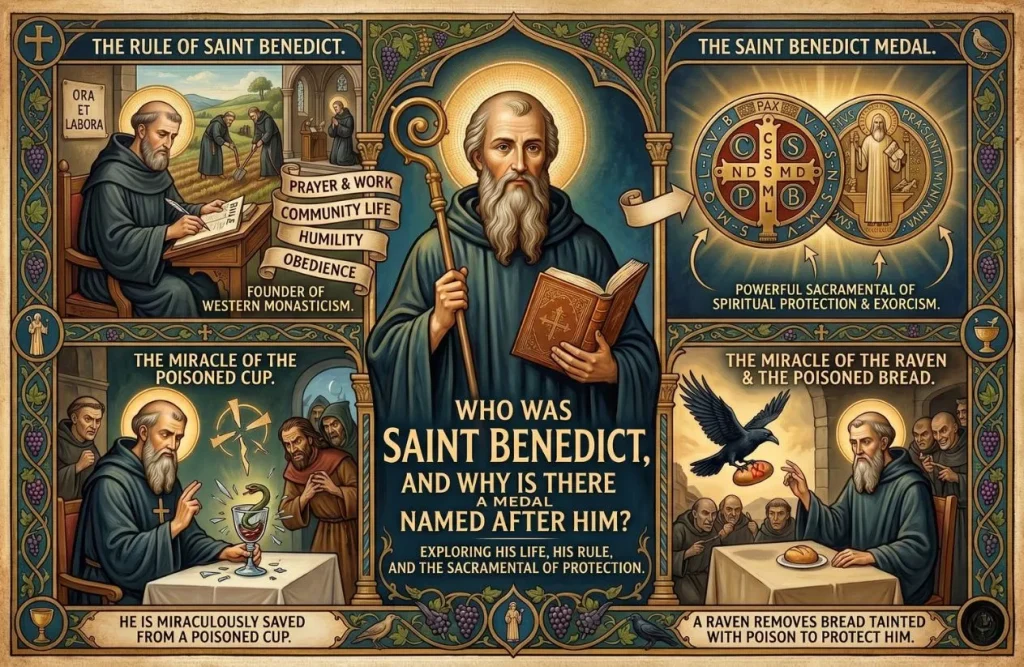
To understand the saint benedict medal meaning, we must first look at the man behind it. Born in Nursia, Italy, around 480 AD, Saint Benedict began his adult life seeking solitude.
Fleeing the moral decay of Rome, he lived as a hermit in a cave in Subiaco, dedicating himself entirely to prayer and penance.
His profound holiness eventually attracted disciples, prompting him to establish twelve monasteries, including the famous Monte Cassino. He penned the Rule of Saint Benedict, a masterpiece of spiritual moderation and monastic life, earning him the title “Father of Western Monasticism.”
The power associated with his medal stems directly from Benedict’s intense life of spiritual warfare. Saint Gregory the Great documented these spiritual battles in his Dialogues, highlighting two specific miracles of protection that are immortalized on the medal’s design:
The Miracle of the Poisoned Cup
Early in his monastic journey, a group of unruly monks grew resentful of Benedict’s strict discipline and holy standards. Desperate to rid themselves of his leadership, they plotted to assassinate their abbot by placing poison in his wine glass.
Following monastic custom before meals, Benedict raised his hand and made the Sign of the Cross to bless the cup. The moment his hand formed the holy gesture, the glass shattered instantly as if struck by a stone, spilling the lethal draft.
Benedict calmly forgave the monks, recognizing the demonic attack behind their malice.
The Miracle of the Raven and the Poisoned Bread
In another attempt on his life, a jealous priest named Florentius sent Benedict a gift of poisoned bread. Through divine grace, Benedict immediately sensed the corruption. A wild raven, which Benedict fed daily at meal times, swooped into the monastery garden.
Benedict commanded the bird, “In the name of Jesus Christ our Lord, take up that loaf, and leave it in some such place where no one may find it.” The raven obeyed, carrying the deadly loaf far into the wilderness where it could harm no one, before returning for its regular blessing.
These historical events are not mere legends; they are testimonies of the authority of the Cross over physical and spiritual poison. The symbols on the modern medal—the chalice, the serpent, and the raven—directly correspond to these miraculous moments.
The Front of the Medal: Standing Strong Against Evil
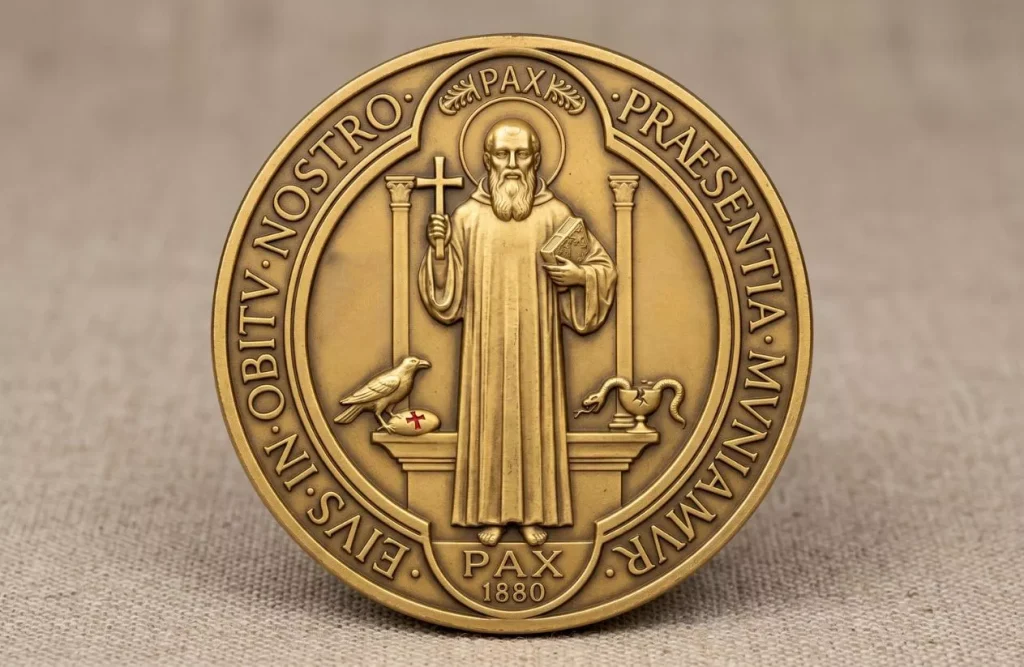
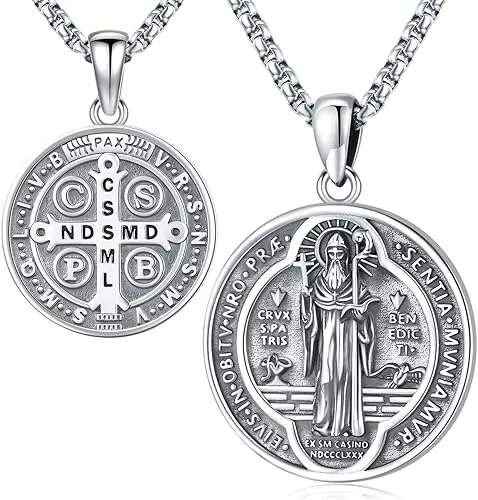
The front side of the medal features a detailed, highly symbolic depiction of the saint himself. When exploring the deeper meaning of saint benedict medal designs—specifically the famous Jubilee Medal minted in 1880 to mark the 1,400th anniversary of the saint’s birth—we find several layered elements that emphasize spiritual protection and final victory over evil.
At the very center of the design stands Saint Benedict. In his right hand, he holds the supreme instrument of Christian salvation: the Holy Cross.
In his left hand, he holds his Holy Rule, the spiritual guide that formed the foundation of Western monasticism and points the believer toward a life of disciplined holiness.
Symbols of Miraculous Deliverance
Flanking Saint Benedict on either side are visual testaments to the historical attempts on his life, underscoring God’s power to deliver His servants:
- The Shattered Chalice: Located at the saint’s right (the viewer’s left), a serpent or viper slithers out of a cracked cup. This illustrates the moment the poisoned wine glass shattered when he signed it with the Cross.
- The Raven with Bread: Located at his left (the viewer’s right), a raven stands with outspread wings, frozen in the moment of picking up the poisoned loaf of bread to dispose of it safely.
Just above these elements, the Latin phrase Crux Sancti Patris Benedicti (often abbreviated as C S P B or spelled out) stands as a declaration: “The Cross of our Holy Father Benedict.”
The Call for Spiritual Strength at Death
Encircling the entire outer edge of the front side is a profound Latin petition that defines a crucial aspect of the medal of saint benedict meaning:
Eius in obitu nostro praesentia muniamur
This translates to: “May we be strengthened by his presence in the hour of our death.”
Historically, Catholics have turned to Saint Benedict as the patron of a happy death. This patronage is rooted in how he passed away—standing in the chapel of Monte Cassino before the altar, supported by his brothers, with his hands raised to heaven in prayer after receiving the Holy Eucharist.
This prayer on the medal acknowledges that our final hours on earth are often when we experience the most intense spiritual warfare, pleading for angelic and saintly defense as we transition to eternity.
The Back of the Medal: Unlocking the Saint Benedict Medal Letters’ Meaning
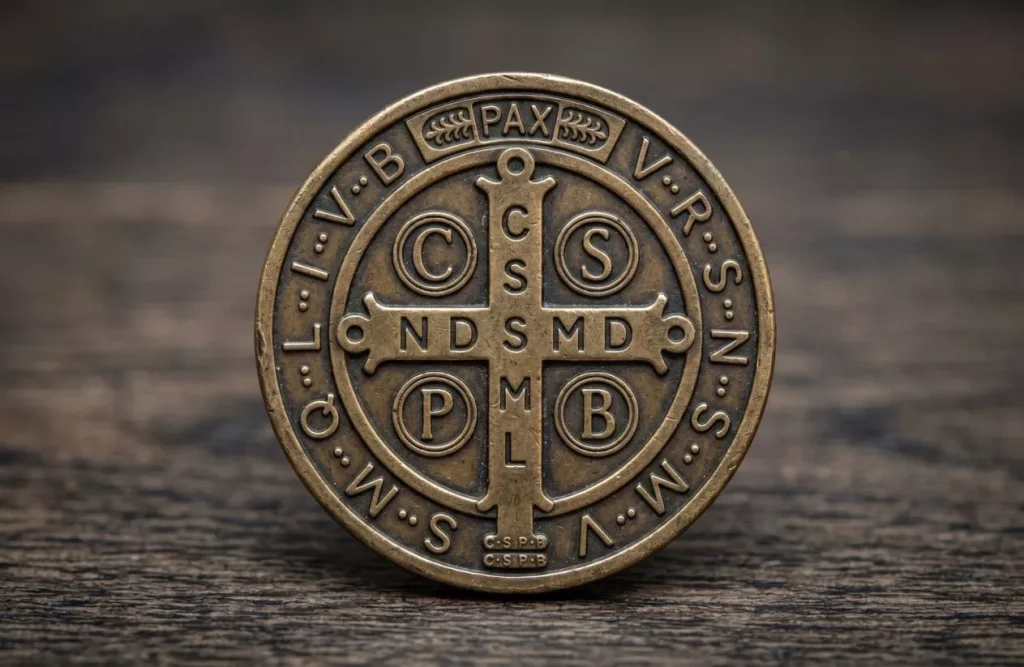
While the front of the medal visualizes the historical miracles of the saint, the reverse side contains the actual formulas of spiritual warfare.
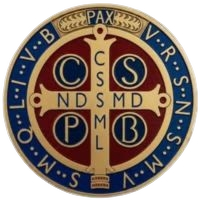
To understand the saint benedict medal letters meaning, we must examine the initials stamped into the metal. The back of the medal is dominated by a large cross surrounded by a series of Latin acronyms that form a potent exorcism prayer.
The Cross at the Center
The central cross contains two intersecting Latin phrases that outline the Christian’s ultimate allegiance and standard of defense. Understanding these vertical and horizontal inscriptions reveals the foundational Saint Benedict cross medal:
- Vertical Beam (C S S M L): These letters stand for Crux Sacra Sit Mihi Lux, which translates to: “May the Holy Cross be my light.”
- Horizontal Beam (N D S M D): These letters stand for Non Draco Sit Mihi Dux, which translates to: “Let not the dragon be my guide” (or “May the dragon never be my leader”).
Together, these two lines establish a boundary of spiritual allegiance: the believer rejects the path of darkness (the dragon) and walks strictly under the light of Jesus Christ on the Cross.
The Four Corners Around the Cross
In the four angles surrounding the arms of the central cross, you will see four letters:
- C S P B: These stand for Crux Sancti Patris Benedicti, which translates to: “The Cross of Holy Father Benedict.”
This confirms that the prayers bound to the medal are offered through the direct spiritual lineage and patronage of Benedict.
The Outer Rim: The Exorcism Prayers
The letters wrapped around the outer margin of the medal are the ones that mystify most people. These letters are the initials of a direct, traditional Catholic prayer of exorcism. When studying the meaning saint benedict medal designs convey, this outer rim represents an active, authoritative rejection of demonic temptation:
- V R S N S M V: These initials stand for Vade Retro Satana! Numquam Suade Mihi Vana!, which translates to: “Begone, Satan! Never tempt me with your vanities!” (or “Get back, Satan! Do not suggest your empty things to me!”). This mirrors the command Christ gave in the wilderness: Vade retro, Satana (Matthew 4:10).
- S M Q L I V B: These initials stand for Sunt Mala Quae Libas. Ipse Venena Bibas!, which translates to: “What you offer me is evil. Drink the poison yourself!” This refers back to the poisoned cup and bread, serving as a prayer that the spiritual poison of temptation recoil onto the tempter rather than infect the Christian soul.
The Word at the Top: PAX
At the very top of the medal, resting above the cross, is the word PAX, which simply means “Peace.”
This is the historic motto of the Benedictine Order. It serves as a reminder that the ultimate goal of spiritual warfare is not conflict, but the true peace of Christ that reigns in a soul preserved from sin and demonic division.
Fun Fact: The front of the medal is actually the back side, and the back, where the exorcism and deliverance prayer is the actual front side of the St benedict medal.
Is the St. Benedict Medal a Magic Amulet? (The Catholic Perspective)
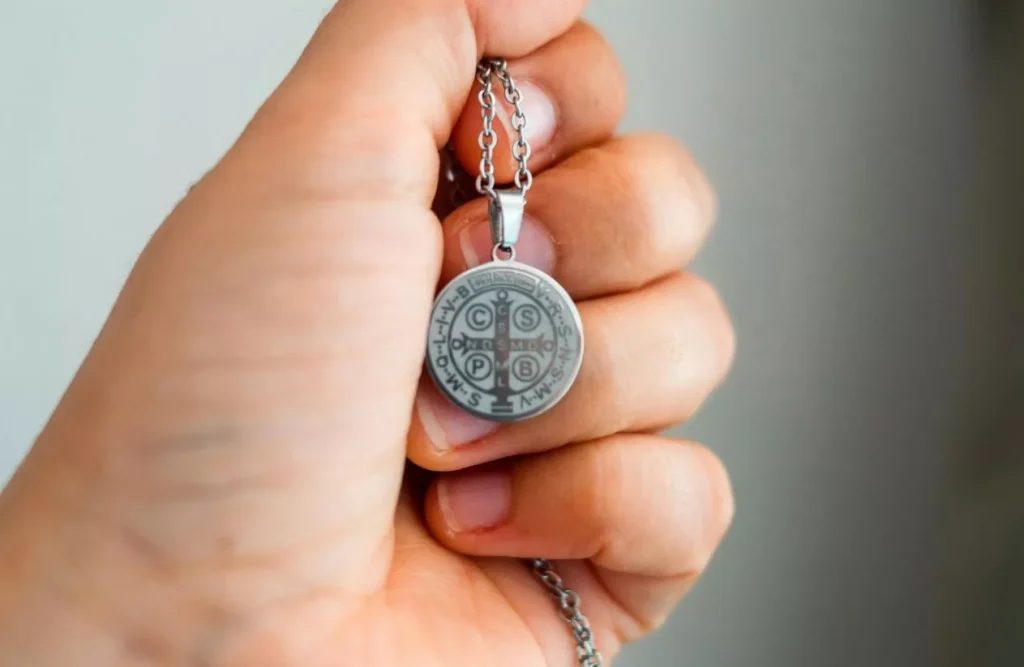
One of the most critical aspects of the meaning of Saint Benedict medal devotion is understanding the difference between Christian faith and pagan superstition.
To those unfamiliar with Catholic theology, wearing a medal covered in ancient acronyms to ward off evil might look like using a magic talisman or a good luck charm. However, the Church rejects all forms of magic and superstition.
The Catechism of the Catholic Church explains that attributing a quasi-magical power to a physical object—as if the metal itself possessed intrinsic energy to protect you—is a violation of the First Commandment.
The Reality of Sacramentals
The Saint Benedict medal is not an amulet; it is a sacramental.
Unlike the Sacraments (such as Baptism or the Eucharist), which were instituted by Christ Himself and directly confer sanctifying grace, sacramentals are holy signs instituted by the Church. They do not contain grace in themselves. Instead, they prepare our hearts to receive grace and cooperate with it.
When you wear a Saint Benedict medal, its power depends entirely on:
- The Mercy of Jesus Christ: The infinite merits of Christ’s sacrifice on the Cross.
- The Intercession of Saint Benedict: The prayers of the saint in heaven on behalf of those who invoke his help.
- The Faith of the Wearer: Your personal disposition, prayerful focus, and trust in God’s providence.
- The Blessing of the Church: The spiritual authority granted by Christ to His Church to bless and consecrate physical objects for spiritual warfare.
By carrying the medal, you are not carrying a magic shield; you are wearing a physical, continuous petition to God, declaring your choice to live under the protection of the Cross and reject the traps of the devil.
The Traditional Latin Exorcism Blessing
What makes the Saint Benedict medal uniquely potent is the specific, solemn blessing historically reserved for it. While any priest can bless a standard religious object with a general prayer, the Rituale Romanum (the traditional Roman Ritual) contains a designated blessing specifically for the medals of Saint Benedict.
This blessing is not a simple prayer of dedication; it is an active, solemn exorcism. When a priest blesses the medal using this traditional ritual, he commands the demonic forces to flee from the physical object and from anyone who wears or uses it.
The prayer includes this authoritative command:
Exorcizo vos, numismata…
“I exorcise you, medals, by God the Father almighty, who made heaven and earth, the seas, and all that is in them. May all the power of the adversary, the entire army of the devil, and every assault and illusion of Satan be rooted out and driven away from these medals…”
When you wear a medal that has received this specific blessing, you are literally carrying a physical extension of the Church’s exorcistic power. It is a constant, tangible warning to the powers of darkness that you belong to Jesus Christ, and that the ground you stand on is protected by His Holy Cross.
How to Use the Medal for Spiritual Warfare and Deliverance
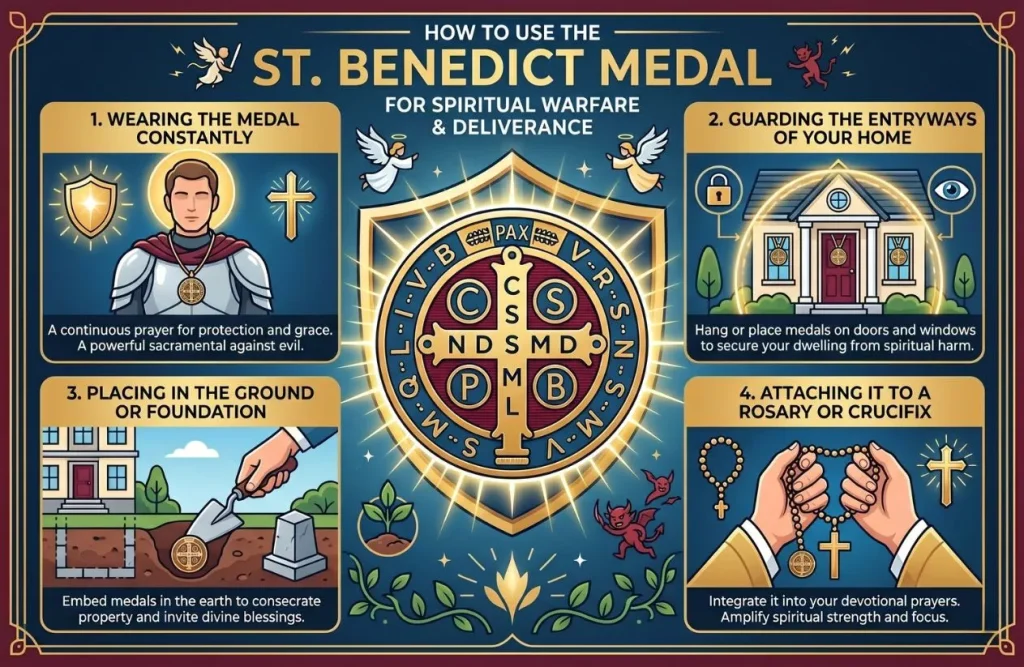
Understanding the theology behind the medal is only the first step. To benefit from this sacramental, you must integrate it practically into your daily life and spiritual battles.
Because dark spiritual forces constantly seek entry points into our families, homes, and minds, the Church encourages the active, prayerful use of sacramentals to establish physical boundaries against evil.
Here are the primary ways Catholics traditionally employ the Saint Benedict medal for spiritual defense and deliverance:
1. Wearing the Medal Constantly
The most common practice is to wear the medal around your neck as a Saint Benedict medal pendant. By keeping it close, you carry a continuous, silent prayer of exorcism throughout your day.
It serves as a spiritual shield against unexpected temptations, mental attacks, and sudden spiritual oppression. You can also carry it in your pocket, inside a wallet, or attach it directly to your car key ring.
2. Guarding the Entryways of Your Home
Your home is meant to be a domestic church—a sanctuary of peace and holy order. To block demonic disruption, many Catholics mount or hang blessed Saint Benedict medals over doorframes, particularly the front and back entryways.
You can also place them on windowsills or attach them securely to doors.
This acts as a prayerful declaration that your home belongs to Christ and that no spirit of division, anger, or spiritual darkness is welcome across your threshold.
3. Placing the Medal in the Ground or Foundation
A time-honored traditional practice is to place or bury Saint Benedict medals in the foundations of new buildings, homes, or additions during construction. If you are dealing with severe spiritual disturbances on your property or neighborhood, you can also bury blessed medals in the four corners of your land.
This dedicates the very ground you live on to God’s protection, asking Saint Benedict to guard your household from underneath.
4. Attaching it to a Rosary or Crucifix
Many traditional Catholic rosaries feature a Saint Benedict medal in place of the center medal or attached directly to the primary crucifix.
By pairing the Saint Benedict medal with the Holy Rosary, you combine two of the most powerful spiritual weapons in the Church’s treasury, invoking both the Blessed Virgin Mary and Saint Benedict to assist you in spiritual battle.
Note: There is also a holy rosary that already has a St. Benedict medal on it. It is also a good options.
Choosing an Authentic, High-Quality Medal
When incorporating this sacramental into your life, the quality of the medal matters. Because sacramentals are meant to be blessed, consecrated, and carried for years, it is wise to avoid cheap, easily breakable metals or mass-produced plastic variants.
A solid, beautifully crafted medal made from high-quality bronze, silver, or heavy-duty stainless steel is a durable heirloom of faith and a worthy vessel for a priest’s solemn exorcism blessing.
If you are looking to purchase an authentic, deeply engraved Saint Benedict medal for yourself or your family, I have found a St. Benedict on Amazon of the highest quality, traditionally crafted medals. These designs are made to withstand daily wear while preserving the sharp, legible Latin inscriptions that make this sacramental so powerful. You can check it for yourself.
The Shield of Faith: A Final Reflection
Understanding the saint benedict medal meaning transforms it from an ordinary piece of religious metalwork into an active shield of continuous prayer. It is not an amulet or a decoration; it is a profound declaration of spiritual warfare.
When you understand the Latin letters stamped onto its surface, the medal ceases to be a mystery and becomes a visual voice.
The initials remind us of the great spiritual legacy of Saint Benedict: to always seek the light of the Cross, to guard our homes and hearts against the subtle poison of temptation, and to confidently command the enemy to get back in the name of Jesus Christ.
By keeping this sacramental close, wearing it in faith, and securing your home with its blessed presence, you stand in the ancient, unbroken tradition of Catholic spiritual defense—declaring that you belong to God alone.
Frequently Asked Questions (FAQs)
What does the Saint Benedict Medal protect you from?
The Saint Benedict Medal is used as a sacramental protection against spiritual and physical dangers. Specifically, it is invoked to ward off demonic oppression, temptations, and witchcraft, as well as to protect against physical poisons, contagious diseases, storms, and lightning. Its efficacy relies on the intercession of Saint Benedict and the user’s faith in Christ.
How do I get my Saint Benedict Medal blessed?
To unlock the full spiritual protection of this sacramental, take it to a Catholic priest or deacon for a blessing. While any standard blessing is holy, you can specifically request the traditional Latin exorcism blessing from the Rituale Romanum (Benedictio Numismatum Sancti Benedicti), which actively commands evil spirits to stay away from the physical medal and anyone who carries it.
Can I pray the Saint Benedict Medal prayers in English?
Yes, you can absolutely pray the prayers in English. While the Latin inscriptions (Vade Retro Satana…) are traditionally honored and carry the historic weight of the Church’s liturgy, God hears the sincere prayers of your heart in any language. The English translation of the outer rim is: “Begone, Satan! Never tempt me with your vanities! What you offer me is evil. Drink the poison yourself!”
Which side of the St. Benedict Medal should face outward?
There is no strict rule regarding which side of the medal must face outward when worn. However, because the side featuring the Cross and the exorcism initials contains the active prayer of spiritual warfare, many Catholics prefer to keep that side facing outward as a bold, visible shield against spiritual adversaries.
Can you use a Saint Benedict Medal to protect your home or property?
Yes. Catholics traditionally use blessed Saint Benedict Medals to establish a spiritual boundary of protection around their homes and properties. This is done by hanging them over main doorframes, placing them on windowsills, or burying them in the four corners of their land. This practice prayerfully petitions God, through the intercession of Saint Benedict, to keep spiritual disturbances, division, and physical dangers away from the household.
Related Article: What to Do During an Active Demonic Attack: A Layperson’s Guide