Demonic Oppression in Sleep: Catholic Discernment, Symptoms, and Remedies
Quick Summary: Catholic theology distinguishes natural sleep disorders from preternatural attacks by evaluating spiritual markers alongside physical symptoms. While neurology explains conditions like sleep paralysis through REM state disruptions, demonic oppression in sleep catholic discernment examines extraordinary phenomena—such as acute aversion to sacred objects upon waking, unexplained physical marks, or intense localized disturbances—to identify authentic diabolical interference during vulnerable sleep states.
Sleep leaves the human body paralyzed and the conscious mind defenseless, creating a unique window of physical passivity. While God designed sleep for bodily restoration and mental peace, the enemy frequently targets these quiet hours to instill acute fear, despair, and spiritual confusion.
Because human imagination and sensory memory remain active while conscious guardrails drop, fallen entities exploit this natural vulnerability to launch targeted attacks against the soul. However, jumping to supernatural conclusions without proper investigation risks severe spiritual and psychological harm.
Navigating these terrifying nighttime encounters requires a grounded, rational approach—one that carefully balances neurological science with traditional Catholic demonology to discern genuine spiritual warfare from standard medical conditions.
Table of Contents
Neurological Sleep Paralysis vs. Demonic Oppression: A Catholic Discernment Framework
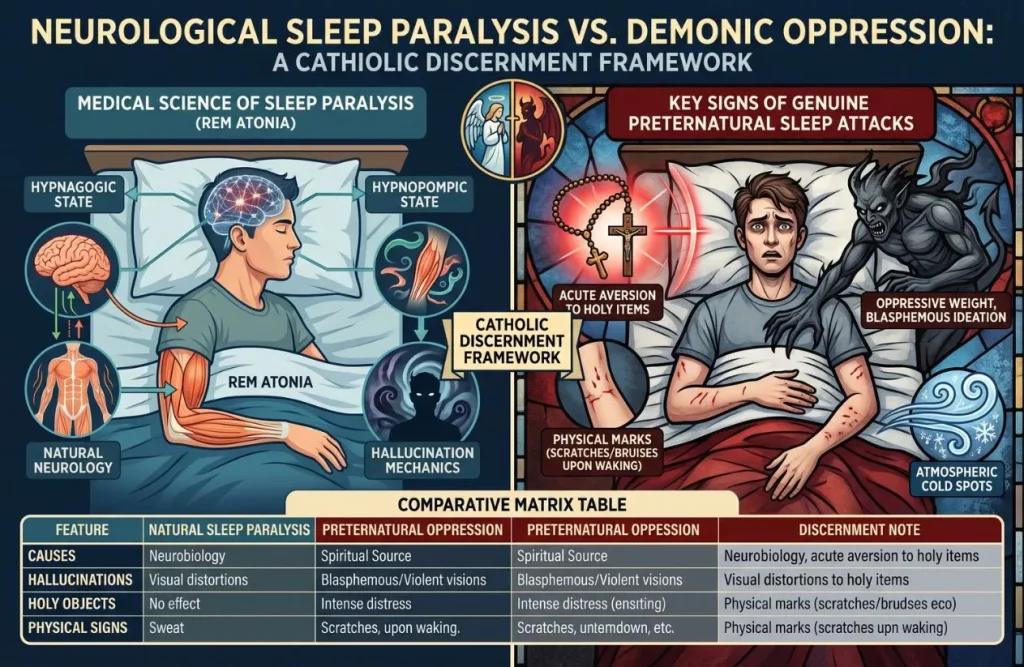
Distinguishing between a natural neurological event and an extraordinary spiritual attack requires careful theological discernment. The Catholic Church always insists on evaluating natural, medical factors alongside preternatural signs.
When terror strikes in the middle of the night, jumping straight to severe demonic conclusions can induce unnecessary panic, while dismissing a subtle spiritual attack as mere stress leaves the soul without adequate spiritual protection.
Understanding Medical Sleep Paralysis (REM Atonia)
From a neurological standpoint, many terrifying wake-up experiences stem from a temporary glitch in the body’s sleep architecture known as sleep paralysis. During Rapid Eye Movement (REM) sleep, the brain actively dreams while shutting off motor neuron function—a natural mechanism called REM atonia that prevents you from physically acting out dreams.
Sleep paralysis occurs when the conscious mind awakens before REM atonia wears off. A person finds themselves fully aware of their surroundings but unable to move or speak. This temporary mismatch triggers an immediate surge of adrenaline, activating the brain’s threat-detection systems and often producing vivid sensory hallucinations, such as feeling a heavy pressure on the chest or sensing a shadowy presence in the room.
Key Signs of Spiritual Oppression During Sleep
Unlike full diabolical possession—where an evil spirit takes temporary control of a person’s body and causes extreme aversion to holy objects—demonic oppression acts externally upon the individual.
It targets the senses, emotions, and physical surroundings without indwelling the soul. In sleep paralysis vs. demonic oppression, exorcists look for subtle yet distinct hallmarks of external harassment during sleep:
- Targeted Blasphemous or Despairing Ideation: Unlike random nightmare imagery, oppressive attacks during sleep often leave behind an acute, uncharacteristic flood of despair, intense dread, or intrusive thoughts directed against God that linger long after waking and cut through normal moral character.
- Unexplained Physical Marks: While medical sleep paralysis cannot produce physical marks on the skin, external oppression can leave unexplained scratches, welts, or red lines discovered immediately upon waking.
- Environmental Disturbances: Nighttime oppression may involve subtle physical phenomena in the sleeping area, such as unexplained cold spots immediately around the bed, foul sulfurous or rotting odors that vanish quickly, or knocking sounds that coincide with the sleep disturbance.
- Inability to Invoke Sacred Names: While a person under oppression does not typically exhibit the severe physical revulsion to sacramentals seen in possession, they may experience a sudden spiritual paralysis—a distinct inability to mentally or vocally invoke the Holy Name of Jesus or pray the Hail Mary during the height of the attack.
Comparative Matrix Table
| Feature | Natural Sleep Paralysis | Demonic Oppression in Sleep |
| Nature of Phenomenon | Neurological mismatch; brain awakens while muscles remain paralyzed in REM state. | External preternatural harassment targeting senses, emotions, or sleeping environment. |
| Physical Aftereffects | Temporary fatigue or anxiety; no physical damage or lingering environmental effects. | Lingering spiritual heaviness; occasional unexplained scratches or marks upon waking. |
| Atmospheric Signs | Strictly internal and subjective sensory hallucinations. | Occasional external cues: sudden localized cold spots, fleeting foul odors, or room noises. |
| Spiritual Impact | Resolves as the body regains movement; no lasting aversion or targeted despair. | Leaves an intense, lingering sense of spiritual oppression, severe dread, or intrusive temptation. |
Why the Enemy Attacks During Sleep: Theological and Psychological Foundations
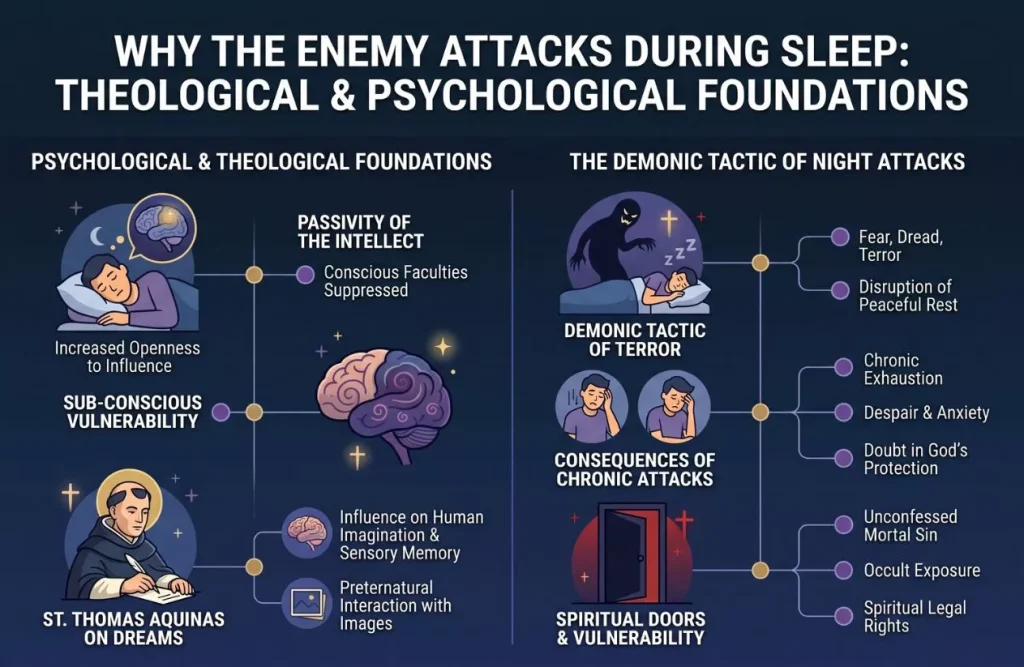
Nighttime spiritual harassment is rarely a random occurrence. The timing of these attacks reveals a calculated strategy aimed at exploiting human nature when physical defenses and rational controls are at their lowest point.
The Mechanism of Attack: St. Thomas Aquinas on the Imagination
To understand how fallen spirits influence human sleep, Catholic theology turns to the insights of St. Thomas Aquinas. In the Summa Theologiae (I, q. 111, a. 3), Aquinas explains that while demons cannot directly read or alter a person’s intellect or free will, they do possess the natural ability to act upon bodily humors, internal senses, and sensory memory.
During waking hours, a person’s active intellect, critical reasoning, and external senses filter incoming impressions.
However, during sleep, conscious guardrails are suppressed. Aquinas noted that preternatural entities can manipulate stored sensory images (phantasms) retained in the human memory.
By stimulating these internal mental images and bodily fluids, an evil spirit can weave intense, terrifying, or blasphemous imagery directly into the sleeping person’s imagination, creating distressing dreams or sudden nighttime awakenings that feel overwhelmingly real.
+-----------------------------------------------------------------------+
|                       Waking vs. Sleeping State                       |
+-----------------------------------------------------------------------+
| Waking State:   Active Intellect + External Senses --> Natural Filter |
| Sleeping State: Passive Intellect + Sensory Memory --> Open Channel   |
+-----------------------------------------------------------------------+
The Strategic Goal: Exhaustion, Fear, and Spiritual Doubt
Demonic strategy relies heavily on erosion rather than immediate destruction. By targeting a person during rest, the enemy seeks to achieve specific psychological and spiritual objectives:
- Fostering Chronic Fatigue: Continuous sleep disruption weakens psychological resilience, clouding judgment and making a person far more susceptible to daytime temptation, irritability, and despair.
- Instilling Dread of the Night: By turning the bed—a place designed for natural restoration—into a site of terror, the enemy induces severe anticipatory anxiety, leading the victim to dread going to sleep.
- Undermining Trust in God: Repeated nighttime spiritual attacks can lead to a quiet, insidious doubt regarding God’s protective providence, tempting the soul to feel abandoned or spiritually helpless.
Contributing Factors: Legal Rights and Open Spiritual Doors
While some spiritual attacks occur by divine permission to test or purify a soul, heightened vulnerability during sleep often traces back to unclosed spiritual doors.
Preternatural entities exploit existing spiritual legal rights to gain easier access to an individual’s subconscious state. Unconfessed mortal sin creates a break from sanctifying grace, weakening the soul’s natural spiritual shield.
Similarly, past or present exposure to occult rituals, New Age practices, divination, or habitual sins of impurity grants the enemy an entry point. These lingering spiritual ties function as standing invitations, allowing fallen spirits to disturb a person’s sleep with greater frequency and intensity.
Exorcists do acknowledge that demons torment people with sexual or physical nocturnal harassment. Where the distinction lies is in how theologians and exorcists define those terms:
- Medieval & Pagan Folklore: Historical folklore treated the incubus and succubus as distinct biological species or supernatural race of creatures that could physically reproduce and father hybrid children (cambions) with human beings.
- Catholic Theology & Exorcist Practice: Catholic demonology teaches that demons are purely spiritual beings with no physical body or biological sex. Exorcists (such as Fr. Chad Ripperger and Fr. Gabriel Amorth) explain that incubus and succubus are not separate species of demons, but rather standard fallen angels using specific tactics of sexual or physical harassment during sleep.
The draft can be adjusted to retain the mention of incubus/succubus phenomena without framing it as mere “folklore myth,” making sure it aligns with how exorcists evaluate these real demonic attacks.
Here is the refined section:
Types of Nighttime Spiritual Disturbances Recognized by Catholic Exorcists
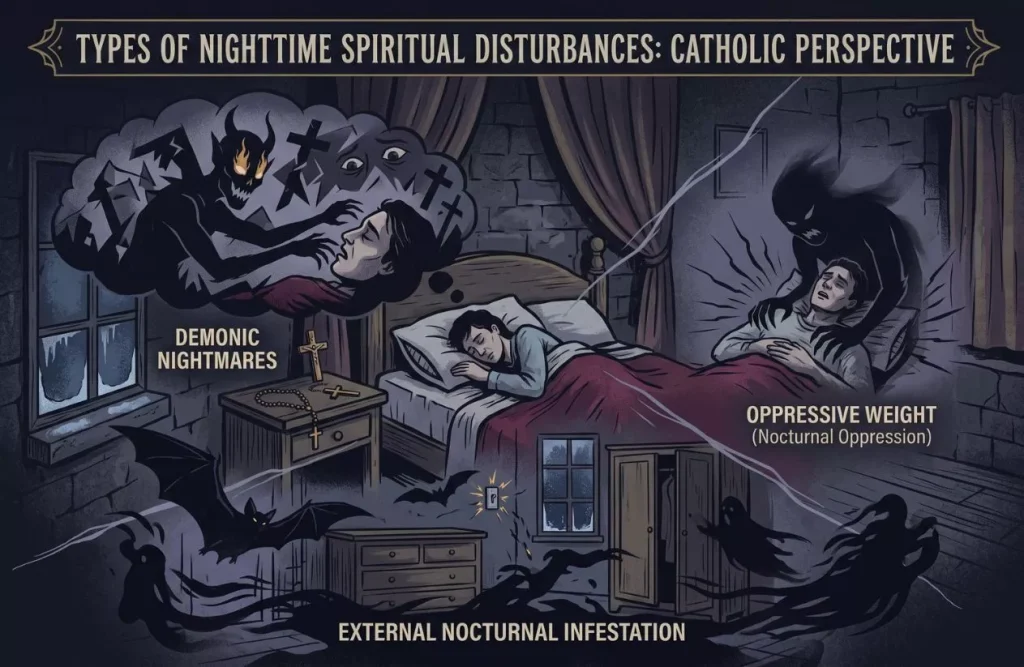
Experienced Catholic exorcists categorize extraordinary preternatural activity based on how and where the influence manifests. During the night, these disturbances range from internal psychological attacks working through the imagination to external physical phenomena that disrupt the sleeping environment.
Demonic Nightmares and Intrusive Terror
Not every frightening dream has a spiritual cause. Ordinary nightmares typically reflect psychological stress, unresolved trauma, physical illness, or subconscious processing.
These natural dreams tend to be chaotic, fragmented, and dissipate quickly as the waking mind regains clarity.
In contrast, demonic oppression in sleep catholic exorcists encounter presents distinct spiritual signatures within dreams:
- Coherence and Targeted Malice: Demonic nightmares carry an intense, unnatural clarity and focus. They rarely feature typical dream absurdity, presenting instead a structured narrative designed to induce despair, terror, or severe spiritual anxiety.
- Blasphemous and Anti-Sacred Content: The dream imagery often directly mocks holy things, depicting sacrilegious acts, demonic figures, or intense hatred toward Christ, the Blessed Virgin Mary, or the Sacraments.
- Lingering Spiritual Oppression: While a natural nightmare fades upon waking, a preternatural dream leaves behind a heavy, suffocating spiritual residue—an uncharacteristic sense of dread, severe isolation, or aversion to prayer that persists throughout the day.
Physical Oppression and Nocturnal Sensations
One of the most distressing forms of nighttime spiritual attacks catholic believers report to exorcists involves physical or sexual harassment during sleep transitions—traditionally referred to in demonology as incubus (male-form) or succubus (female-form) attacks.
While popular folklore historically mistook these for distinct biological species capable of physical reproduction, Catholic exorcists clarify the underlying theological reality: demons are pure spirits without physical bodies or sex, but they can manipulate sensory perception and physical matter to launch physical or sexual attacks.
During these episodes, an individual awakens to an overwhelming physical weight pressing down on their chest, throat, or limbs, accompanied by:
- Suffocation or Choking: An intense inability to draw air, feeling as though an unseen physical presence is actively smothering them.
- Forced Speech Impediment: A profound, targeted paralysis of the vocal cords that specifically prevents the victim from speaking, crying out, or vocalizing prayers.
- Inability to Invoke Sacred Names: The person often finds their mind blocked when trying to form the Holy Name of Jesus, needing intense interior effort to break through the spiritual constriction and call upon divine aid.
External Nocturnal Infestation
While oppression acts directly upon a person’s body, mind, or senses, nocturnal infestation targets the surrounding physical environment—specifically the bedroom or sleeping space. Catholic exorcists note that this form of disturbance aims to rob the home of peace and induce chronic sleep deprivation.
Common environmental signs of nocturnal infestation during sleep hours include:
- Auditory Disturbances: Unexplained physical noises occurring repeatedly at night, such as heavy footsteps, wall knocks, scratching sounds inside walls or ceilings, or the sound of heavy objects dropping without any physical source.
- Atmospheric and Thermal Shifts: Sudden, unnatural drops in temperature isolated strictly to the bed or bedroom area, often accompanied by unpleasant, metallic, or sulfurous odors that manifest and disappear suddenly.
- Visual and Electrical Interference: Shadowy figures moving across the room that do not align with outside light sources, alongside unexplained electrical malfunctions, such as lights flickering, alarms triggering, or devices turning on independently during the night.
How to Close Nighttime Spiritual Open Doors
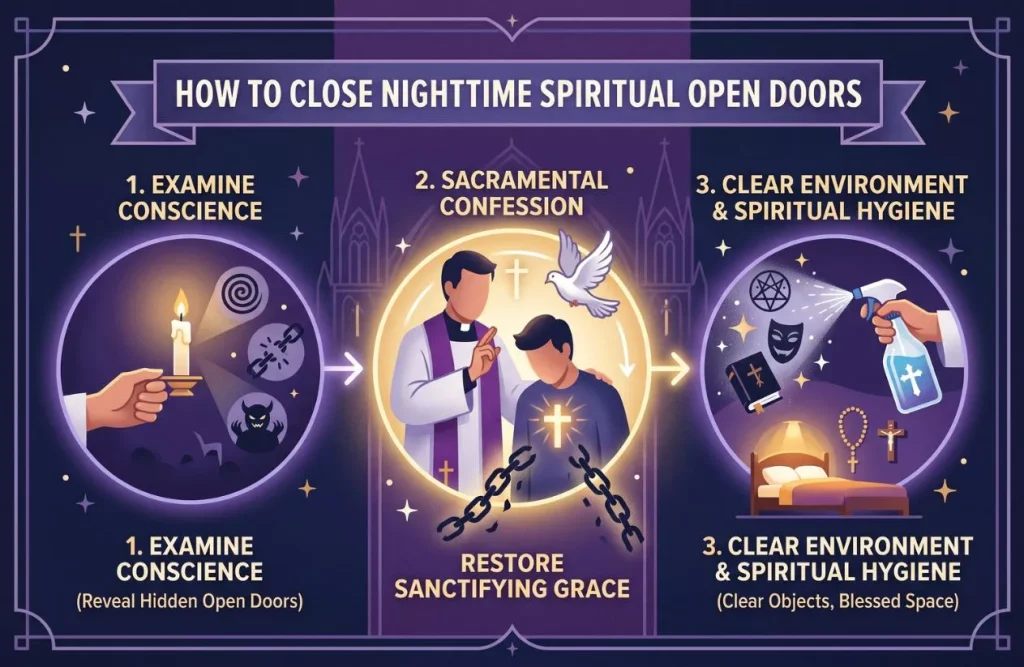
Ending persistent spiritual oppression during sleep requires removing the underlying spiritual legal rights that allow fallen entities access. Demons do not operate arbitrarily; they exploit unconfessed sin, occult exposure, or unblessed surroundings to gain a foothold.
By systematically addressing these entry points through Catholic spiritual hygiene, you strip the enemy of authority and establish lasting peace in your sleeping environment.
+---------------------+     +-----------------------+     +------------------------+     +------------------------+
| 1. Examine & Identify| --> | 2. Sacramental        | --> | 3. Physical & Spiritual| --> | 4. Seek Clergy Help    |
| (Locate Open Doors) |     |    Confession         |     |    Cleansing           |     | (Exorcist Referral)    |
+---------------------+     +-----------------------+     +------------------------+     +------------------------+
Step 1: Conduct a Thorough Examination of Conscience
The first step in resolving demonic oppression during sleep is identifying how the enemy gained access. Conduct a focused examination of conscience targeting common spiritual open doors:
- Occult and New Age Exposure: Review past or recent participation in divination, astrology, tarot readings, Reiki, energy healing, or superstitious rituals. Even casual or curiosity-driven involvement grants spiritual legal standing.
- Habitual Sins of Impurity: Sexual sins—including X-rated use, fornication, or masturbation—weaken spiritual defenses and frequently open doors to distressing nocturnal harassment and sensory oppression.
- Media and Intellectual Ingress: Consuming media that glorifies the occult, extreme violence, blasphemy, or horror can invite dark spiritual influences directly into your home and imagination, where they manifest during sleep.
- Unforgiveness and Bitterness: Holding deep resentment, malice, or an unwillingness to forgive creates a spiritual vulnerability that fallen spirits readily exploit to produce interior torment.
Step 2: Receive Sacramental Confession
Unconfessed mortal sin severs your connection to sanctifying grace, removing the primary spiritual shield that protects your soul. Receiving Sacramental Confession is the single most effective action you can take to close spiritual open doors.
When you confess your sins to a Catholic priest, the Sacramental absolution instantly restores sanctifying grace and completely revokes the legal standing the enemy claimed through your choices.
If you suspect specific New Age, occult, or habitual sins triggered the nighttime attacks, confess them explicitly by name to ensure complete spiritual liberation.
Step 3: Clear and Cleanse Your Physical Environment
Spiritual hygiene must extend into your physical living space. Demons can utilize physical items, media, or unblessed spaces as anchors for localized infestation or oppression.
- Remove Occult and Unholy Paraphernalia: Thoroughly inspect your bedroom and home for objects associated with New Age practices, pagan religions, false idols, or explicit media. Render these items unusable and discard them.
- Perform a Spiritual Cleansing: Request a Catholic priest to perform an official blessing of your home using exorcised water and salt.
- Incorporate Sacramentals: Place a blessed Crucifix on the wall facing your bed, sprinkle exorcised salt along window sills and room thresholds, and keep a font of Holy Water near your doorway to bless yourself before going to sleep.
Step 4: Seek Help from Clergy When Attacks Persist
If you have thoroughly cleansed your environment, made a sincere Sacramental Confession, and consistently used sacramentals, yet the severe nighttime disturbances continue, you may be facing a higher-ranking or entrenched demonic entity. When basic lay measures do not resolve the issue, additional spiritual authority is required:
- Deliverance Prayers and Rites: A priest can pray focused deliverance prayers over you to break persistent spiritual bonds, generational curses, or heavy preternatural attachments that require ministerial authority.
- Consult Your Local Parish Priest: Schedule a private meeting with your parish priest. Explain the history of the attacks, your medical evaluation steps, and the spiritual remedies you have already tried.
- Endorsement to a Verified Diocesan Exorcist: Your parish priest acts as the primary pastoral gateway. If he determines that extraordinary preternatural harassment or oppression is present, he can officially endorse your case and refer you to your diocese’s mandated, verified exorcist priest for formal evaluation and solemn ministry.
Catholic Prayers and Sacramentals for Total Nighttime Protection
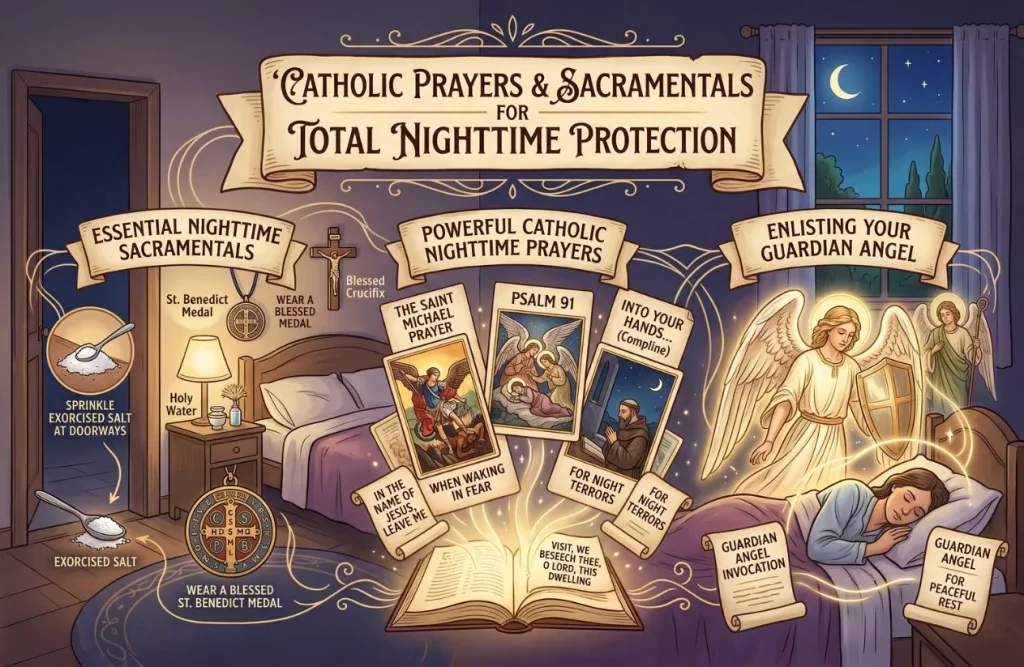
Securing your bedroom against preternatural intrusion requires combining internal faith with external spiritual weapons given by the Church.
Sacramentals and targeted nighttime prayers do not act as superstitious talismans; rather, they serve as tangible channels of the Church’s intercessory authority, invoking Christ’s victory over the forces of darkness while you sleep.
+-------------------------------------------------------------------------+
|                  Nighttime Catholic Defense Shield                       |
+-------------------------------------------------------------------------+
| Physical Defenses: Crucifix + St. Benedict Medal + Exorcised Salt       |
| Liturgical Defenses: Compline (Night Prayer) + Holy Water               |
| Direct Invocations: Holy Name of Jesus + St. Michael + Guardian Angel   |
+-------------------------------------------------------------------------+
Essential Nighttime Sacramentals
Sacramentals are sacred signs instituted by the Church that dispose the faithful to receive grace and draw divine protection.
When facing demonic oppression in sleep, it is recommended to establish a physical boundary of protection around your sleeping quarters:
- Blessed Crucifix: Hang a traditional Catholic Crucifix prominently on the wall facing your bed. The physical image of Christ crucified serves as an immediate visual anchor of His victory over Satan, reminding spiritual forces that the room belongs to the Lord.
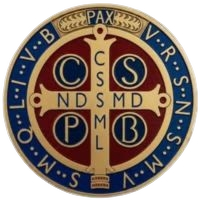
- St. Benedict Medal: Have a St. Benedict Medal blessed by a priest using the traditional Latin exorcism blessing. Wear the medal around your neck or attach it above your bedroom doorway and window frames to invoke the saint’s powerful intercession against diabolical harassment.
- Blessed or Exorcised Salt: Line the thresholds of your bedroom doors, window sills, and room corners with a small amount of blessed salt. In traditional Catholic rituals, exorcised salt is specifically blessed to drive away demonic presence and preserve places from spiritual contamination.
- Holy Water Font: Keep a small Holy Water font near your bedside or doorway. Blessing yourself with the sign of the cross using Holy Water before getting into bed reaffirms your baptismal dignity, driving away subtle spiritual influences and bringing peace to the mind.
Powerful Catholic Nighttime Prayers
When waking up in sudden fear, feeling a suffocating weight, or battling night terrors, catholic prayers for night terrors become your immediate defense. The vocal or interior recitation of targeted Catholic prayers breaks through preternatural paralysis and re-establishes spiritual authority.
1. The Holy Name of Jesus
The Holy Name of Jesus carries absolute divine authority before which every knee must bow (Philippians 2:10). If you awaken feeling frozen or oppressed, mentally or vocally repeat the Name of Jesus with quiet confidence:
“In the Name of Jesus Christ, depart from me and go straight to the foot of His Cross.”
2. The Prayer to Saint Michael the Archangel
Promulgated by Pope Leo XIII following a prophetic vision of spiritual warfare against the Church, the St. Michael Prayer (simplified version or what we often called short version) remains the primary daily exorcistic prayer for the lay faithful:
“Saint Michael the Archangel, defend us in battle. Be our protection against the wickedness and snares of the devil. May God rebuke him, we humbly pray; and do thou, O Prince of the Heavenly Host, by the power of God, cast into hell Satan and all the evil spirits who prowl about the world seeking the ruin of souls. Amen.”
3. Prayers from Compline (The Night Office)
Compline, the official final hour of the Church’s Liturgy of the Hours, has been prayed by priests, religious, and laypeople for centuries specifically to prepare the soul for night rest. Incorporating its core invocations provides profound interior peace:
“Into your hands, Lord, I commend my spirit… Visit, we beseech thee, O Lord, this dwelling, and drive far from it all snares of the enemy; let thy holy angels dwell herein to preserve us in peace; and let thy blessing be upon us evermore. Through Christ our Lord. Amen.”
4. Psalm 91 (The Protection Psalm)
Reciting or listening to Psalm 91 before sleep instills unwavering trust in God’s angelic protection, reminding the soul that those who abide under the shadow of the Almighty need not fear the terror of the night:
“You will not fear the terror of the night, nor the arrow that flies by day… For he will command his angels concerning you to guard you in all your ways.” (Psalm 91:5, 11)
Enlisting Your Guardian Angel and Saint Raphael
God assigns a Guardian Angel to every human soul to protect, guide, and defend them. Too often, believers forget to explicitly activate this angelic partnership before going to sleep.
Before closing your eyes, formally entrust your bedroom and your subconscious mind to your Guardian Angel. Ask your angel to stand guard at your bedside, repelling any dark influences, intrusive imagery, or preternatural harassment that seeks to enter your dreams.
Additionally, invoke Saint Raphael the Archangel, whose name means “God Heals.” In the Book of Tobit, St. Raphael explicitly bound the demon Asmodeus and protected Tobias and Sarah during their night of rest. Invoking St. Raphael alongside your Guardian Angel establishes an angelic shield over your home, granting deep, uninterrupted physical and spiritual healing throughout the night.
Frequently Asked Questions (FAQ)
Can a demon attack a Catholic who is in a state of grace during sleep?
Concise Answer: Yes. God may allow preternatural attacks during sleep by divine permission for spiritual testing, purification, or merit, as seen in the lives of saints like St. John Vianney and Padre Pio. However, remaining in a state of sanctifying grace protects your soul from internal diabolical dominion or possession, keeping the attack strictly external.
What should I do immediately if I wake up feeling frozen and sensing an evil presence?
Concise Answer: Mentally or vocally invoke the Holy Name of Jesus, pray the Hail Mary, or invoke the Precious Blood (“Precious Blood of Jesus, cover me”). In sleep paralysis or demonic oppression, catholic discernment, invoking Christ’s authority immediately breaks preternatural spiritual paralysis, as all evil spirits must submit to the Name of Jesus (Philippians 2:10).
Is it a sin if I experience demonic or impure dreams?
Concise Answer: No. For an act to be a sin, Catholic theology requires full knowledge and deliberate consent of the free will. Because sleep naturally suppresses conscious intellect and voluntary control, involuntary dreams—regardless of how terrifying, impure, or blasphemous they appear—are not sinful. Simply reject the dream upon waking and restore your peace of mind through prayer.
Final Reflection: Entrusting Your Rest to the Prince of Peace
Waking up to nighttime spiritual disturbances can leave you feeling shaken, exhausted, and anxious about closing your eyes. However, the most effective weapon the enemy uses in the dark is not raw power, but the spirit of fear itself. Fear paralyzes trust, clouding the fundamental reality that Jesus Christ holds absolute, unwavering authority over both the day and the night.
No fallen entity, no matter how intimidating or persistent, can ever override the supreme sovereignty of God or breach the protection of His Church without divine permission.
By taking practical medical steps to evaluate your health, restoring your soul through Sacramental Confession, cleansing your home, and invoking the powerful sacramentals of the Church, you place yourself firmly under the mantle of divine providence. You do not face the night alone or defenseless.
As you prepare for sleep each evening, reject anticipatory anxiety and anchor your heart in the truth of Sacred Scripture:
“In peace I will both lie down and sleep; for you alone, O Lord, make me dwell in safety.” — Psalm 4:8
Entrust your mind, your body, and your subconscious dreams to the Prince of Peace. Through the intercession of the Blessed Virgin Mary, Saint Michael the Archangel, and your Guardian Angel, you can close your eyes with total confidence, resting securely in the victory already won by Jesus Christ.