Exorcised Salt vs. Regular Blessed Salt: History, Theology, and Roman Ritual Prayers
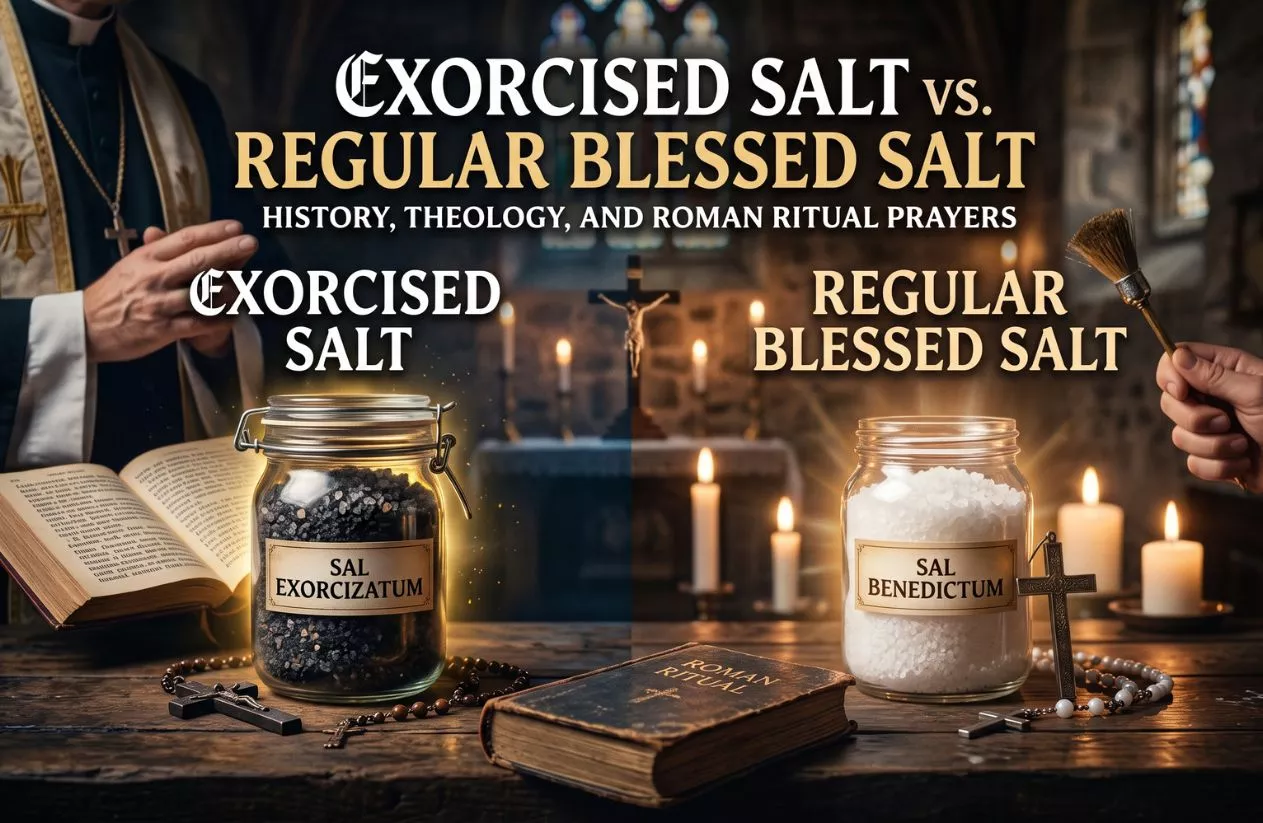
Quick Summary: In Catholic tradition, exorcised salt differs from standard blessed salt by undergoing a specific, traditional Rituale Romanum rite that explicitly commands any diabolical presence to depart from the element before it is blessed. While standard post-Vatican II blessings use a prayer of thanksgiving and sanctification, traditional exorcised salt serves a dual purpose: repelling evil spirits and protecting homes from diabolical infestation. It is used by sprinkling it along thresholds, doors, windows, and home perimeters while invoking the Holy Trinity.
For centuries, the Catholic Church has utilized physical matter as a conduit for spiritual protection and sanctification. Among these sacramentals, salt occupies a unique place in sacred tradition, serving as a powerful tool for purifying spaces and warding off diabolical influence.
However, many believers are unaware of the distinct theological difference between ordinary blessed salt and salt that has undergone traditional exorcism.
Understanding the nature and proper application of exorcised salt Catholic teaching provides faithful households with a time-tested spiritual defense. By examining the historical roots, canonical prayers, and practical uses of this ancient sacramental, Catholics can effectively fortify their homes against demonic harassment and cultivate a sanctuary grounded in divine grace.
Table of Contents
The Theological Difference: Exorcised Salt vs. Regular Blessed Salt
To understand why traditional exorcists place such immense value on sacramental salt, one must first understand what a sacramental is within Catholic theology.
According to the Catechism of the Catholic Church (CCC 1667–1679), sacramentals are sacred signs instituted by the Church that bear a resemblance to the Sacraments. They do not confer sanctifying grace in the manner of the Seven Sacraments, but through the intercessory prayer of the Church, they prepare the faithful to receive grace and dispose them to cooperate with it.
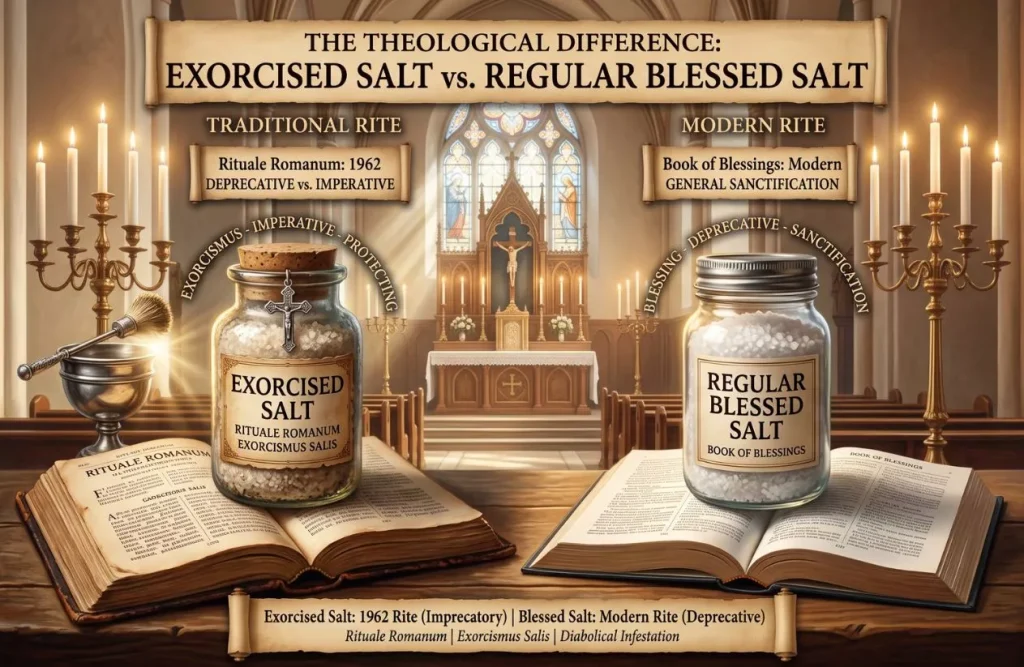
When examining exorcised salt vs Blessed salt, the primary difference lies not in the physical matter itself, but in the specific liturgical rite pronounced over the salt by an ordained priest.
The Two Liturgical Rites: 1962 Rituale Romanum vs. Modern Book of Blessings
The Catholic Church maintains two distinct formulas for blessing salt, representing two different theological emphases:
- The Traditional Rite (Rituale Romanum, 1962): This classical form includes an explicit Exorcismus Salis (Exorcism of the Salt). Before the element is blessed, the priest pronounces a direct, authoritative command driving out any diabolical presence, corruption, or spiritual infestation attached to the material element itself. Once exorcised, the salt is formally blessed to become a spiritual medicine that repels evil spirits and cleanses the locations where it is sprinkled.
- The Modern Rite (Book of Blessings, 1984): The post-Vatican II blessing focuses primarily on praise, thanksgiving, and invoking God’s blessing upon those who use the salt. It asks God to sanctify the creation and bless the faithful who consume or use it, omitting the direct command of exorcism against the power of Satan.
Why Traditional Exorcists Advocate for the 1962 Rite
Renowned Catholic exorcists—including the late Fr. Gabriele Amorth (former Chief Exorcist of Rome) and Fr. Chad Ripperger—have consistently advocated for using the 1962 Rituale Romanum formula when preparing salt for spiritual warfare.
Their reasoning is rooted in spiritual theology: while both blessings make the salt a holy sacramental, the traditional rite specifically targets diabolical infestation. The explicit exorcism prayer strips the material element of any potential demonic foothold and imparts a specific spiritual commission to the salt—acting as a spiritual barrier against dark forces.
For households suffering from localized spiritual disturbances, unexplainable atmospheric heaviness, or demonic harassment, exorcised salt catholic guidelines strongly recommend requesting the traditional Latin exorcism rite from a parish priest.
Comparison of Sacramental Salt Blessings
| Feature | Exorcised Salt (1962 Rituale Romanum) | Regular Blessed Salt (Book of Blessings) |
| Liturgical Source | Traditional Rituale Romanum (Title VIII, Ch. 2) | Modern Book of Blessings (Chapter 39) |
| Core Element Rite | Includes explicit Exorcismus Salis prior to blessing | Includes a prayer of blessing and thanksgiving |
| Theological Focus | Deprecatory and imperative spiritual cleansing | General sanctification and divine favor |
| Primary Intent | Driving away evil spirits, breaking hexes, home protection | General spiritual use, seasoning, and piety |
| Diabolical Defense | Specifically targeted for spiritual warfare and infestation | General sacramental protection for the faithful |
Biblical and Historical Roots of Exorcised Salt

The use of salt for spiritual purification and protection is not a recent innovation or a medieval superstition; it is deeply rooted in Sacred Scripture and apostolic tradition.
Throughout salvation history, God has chosen physical elements—water, oil, bread, wine, and salt—to convey divine realities and communicate spiritual protection. Understanding the biblical foundations of exorcised salt reveals how God routinely uses humble matter to overcome corruption and manifest His divine power.
Old Testament Precedent: Elisha and the Waters of Jericho
The primary biblical foundation for exorcising and blessing salt is found in the Second Book of Kings. The city of Jericho suffered from tainted, deadly water that caused barrenness throughout the land. The prophet Elisha did not perform an abstract miracle; instead, he commanded that salt be brought in a new bowl and poured directly into the contaminated source:
“He went out to the spring of water and threw salt into it and said, ‘Thus says the Lord, I have healed this water; from now on neither death nor miscarriage shall come from it.’ So the water has been healed to this day, according to the word that Elisha spoke.” — 2 Kings 2:21–22
The Church Fathers and exorcists highlight key spiritual principles from this passage:
- Physical Element as a Spiritual Instrument: Salt itself possessed no natural chemical ability to purify an entire city’s water supply; rather, God used salt as the tangible instrument of His miraculous healing.
- Precursor to Exorcised Salt: Just as Elisha used salt to heal a corrupted, deadly spring, the Church uses exorcised salt to purify physical spaces and drive out the spiritual corruption of diabolical infestation.
- The Covenant of Salt: In the Old Covenant, salt represented permanence, loyalty, and incorruptibility (Numbers 18:19). It was required in liturgical sacrifices to symbolize an enduring covenant that cannot rot or fade.
New Testament Symbolism: Incorruptibility and Divine Light
In the New Testament, Jesus Christ elevates the spiritual symbolism of salt during the Sermon on the Mount:
“You are the salt of the earth; but if salt has lost its taste, how shall its saltiness be restored? It is no longer good for anything except to be thrown out and trodden under foot by men.” — Matthew 5:13
In the ancient Greco-Roman world, salt served two critical functions: preserving meat from decay and adding flavor. By calling His disciples the “salt of the earth,” Christ instructed believers to preserve the world from moral rot and spiritual corruption.
When the Church exorcises salt, she invokes this exact imagery—asking God to make the element a spiritual preserver that prevents demonic forces from decaying the spiritual life of a Christian home.
Historical Church Practice: From Early Rites to Medieval Christendom
The historical use of salt as a sacramental expanded rapidly in early Church tradition and liturgical practice:
1. The Salt of Wisdom (Sal Sapientiae) in Baptism
In the early Church and the traditional Roman Rite of Baptism, a small grain of exorcised and blessed salt (Sal Sapientiae, or the “Salt of Wisdom”) was placed on the tongue of the catechumen before entering the baptismal font.
This action symbolized the cleansing of the mind from pagan error, the imparting of spiritual wisdom, and protection against diabolical deception as the soul prepared to enter the Family of God.
2. Purification of Places Across Medieval Christendom
Throughout early and medieval Church history, priests routinely used a mixture of exorcised salt and holy water (known liturgically as Aqua Benedicta) to bless homes, fields, livestock, and newly constructed churches. Medieval pastoral manuals documented that sprinkling exorcised salt along boundary lines protected communities from pestilence, strange atmospheric phenomena, and diabolical harassment.
By preserving these ancient rites, the Catholic Church maintains an unbroken continuity with biblical prophets, early Church fathers, and centuries of Christian tradition, offering the faithful a battle-tested sacramental for spiritual defense.
The Traditional Rituale Romanum Latin Prayer of Exorcism (Exorcismus Salis)

Understanding the spiritual weight of exorcised salt in Catholic tradition requires examining the actual words pronounced by the priest during the traditional rite.
Found within the 1962 Rituale Romanum (Title VIII, Chapter 2), the Exorcismus Salis is an authoritative, sacerdotal prayer that addresses both the material element and Almighty God.
While the priest typically recites the prayer in Latin to maintain sacred continuity, examining the official English translation reveals the profound theological depth and binding power embedded in this ancient sacramental.
The Official English Translation of the Exorcismus Salis
The solemn exorcism and blessing of salt consist of two distinct parts: the explicit command driving away evil spirits, followed by the prayer of consecration.
Priest: Our help is in the name of the Lord.
Response: Who made heaven and earth.
Exorcism of the Salt:
“God’s creature, salt, I exorcise you by the living God, by the true God, by the holy God, by the God who ordered you to be thrown into the water by Elisha to heal its barrenness. Be purified salt for the health of the faithful, and be a medicine of soul and body to all who consume you. May all evil dreams, malice, and deception of the devil depart and flee from the place where you are sprinkled, as well as every unclean spirit, adjured by Him who will come to judge the living and the dead and the world by fire. Amen.”
Prayer of Blessing:
“Almighty and everlasting God, we humbly implore Your infinite mercy that You would graciously bless and sanctify this Your creature, salt, which You have given for the use of mankind. May all who use it find in it a remedy for mind and body; and grant that whatever is touched or sprinkled by it may be freed from all uncleanness and protected from all assaults of evil spirits. Through Christ our Lord. Amen.”
Warning: This prayer should only be prayed by a priest.
Theological Breakdown of Key Phrases
The language of the Rituale Romanum salt prayer contains specific theological markers that explain its efficacy in spiritual warfare:
- “God’s creature, salt, I exorcise you…”The prayer addresses physical matter directly. In Catholic theology, physical creation can carry residual effects of original sin or be exploited by fallen angels. The exorcism purifies the element itself, stripping away any diabolical influence before it is set apart for holy use.
- “…by the God who ordered you to be thrown into the water by Elisha…”The Church explicitly grounds this sacrament in Sacred Scripture, invoking the historic miracle of 2 Kings 2 to request the same purifying power over present physical spaces.
- “…medicine of soul and body to all who consume you…”Unlike non-consumable sacramentals (such as holy oil used for anointing walls), exorcised salt is unique because it can be ingested. Exorcists often recommend using small amounts of exorcised salt in cooking for individuals suffering from internal spiritual oppression or targeted diabolical attack.
- “May all evil dreams, malice, and deception of the devil depart…”The prayer directly targets the psychological and spiritual manifestations of demonic activity—specifically night terrors, unexplainable atmospheric heaviness, and deceptive spiritual thoughts.
Canonical Authority: Who Can Exorcise Salt?
A crucial principle in Catholic canon law is the distinction between lay devotion and sacerdotal authority.
Laypeople cannot perform the Exorcismus Salis. The power to command physical matter to be purified of demonic influence in the name of the Church belongs exclusively to validly ordained priests (and deacons operating within approved liturgical faculties). When a priest pronounces this prayer, he acts in persona Christi Capitis (in the person of Christ the Head) and speaks with the full spiritual authority of the Mystical Body of Christ.
Lay Catholics do not generate the blessing themselves; rather, they take salt that has already been validly exorcised by a priest and apply it within their legitimate sphere of authority—their home, family, and personal property.
Practical Guide: How to Use Exorcised Salt for Home Protection

Knowing how to use exorcised salt correctly allows lay Catholics to exercise spiritual stewardship over their living spaces. While the priest holds the sacerdotal authority to exorcise the salt, parents and homeowners possess legitimate spiritual authority over their own property and household.
By applying this sacramental along physical access points, faithful families establish a tangible perimeter of prayer that helps guard the domestic church against diabolical disturbance.
Step-by-Step Salt Placement Protocol
Applying catholic exorcised salt home protection is simple, practical, and grounded in prayer. A small amount of salt is all that is required—there is no need to pour heavy lines or create visible messes.
1. Doorways and Main Thresholds
- Application: Lay a thin, discreet line of exorcised salt directly across the threshold of your front, back, and garage entry doors.
- Spiritual Significance: Main doorways represent the primary physical and spiritual entry points of the home. Placing salt here symbolizes closing the door to unwanted spiritual influences and establishing Christ’s peace over all who enter.
2. Windows and Alternate Points of Access
- Application: Sprinkle a small pinch of salt along window sills, basement light wells, sliding patio doors, and attic access hatches.
- Spiritual Significance: Physical structures often have secondary openings. Fortifying windows and lower-level access points ensures that every physical opening in the dwelling is dedicated to divine protection.
3. Room Corners and Property Lines
- Application: Place a tiny pinch of salt in the four interior corners of rooms experiencing atmospheric heaviness, bad dreams, or spiritual unrest. If you own your land, you can also sprinkle salt along the four outer corners of your property perimeter.
- Spiritual Significance: Marking the four corners of a room or land boundaries visually and spiritually encloses the space under God’s protection, reclaiming the entire footprint of the property for the Lord.
Accompanying Prayer Protocol
Sacramentals are not superstitious talismans; their spiritual efficacy relies on faith, the intercession of the Church, and sincere prayer. Whenever you place exorcised salt guidelines recommend combining the action with explicit prayers:
- The Sign of the Cross: Always begin and end your placement by making the Sign of the Cross over the area.
- Simple Invocations: As you apply the salt, pray aloud or silently:“In the Name of Jesus Christ, may this home be freed from all diabolical influence, and may the peace of the Holy Spirit rest upon all who dwell here.”
- The St. Michael Prayer: Recite the prayer to St. Michael the Archangel after completing the placement to ask for angelic guardianship over the household boundaries.
- The Lord’s Prayer (Our Father): Seal the spiritual cleansing of the room by reciting the Lord’s Prayer, specifically focusing on the petition “deliver us from evil.”
Frequently Asked Questions (FAQ)
Can any Catholic priest bless salt using the traditional exorcism rite?
Yes, any validly ordained Catholic priest can exorcise and bless salt using the traditional 1962 Rituale Romanum. While modern liturgical books offer shorter blessings of praise, a priest retains the spiritual authority to utilize the traditional Latin exorcism formula upon request to prepare salt specifically for home protection and spiritual warfare.
Can laypeople exorcise salt themselves?
No, laypeople cannot perform the exorcism of salt because they lack sacerdotal authority. Exorcising physical matter requires the sacramental power of Holy Orders acting in persona Christi Capitis. Lay Catholics can safely use salt that has already been validly exorcised by a priest, applying it within their homes and personal property under their legitimate domestic authority.
Does exorcised salt lose its blessing or expire?
No, the spiritual blessing attached to exorcised salt does not expire or fade over time. As a sacramental, its spiritual dedication remains intact. However, if the physical salt washes away, dissolves, or is swept up during routine cleaning, laypeople can simply reapply fresh exorcised salt as an ongoing sign of faith and divine protection.
Final Reflection: Living Under the Shield of Sacred Tradition
Incorporating exorcised salt catholic devotions into your home spiritual routine offers a time-tested way to fortify your domestic church against diabolical disturbance. Yet, it is essential to remember the true nature of sacramentals: they are not magical fetishes, charms, or automatic guarantees of safety. Their power stems from the intercessory prayer of the Church, the merits of Christ’s Passion, and the sincere disposition of faith with which they are used.
Salt, water, and holy oils serve as visible conduits of invisible divine protection, constantly pointing our hearts back to the ultimate lordship of Jesus Christ. When used with reverent trust, these traditional gifts help cultivate a peaceful domestic sanctuary where grace abounds and darkness has no entry. By grounding your household in the Sacraments, active prayer, and the protective shield of sacred tradition, you can rest secure in the abiding peace and victory of the Savior.