Catholic Exorcism vs. Hollywood Exorcisms: 4 Fascinating Myths Debunked
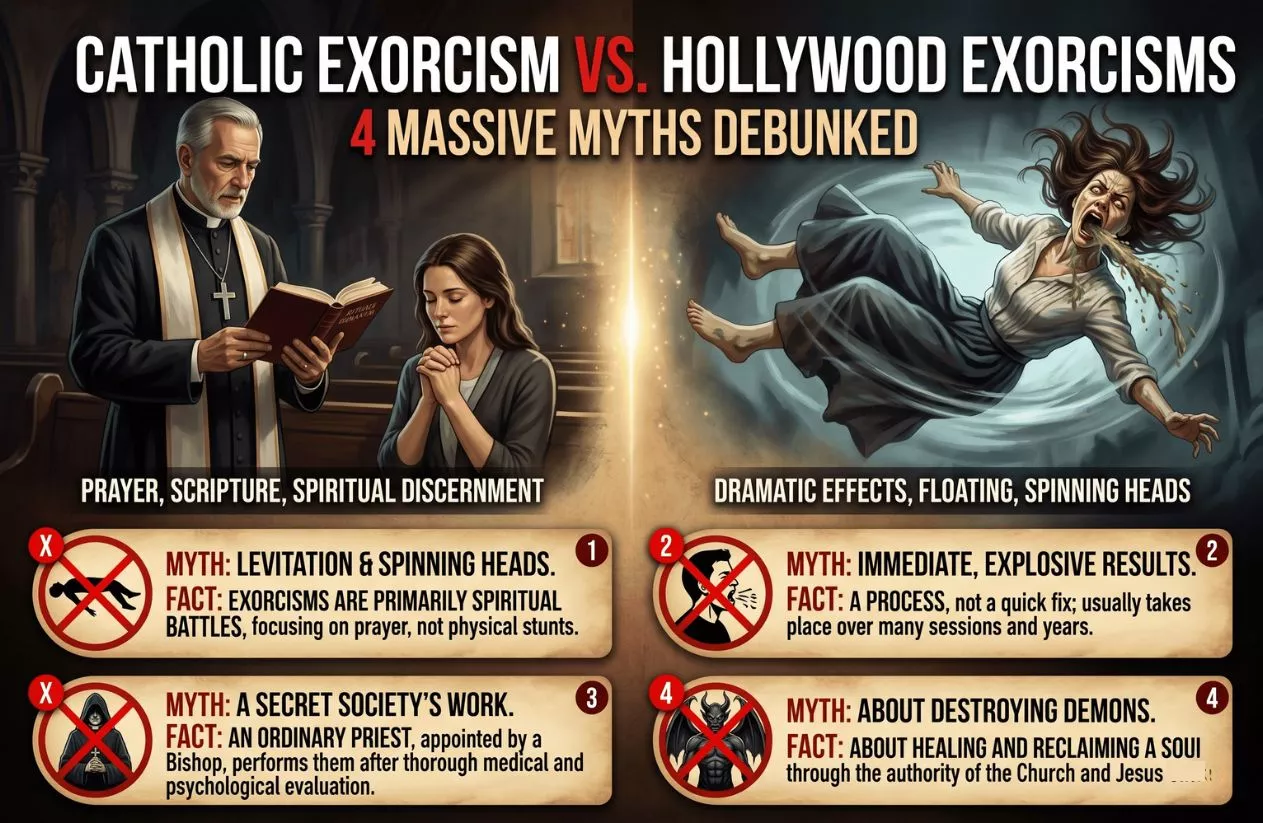
Pop culture has long been obsessed with spiritual warfare. From the iconic 1973 classic The Exorcist to recent blockbusters like The Pope’s Exorcist, Hollywood has single-handedly shaped how the modern world views demonic possession. But when you look at actual Catholic exorcism vs movies, the silver screen couldn’t be further from reality.
Where cinema relies on special effects, jumpscares, and chaotic shouting matches to terrify audiences, the actual ministry of the Church is profoundly different.
The real Rituale Romanum (the Roman Ritual) is a solemn, highly structured liturgical rite. It is not an intense battle of human wills, but a quiet, orderly process centered entirely on the supreme authority of Jesus Christ and the institutional Church.
Quick Summary: Catholic Exorcism vs Movies at a Glance
The gap between theatrical fiction and actual sacred practice comes down to a few core operational differences.
| Element | Hollywood Version | Actual Catholic Practice |
| The Tone | Aggressive screaming match, chaotic, and panic-driven. | Solemn, quiet, deeply prayerful, and strictly liturgical. |
| Primary Weapon | The priest’s personal willpower, stamina, or emotional grit. | The authority of Jesus Christ and the mandate of the Church. |
| The Vetting Process | Non-existent; immediate action based on a hunch or jump scare. | Months of medical, psychological, and psychiatric clearance. |
| Duration | Resolved in a single, terrifying, two-hour cinematic climax. | Often requires multiple sessions over months or years. |
| The Ultimate Focus | Sensational parlor tricks, fear, and cinematic horror. | Spiritual liberation, healing, and reconciliation with God. |
Key Takeaway: Hollywood treats spiritual warfare as a heavyweight boxing match between a priest and a demon. The Catholic Church treats it as a focused application of Christ’s healing authority, where the outcome is already decided by faith.
Table of Contents
Myth 1: It’s a Cinematic Battle of Wills (The Shouting Match Myth)
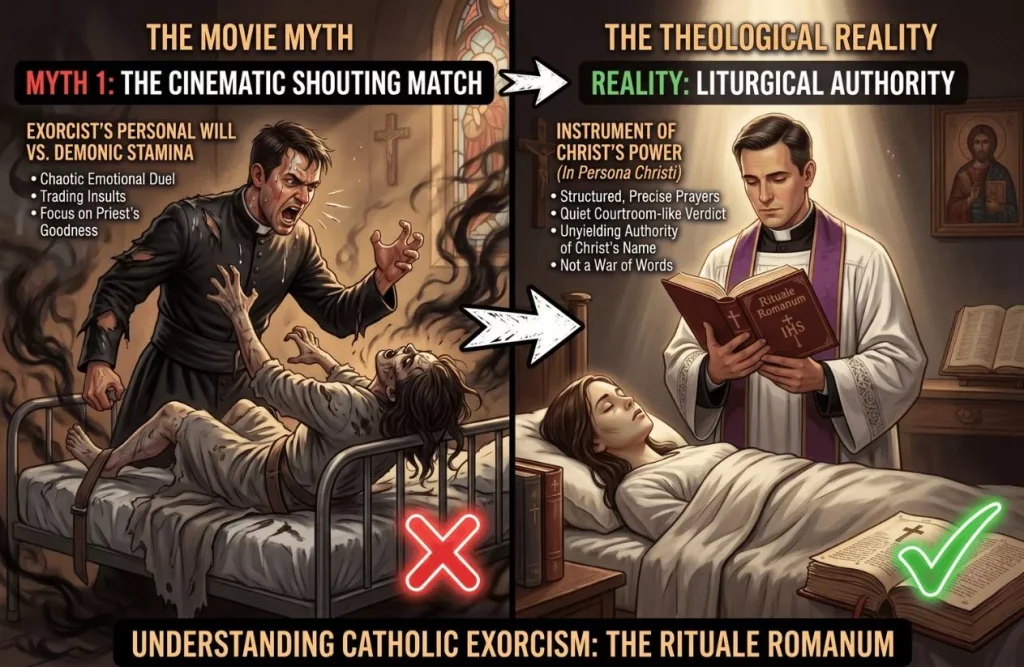
In almost every horror film featuring a possession, the climax involves a sweat-drenched priest standing over a bed, screaming insults at a demon.
Directors paint the scene as an intense, personal duel of stamina and mental grit—as if the priest’s own emotional strength or internal goodness is the deciding factor in conquering evil.
The actual theological reality is completely the opposite. An ordained exorcist is an instrument, never the source of power. He does not engage in a war of words or trade insults with an unclean spirit. Instead, he operates In Persona Christi (in the person of Christ) and acts under the direct mandate of the Church.
The Rituale Romanum provides a highly structured, quiet, and solemn liturgy. Engaging in a chaotic screaming match actually plays into the demonic strategy of distraction and pride. The real rite relies entirely on the objective, unyielding authority of the name of Jesus Christ.
The priest reads steady, prescriptive prayers and commands the spirit to depart, making the environment feel more like a quiet courtroom verdict than a dramatic street fight.
Myth 2: Levitating Beds and Green Vomit Are Everyday Occurrences
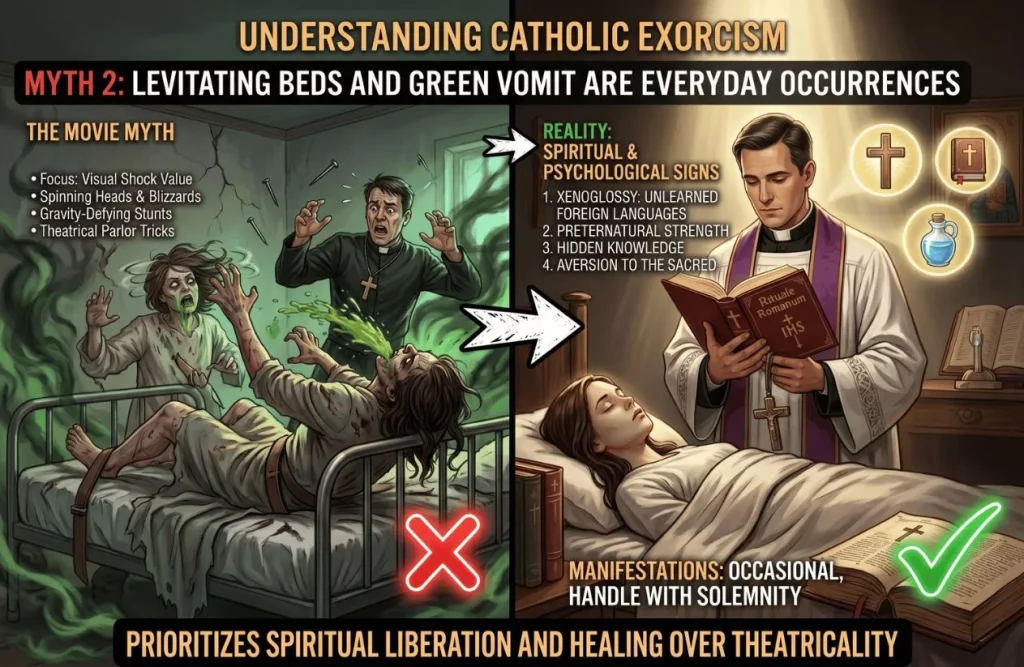
Cinema relies entirely on visual shock value. To prove a presence is demonic, filmmakers fill the screen with theatrical parlor tricks like spinning heads, sudden indoor blizzards, and gravity-defying stunts custom-built to serve as horrific jump scares.
In actual spiritual warfare, physical manifestations like levitation or the vomiting of strange objects (such as nails, needles, or thick mud) absolutely do happen. Actual church ministry records and veteran exorcists confirm that these anomalies occur during severe cases—but they do not happen in every single instance, nor are they the everyday norm.
Instead, the Church officially looks for specific, extraordinary signs before confirming diabolical influence:
- Xenoglossy: Speaking or understanding a completely foreign language the person has never learned or been exposed to.
- Preternatural Strength: Demonstrating physical power that vastly exceeds the individual’s natural physical capacity, age, or health condition.
- Hidden Knowledge: Revealing secret, distant, or private facts about bystanders or the priest that the person could not possibly know by natural means.
- Aversion to the Sacred: Severe, violent physical or emotional reactions to holy water, blessed relics, or specific liturgical prayers.
When physical phenomena like levitation or vomiting do occur, they are handled with absolute solemnity, not panic. Exorcists prioritize spiritual liberation and psychological healing over theatricality.
The actual process consists almost entirely of intense, quiet, focused prayer and scripture reading. Real-world manifestations are managed with absolute discretion and solemnity, far away from cinematic sensationalism.
Myth 3: Exorcists Are Lone-Wolf Maverick Priests
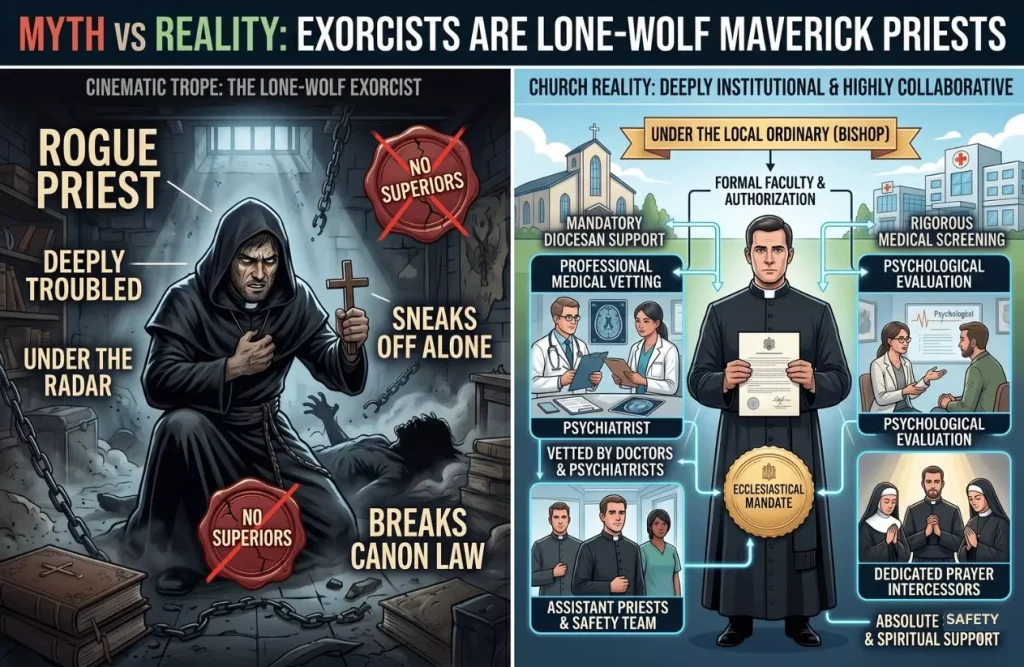
Movies love the trope of the rogue, deeply troubled priest who operates under the radar. In cinema, these characters hide secrets from their superiors, break canon law, and sneak off into dark basements to fight demons single-handedly.
This lone-wolf archetype makes for great dramatic tension, but it completely distorts how the Church operates.
When analyzing actual Catholic exorcism vs movies, the reality is deeply institutional and highly collaborative. No priest can simply decide to perform a Major Exorcism on his own initiative.
Under church law, a priest must receive explicit, formal faculty and case-by-case authorization from the local Ordinary, usually the diocesan Bishop. Operating without this ecclesiastical mandate strips the priest of his spiritual authority and protections within the rite.
Far from being isolated renegades, real-world exorcists function at the center of an established diocesan network. The ministry requires a multidisciplinary team approach. Before a case ever reaches the liturgical stage, it undergoes rigorous vetting by professional medical doctors, psychiatrists, and psychologists to rule out natural mental health conditions or neurological disorders.
Along with medical professionals, the ministry relies on a dedicated team of prayer intercessors and assistant priests to ensure absolute safety, psychological vetting, and spiritual support throughout the entire process.
Related Article: How to Put On the Full Armor of God: A Daily Strategy for Laypeople
Myth 4: Spiritual Warfare Is Resolved in a Single, Two-Hour Climax
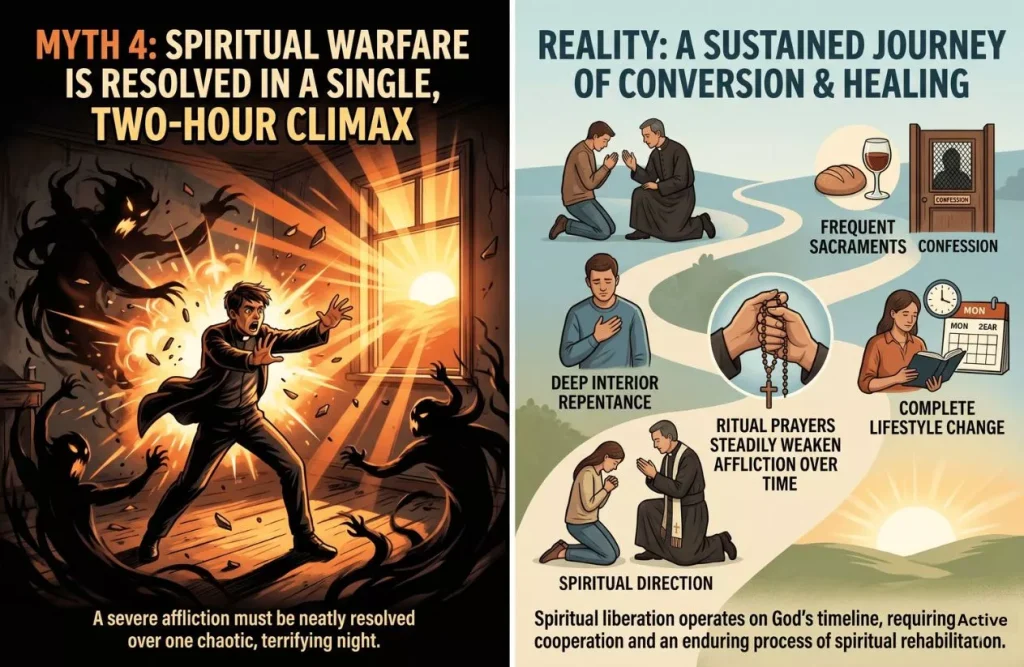
Filmmakers construct their stories around a strict three-act structure. Because of this, a severe affliction must be neatly resolved over the course of one chaotic, terrifying night.
The movie ends with a definitive, explosive showdown where the dark spirit is expelled just as the sun begins to rise, leaving the victim instantly and permanently cured.
In reality, spiritual liberation operates on God’s timeline, not a theatrical script. While some individuals are completely liberated after just a few short sessions, many severe or deep-seated cases require a sustained effort that can stretch over several months or even years.
True deliverance is not a quick-fix magical formula; it is a serious journey of spiritual conversion and interior healing.
Because the ritual prayers are designed to steadily weaken the grip of the affliction over time, the duration depends heavily on the root causes of the attachment. Ultimate freedom requires the active cooperation of the individual.
For lasting liberation, the sessions must be paired with a complete lifestyle change, including regular spiritual direction, deep interior repentance, and the frequent reception of the Sacraments—specifically regular Confession and the Holy Eucharist. It is an enduring process of spiritual rehabilitation, not a dramatic, instantaneous movie ending.
Conclusion: The True Power of the Rite
When you strip away the cinematic special effects and evaluate actual Catholic exorcism vs movies, a profound truth emerges. Filmmakers rely on fear, panic, and chaos to fill theater seats and sell tickets. The Church, by contrast, relies on absolute order, deep humility, and the quiet, unyielding peace of Christ to restore human dignity and bring true freedom to those who are suffering.
The real power of the ministry does not lie in sensational parlor tricks, but in the ordinary authority of the Church and the sacraments. Understanding this distinction shifts our perspective from a place of fear to one of deep faith and spiritual security.
Help us break the cinematic spell. If this breakdown helped clarify the reality of spiritual warfare for you, take a moment to share this article on your social channels to help dispel these common cultural misconceptions.
Related Article: Protective Bible Verses to Cast Out Fear and Night Terrors
Frequently Asked Questions
Can any priest perform an exorcism?
No. An ordinary priest cannot perform a Major Exorcism on his own authority. Under canon law, only a priest who has received explicit, formal permission (called faculties) from his local diocesan Bishop can perform the rite. Furthermore, the priest must be known for his piety, knowledge, prudence, and integrity of life.
How does the Church rule out mental illness before performing the rite?
The Church uses a strict, multidisciplinary vetting process. Before any liturgical intervention is authorized, the individual must undergo extensive evaluations by licensed medical doctors, psychiatrists, and psychologists. The goal is to thoroughly rule out natural explanations such as schizophrenia, epilepsy, dissociative identity disorders, or other neurological and mental health conditions.
Is holy water actually used during the process?
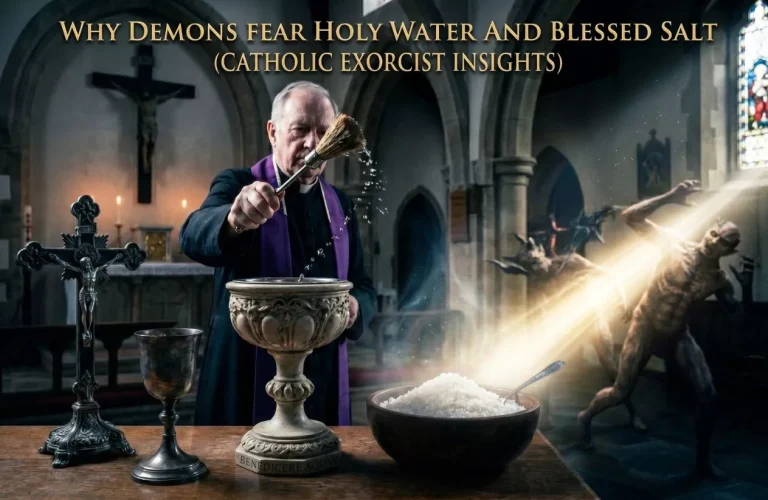
Yes, holy water is used, but not as an offensive weapon thrown during a chaotic battle. It is applied solemnly at specific moments within the liturgical framework of the Rituale Romanum as a sacramental reminder of baptism and spiritual cleansing, accompanied by prescribed prayers.
Can an individual become possessed just by watching horror movies?
No, simply watching a scary movie does not cause demonic possession. Possession typically involves a deliberate opening of spiritual doors through grave sin, involvement in occult practices, or severe spiritual vulnerability. However, church practitioners often note that obsessing over dark themes can cultivate an unhealthy environment of fear and anxiety, which weakens a person’s interior spiritual life.