Do Catholics Worship Saints? A Simple Breakdown for Searching Christians
No, Catholics do not worship saints. In Catholic theology, worship belongs to God alone. Catholics honor, respect, and ask the saints to pray for them, treating them as holy peers and spiritual family members rather than divine beings.
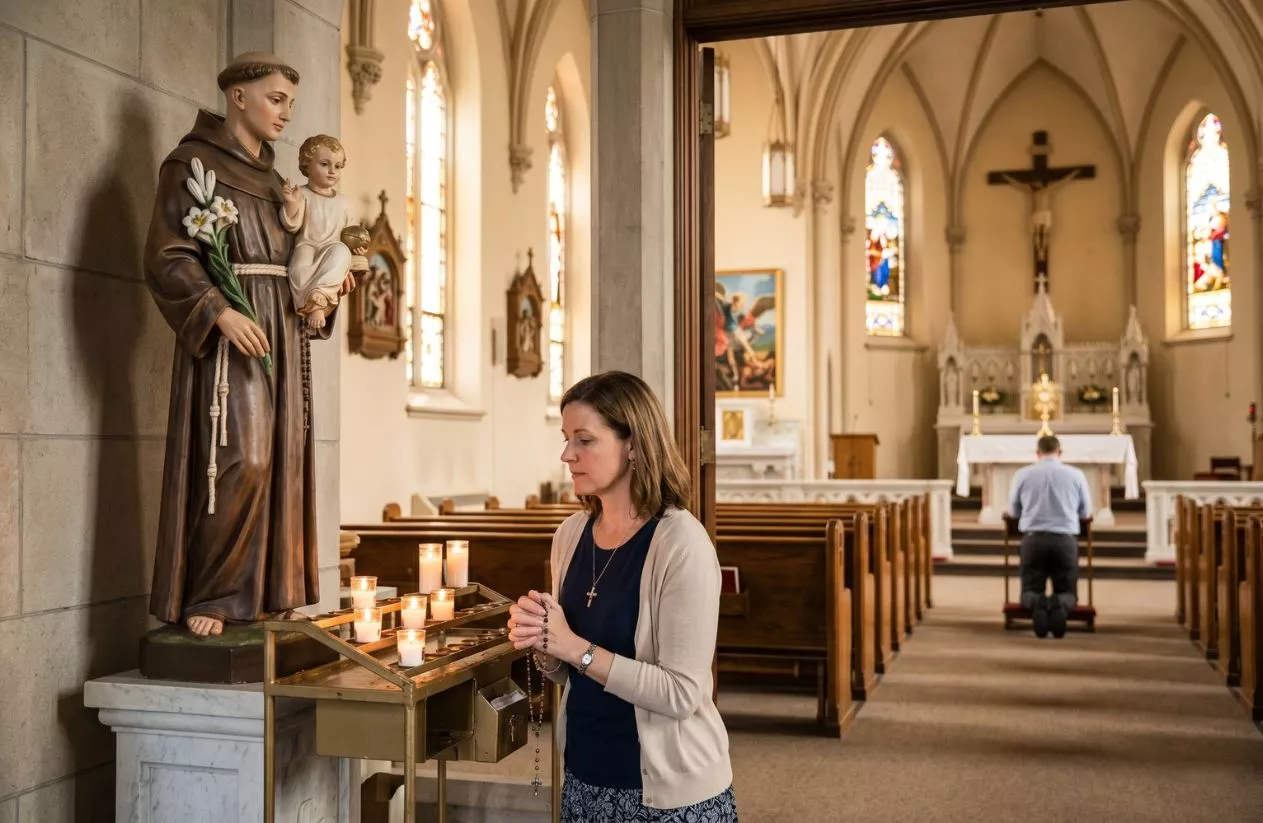
For many searching Christians, walking into a Catholic parish or scrolling through Catholic resources can feel jarring. You might see someone kneeling before a statue of St. Anthony, lighting a candle at the feet of a carved image of St. Therese, or chanting the Litany of Saints during a solemn service.
If your background is rooted in traditional Protestant or non-denominational communities, your immediate, protective instinct might trigger a serious question: Why do catholics worship saints?
It is a completely fair question. From the outside looking in, the physical expressions of Catholic devotion—bowing, kissing relics, lighting candles, and speaking directly to the deceased—look identical to the actions reserved for God.
If you have been taught your entire life that any religious devotion directed away from the Holy Trinity is idolatry, seeing these practices can be an immediate roadblock.
To truly understand why do catholic worship saints is a widespread misconception, we have to pull back the curtain on the language and theology behind these actions. The Church draws a strict, unbreakable line between the creator and the creature.
What looks like worship to the casual observer is actually a deep, ancient form of familial respect. Let’s break down exactly where that line is drawn.
Here is the updated section with a clear subheading structure to bridge the transition seamlessly from the introduction into the theological definitions.
Latria vs. Dulia: The Catholic Teaching on Veneration of Mary and Saints vs Worship
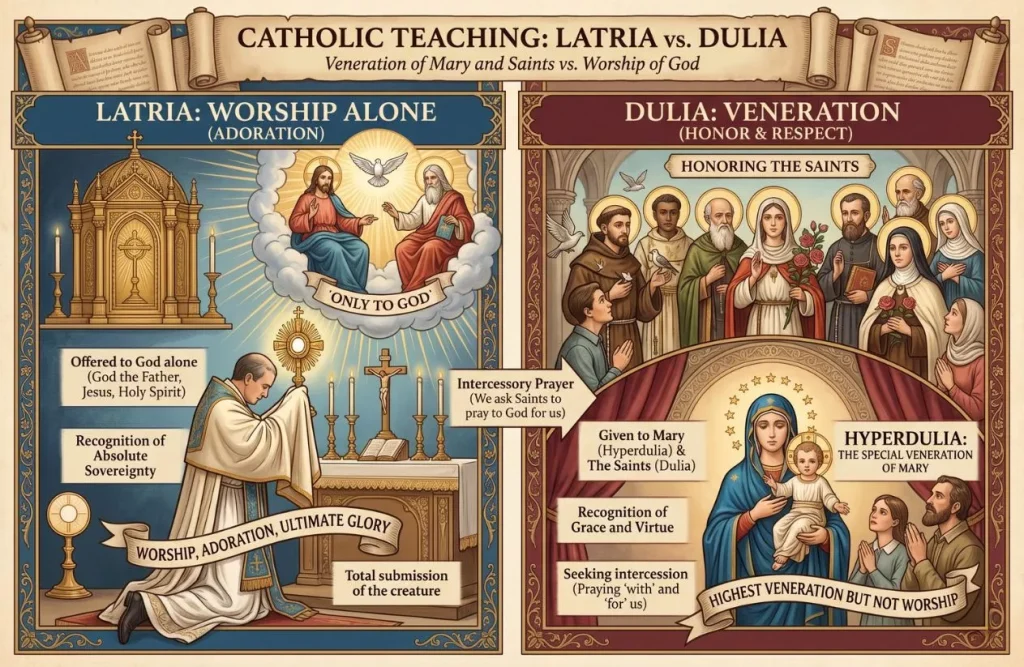
To resolve the confusion raised in the introduction, we have to look closely at the precise vocabulary used by the early Church. Language matters, and a major cause of modern theological friction is that the English language often uses a single word—like “honor” or “praise”—to describe vastly different levels of devotion.
The Church uses distinct Greek terms to draw a hard line between the Creator and the creature. This clear theological boundary ensures that God is never stripped of His unique glory, while still allowing Christians to recognize the work of the Holy Spirit in holy men and women.
Understanding Latria: Worship Due to God Alone
The highest form of devotion is latria. This is the Greek term for adoration, sacrificial worship, and total surrender.
In sacred Scripture, latria is the response due exclusively to the Holy Trinity—Father, Son, and Holy Spirit. It is the acknowledgement of God as the supreme Creator, Savior, and Master of existence. True worship always involves an element of sacrifice.
In the Catholic Mass, this sacrifice is the Holy Eucharist. No saint, no angel, and not even the Virgin Mary can ever be offered latria. To give latria to anyone but God is the literal definition of idolatry.
Understanding Dulia: Honoring Our Holy Peers
The second term is dulia. This refers to the honor, high respect, and admiration given to the saints.
Think of dulia as spiritual appreciation. When you read a biography of an inspiring Christian missionary, or when you honor a faithful pastor, you are practicing a form of dulia. The Church applies this to the saints because they are our holy peers who have finished the race before us.
We do not look at them as minor deities; we look at them as reflections of God’s grace. When we honor a saint, we are ultimately praising the Master Craftsman who made them holy.
Understanding Hyperdulia: A Unique Honor for Mary
There is a subset of honor called hyperdulia. This is a highly elevated form of respect reserved solely for the Blessed Virgin Mary.
Why does she get a special category? Because of her unique role in salvation history as the Theotokos (the God-bearer). She was chosen to carry the incarnate Word of God. However, the prefix hyper- simply means “more.” It signifies the highest level of human honor, but it remains strictly within the boundary of dulia.
It never crosses the infinite chasm into latria. Mary remains a creature, completely dependent on the mercy of her Savior.
The Clear Linguistic Difference Between Latria and Dulia
To visualize this boundary, this comparison table breaks down the strict categorical distinctions maintained in Catholic dogmatic theology:
| Theological Term | Type of Devotion | Intended Recipient | Biblical/Liturgical Action |
| Latria | Absolute Adoration & Worship | The Triune God Alone | The Holy Sacrifice of the Mass, total submission of the soul. |
| Hyperdulia | Highest Human Veneration | The Virgin Mary | Marian prayers (e.g., the Magnificat), honoring her role as Mother of God. |
| Dulia | Veneration & High Respect | Angels and Saints | Requesting intercession, honoring feast days, emulating their virtues. |
The Core Takeaway: Worship (latria) changes the orientation of your soul toward your ultimate Creator. Veneration (dulia) is simply recognizing Christ’s victory shining through a human life.
Clear Distinctions: Catholic Veneration of Mary and Saints Not Worship
When trying to process why external actions look a certain way, it helps to separate physical posture from the internal intent of the heart. To someone looking in from a different tradition, seeing a believer light a candle before a statue looks exactly like religious adoration.
But the physical actions of catholic veneration of mary and saints not worship are built on a completely different framework than divine praise.
To unpack why these actions are performed, we have to look at how humans use physical signs to communicate honor, memory, and respect.
Why Do Catholics Use Statues, Candles, and Images?
The primary objection usually comes down to the physical objects themselves. Why are there statues in Catholic churches?
The answer is simple: they are physical reminders of our heavenly family. A statue or an icon has no power of its own. It is piece of stone, wood, or plaster.
When a Catholic bows before an image or places flowers near it, the honor is directed toward the person the image represents, not the physical material.
Think of it this way: if you keep a photo of your deceased grandparent in your wallet, you might occasionally look at it, smile, or even kiss the photo when you miss them. You are not treating the photo paper as your actual grandparent, nor are you worshiping them.
You are using a physical, visual medium to honor their memory. The honor passes from the image straight to the prototype.
Understanding Relics and Sacramentals
Another point of confusion is the use of relics—such as a piece of clothing worn by a saint, or a fragment of their bone—or sacramentals like holy water and blessed medals.
These objects are never viewed as magical charms. Instead, they represent physical touchpoints of historical faith. Throughout salvation history, God has consistently used physical matter to convey grace and perform miracles.
- In the Old Testament, a dead man came back to life the moment his body touched the bones of the prophet Elisha (2 Kings 13:21).
- In the New Testament, people were healed simply by touching the fringes of Jesus’ cloak (Matthew 9:20), or by placing aprons and handkerchiefs that had touched the skin of the Apostle Paul onto the sick (Acts 19:11-12).
When we preserve relics, we are honoring the physical vessels that the Holy Spirit used to impact the world.
The Pure Intent of Veneration
Ultimately, when critics assert that catholics worship saints, they are conflating a outward sign of affection with an internal act of sacrifice. Kneeling, bowing, and lighting candles are ancient cultural signs of deep honor. In many Eastern cultures, people bow deeply to their parents or political leaders out of pure respect, with zero religious intent.
For Catholics, veneration is an act of love directed at our spiritual brothers and sisters who have successfully finished their earthly race. It is a family gathering where we celebrate the masterpieces of God’s grace, keeping our eyes firmly fixed on the Father who made them who they were.
The Linguistic Shift: Do Catholics Worship Mary and the Saints When They “Pray”?
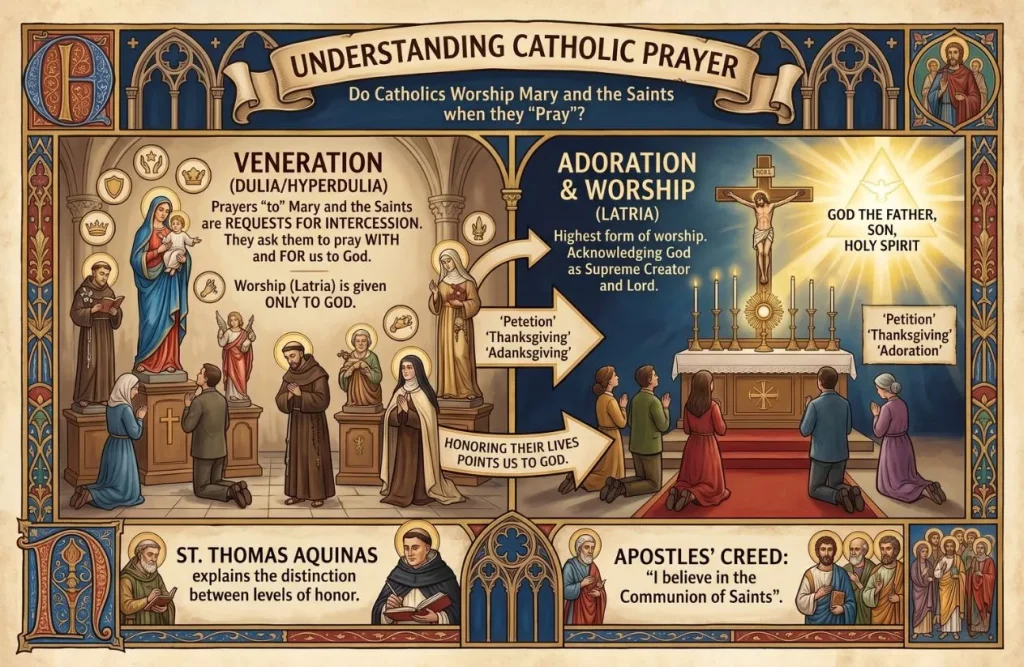
At the root of the question—do catholics worship mary and the saints—is a massive linguistic misunderstanding. When a non-Catholic hears the phrase “praying to saints,” they automatically hear the word worship.
In modern English, “prayer” has become a religious term reserved exclusively for communication with God. Because of this modern definition, it seems completely logical to conclude that praying to anyone else is a form of forbidden catholic saint worship.
However, looking at the history of the English language reveals that the word “pray” did not always mean worship.
The Original Definition of “Pray”
Historically, the English word pray comes from the Old French prier, which originates from the Latin precari, meaning simply “to ask,” “to request,” or “to entreat.”
For centuries, the word was used in everyday, non-religious conversation. If you read old literature, legal texts, or Elizabethan plays, you will see characters saying things like:
- “Pray tell, what is the hour?” (Please tell me…)
- “I pray thee, hear my request.” (I ask you…)
In these contexts, nobody was worshiping the person they were speaking to. They were simply making a request. When Catholics use the term “praying to saints,” they are using the word in this classic sense. They are not worshiping the saints; they are asking, or requesting, that the saints speak to God on their behalf.
The Peer Analogy: The “Prayer Warrior” Connection
To understand how this works in practice, look at how Christians interact with each other on Earth. If you are going through a difficult trial—like a health crisis, a financial burden, or a spiritual attack—what do you do? You call or text a trusted Christian friend, a pastor, or a “prayer warrior” in your church, and you say, “Please pray for me.”
When you ask a friend on Earth to pray for you, you are not violating the unique role of Jesus. You are participating in intercessory prayer. You recognize that your friend has no divine power to grant your request on their own; instead, you are asking them to stand with you in faith before the throne of God.
Asking Saint Michael the Archangel for defense or Saint Therese for intercession is exactly the same as asking your friend on Earth to pray for you.
The only difference is that the saint is no longer limited by a physical body on Earth. They are alive in the presence of God, part of the cloud of witnesses, and offering their prayers directly to the Father. You are not treating them as a replacement for God—you are treating them as part of your spiritual family.
The Biblical Basis for the Communion of Saints
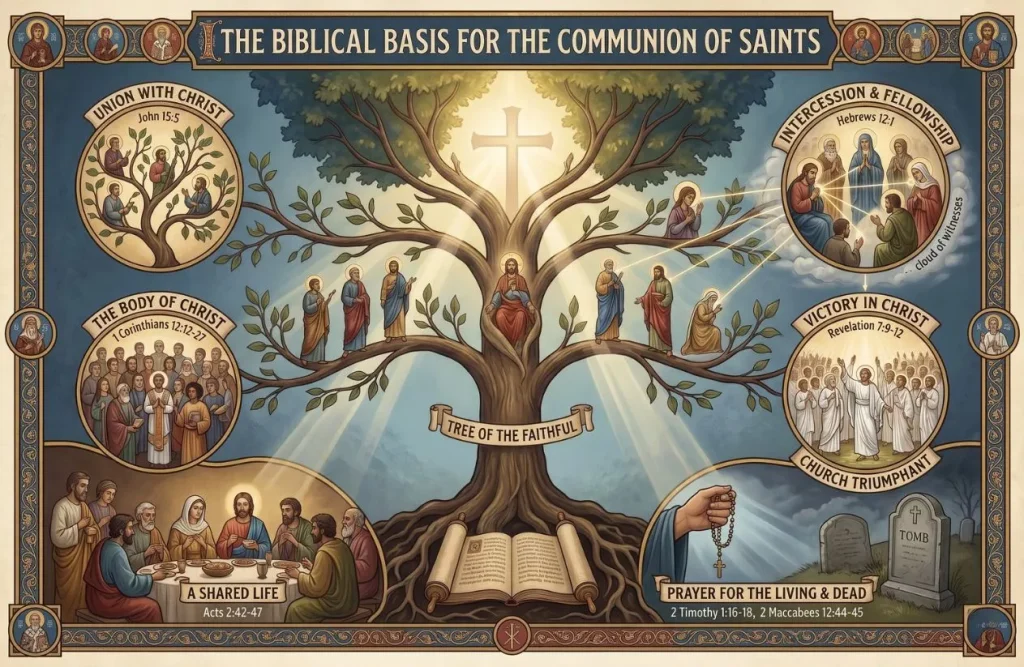
A common hurdle for many Christians exploring this topic is finding the scriptural foundation. If you want to know is praying to saints biblical, you have to look at how the Bible defines the body of Christ, the reality of physical death, and the nature of intercession.
When looking at the scriptural evidence, the practice is not an invention of church tradition. It is a direct reflection of biblical truths regarding our eternal connection to one another.
Addressing the “One Mediator” Objection (1 Timothy 2:5)
The most frequent biblical objection brought against Catholic practice relies on the words of the Apostle Paul:
“For there is one God, and there is one mediator between God and men, the man Christ Jesus.” (1 Timothy 2:5)
If Jesus is our sole mediator, the argument goes, then going through saints must be unbiblical. But if we read that verse in its full context, we see that just a few sentences earlier, in verses 1 through 3, Paul explicitly commands Christians to engage in intercessory prayer: “I urge that supplications, prayers, intercessions, and thanksgivings be made for all people.”
If Jesus’ unique role as the one mediator made it wrong to ask others to pray for us, then asking a pastor, a family member, or a friend on Earth to pray for you would also violate 1 Timothy 2:5.
Jesus is the unique mediator because He alone paid the price for our redemption on the cross. Our prayers for one another do not take away from His mediation; instead, they participate in it. We are parts of His body, working together to bring requests to the Father.
Death Cannot Separate the Body of Christ (Romans 8:38-39)
Another core piece of the puzzle is understanding what happens to a Christian when they die physically. Many assume that the deceased are unconscious, sleeping, or entirely cut off from the affairs of Earth.
However, Jesus made it clear that God “is not God of the dead, but of the living, for all live to him” (Luke 20:38). The saints in heaven are more alive right now than we are.
Furthermore, Paul explicitly states in his letter to the Romans that physical death has no power to sever our spiritual bond with the body of believers:
“For I am sure that neither death nor life… nor anything else in all creation, will be able to separate us from the love of God in Christ Jesus our Lord.” (Romans 8:38-39)
If death cannot separate us from Christ, it cannot separate us from each other. The church on Earth and the church in heaven form one single, unbroken mystical body. Christians in heaven do not stop caring about their brothers and sisters struggling on Earth just because their physical bodies passed away.
The Heavens Presenting Our Prayers (Revelation 5:8)
So, why do catholics pray to saints if they can just go directly to God? They do go directly to God, but they also value the support of their heavenly family. The Bible reveals that those in heaven are actively involved in presenting our needs to the Lord.
In the Book of Revelation, John is given a vision of the heavenly court. He observes the elders standing before the throne of the Lamb:
“And when he had taken the scroll, the four living creatures and the twenty-four elders fell down before the Lamb, each holding a harp, and golden bowls full of incense, which are the prayers of the saints.” (Revelation 5:8)
The “saints” mentioned here are the believers struggling on Earth. The elders in heaven are holding golden bowls filled with our prayers and offering them up to God. This clearly demonstrates that those in the presence of God hear our requests, care about our trials, and actively intercede on our behalf. Asking for their prayers is a purely biblical expression of living as a unified family in Christ.
Conclusion & Direct FAQ Summary
Understanding the role of holy men and women in the Church helps clear up the ultimate roadblock for many searching Christians. The persistent claim that Catholics worship saints is built on a misunderstanding of historical theology and shifting vocabulary. Catholics do not view the saints as competition for God, but as trophies of His grace and active members of the family of believers.
Related Article: Powerful Spiritual Warfare Prayers
To help optimize this for voice search and quick-scroll reference, here is a direct summary of the most common questions:
Common Questions About Catholics and Saints
- Do Catholics worship saints?No. Catholics practice veneration (high respect and honor) toward saints, but reserve worship and adoration strictly for God alone.
- Why do Catholics pray to saints if they can go straight to God?Catholics pray directly to God every single day. However, they also ask the saints to pray with them and for them, exactly like asking a trusted Christian friend or pastor on Earth to lift up your needs in prayer.
- Is praying to saints biblical?Yes. Scripture confirms that the body of Christ is not divided by physical death (Romans 8:38-39) and that those in heaven actively offer the prayers of the faithful on Earth up to God like incense (Revelation 5:8).
- What is the difference between latria and dulia?Latria is the absolute adoration and sacrificial worship owed exclusively to the Holy Trinity. Dulia is the honor and admiration given to the saints as holy peers who finished their earthly race faithfully.
- Do Catholics worship Mary?No. Mary is given a special level of honor known as hyperdulia because she was chosen to be the mother of Jesus, but she remains a human creature dependent on God’s salvation. She is never offered divine worship.